

On a busy week, the money saving tips that keep working are the ones you set up once and then barely touch: a transfer to savings on payday, a 10-minute weekly money check, one recurring charge reviewed each week, a 24-hour wait for non-essentials, and one number for what you kept. Together they take about 15 minutes a week.
I’ll be blunt about money saving tips lists: the problem with 101 of them isn’t that they’re wrong, it’s that nobody with a full-time job, a commute and a fridge that empties itself every three days has the time to remember 101 of anything (I’d lose count somewhere around tip 12).
So this one is short on purpose. You get five money saving habits that run in the background of a busy week, a weekly check you can do with your coffee, a filled-in example where every dollar adds up, and a one-page checklist to keep it all in one place. It lives with our other saving and money goals guides.

Read this also:
- How to Choose a Savings Challenge You Can Actually Fund
- Budgeting Mistakes You Can Find With a Simple Check
- A Printable Habit Tracker With Room for Imperfect Weeks
- How to Automate Savings Without Leaving Your Bills Short
What Are the Best Money Saving Tips When Your Week Is Already Full?
The best money saving tips for a full week are a few set-once defaults plus one short weekly check, not a long list of things to remember. The big tip lists online run anywhere from 7 to 181 ideas, and most of them are fine on their own, they just all ask for your attention at the same time.
Here’s the short version we’re building in this post:
| Habit | When | Time it takes |
|---|---|---|
| Move money to savings | Payday, automatically | About 10 minutes to set up once |
| Weekly money check | Same day every week | About 10 minutes |
| Review one recurring charge | Inside the weekly check | Part of those 10 minutes |
| 24-hour wait list | Whenever an extra tempts you | Seconds, then a day of waiting |
| Write the money-kept number | End of the weekly check | About 5 minutes with the wait list |
If you’d rather start with just one of these, that’s a perfectly good plan, and here’s how to start with one small repeatable step. And if you like seeing streaks, the same five boxes fit on a habit tracker printable. The bigger lifestyle stuff, like cooking at home more or deciding what’s worth paying for, belongs in frugal living tips, because that’s a whole different conversation.
Which Money Saving Tip Belongs on Payday?
Moving money to savings on the day your pay lands is the one tip that needs zero willpower after setup. The money is gone before you see it as spending money, so there’s no Thursday-night debate with yourself about whether you can afford it.
The Consumer Financial Protection Bureau calls making your savings automatic one of the easiest and most consistent ways to save, because once it’s set up you put money into savings “without thinking twice”. The FDIC says the same thing in plainer words: automatic transfers on a set schedule help you save money before you spend it, and their example is $20 each pay period, which adds up to $520 a year (plus interest) if you’re paid every other week.

Split your direct deposit or schedule a transfer
You have two ways to do it. Some employers let you split your direct deposit so part of each paycheck goes straight into a savings account, which the CFPB lists as an easy way to save each payday. If yours doesn’t, set up a recurring transfer in your bank app for the same day your pay arrives (not the day before, because a payday can move by a day around weekends and holidays).
This is the only habit on the list I do on full autopilot. My transfers go out on payday itself, from my income account into separate pots, because those are “no brainer things” for me, and I’d rather not think about them at all. If you want the full how-to with bill timing, read how to automate savings without leaving your bills short, and if you’ve heard people say pay yourself first, this is exactly that idea, just with a calendar date attached.
What if your pay changes
If your hours change week to week, pick a small amount you could still move in your slowest pay period, and treat anything extra as a bonus you move by hand during the weekly check. A small amount that happens every payday beats a big amount you cancel twice a month. And yes, $20 counts, the FDIC literally uses it as the example.
What Does a 10-Minute Weekly Money Check Look Like?
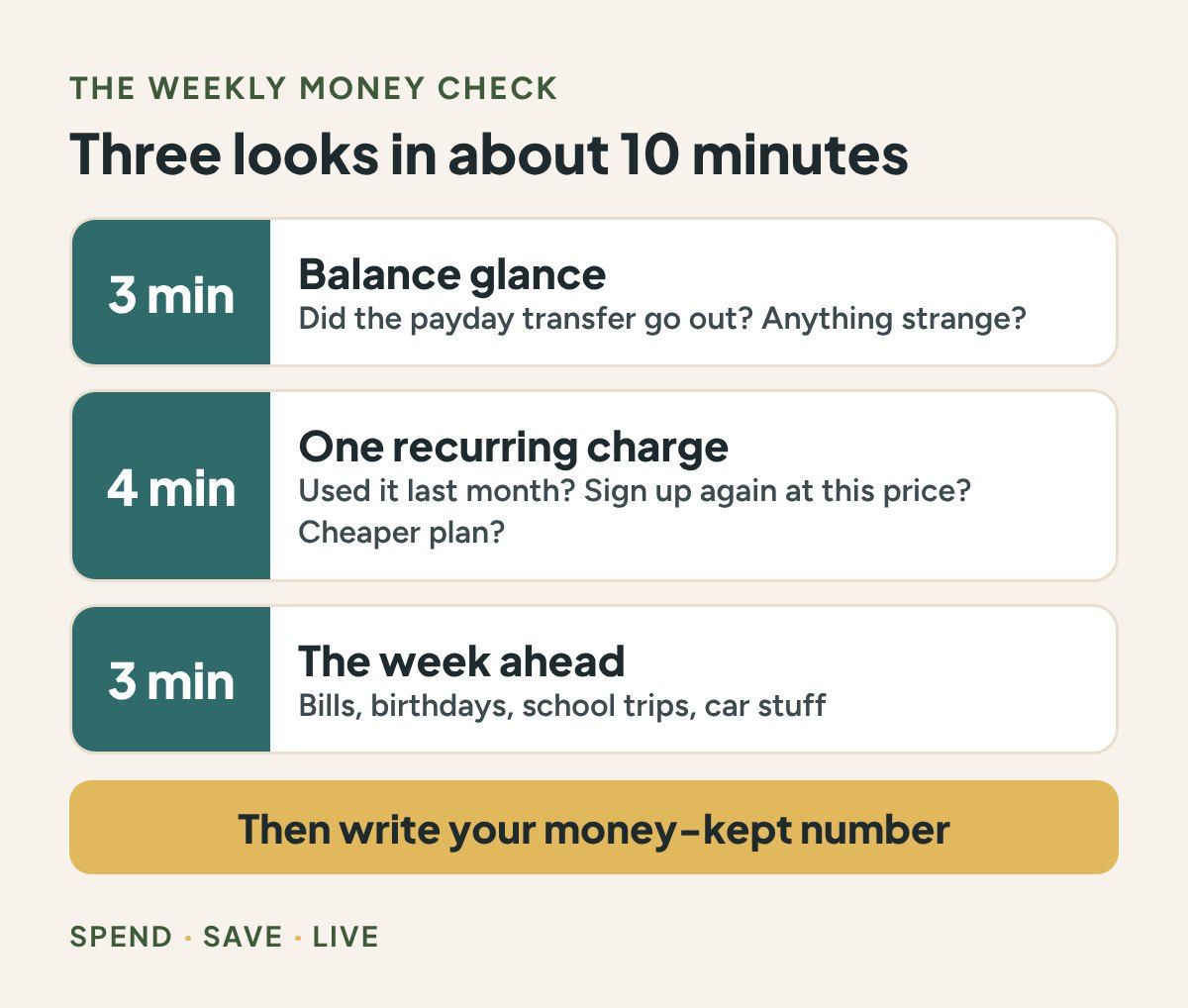
A 10-minute weekly money check is three quick looks: your balances, one recurring charge and the week ahead. Pick a day you’re usually home, like Sunday evening, and do it with a timer so it can’t swallow your evening.
- Open your checking and savings and look at the balances (about 3 minutes). Did the payday transfer go out, and is anything strange or missing?
- Pick one subscription or bill from your statement and run it through the three questions in the next section (about 4 minutes).
- Look at the week ahead for any bill, birthday, school trip or car thing coming up (about 3 minutes), so you spot it now and not on the day.
Full disclosure, my own weekly money check takes about 30 minutes, because I like poking at numbers (some people knit, I poke at my budget dashboard). Ten minutes is plenty to start, though, and if you already keep a weekly budget, check what is safe to spend this week in the same sitting. Our post on budgeting mistakes you can find with a simple check goes deeper if you want a monthly version too. The 10 and 15 minute times in this post are our own estimates, not a rule from anywhere.
How Do You Remove One Low-Value Charge Without Auditing Everything?
Review one recurring charge per week instead of auditing all of them at once. Over a few months you get through every subscription and auto-renewal without ever giving up a whole Saturday to it.
For the one charge you picked, ask yourself three things:
- Did I use this in the last month?
- Would I sign up again today at this price?
- Is there a cheaper plan, a pause option or an annual price I’d actually use?
Two no’s and it goes, or it gets downgraded. Write it down either way, so next week you move on to the next charge instead of re-reading the same one. Not everything cheap is a win, and some things are worth every cent, so if you’re torn, here’s how to tell whether a cheap purchase is actually frugal. If you keep forgetting what renews when, a subscription tracker keeps the list for you.
And nobody here is going to tell you to give up your coffee. If something makes your week better and you use it, keep it and move on to the next charge, that’s the whole point of looking at one at a time.
How Do You Stop Small Extras From Leaking Out in a Busy Week?
Put non-essential buys on a 24-hour wait list. Busy weeks are exactly when tired, rushed shopping happens, and a short pause gives you a second look at the thing when you’re not tired and rushed.
I do a version of this with online shopping: I leave the thing in the cart and wait a few days, and a surprising amount of it just stops mattering. Your wait list can be a note on your phone with the item, the price and the date. During the weekly check, look at the list, buy what you still want, delete the rest and add the deleted prices to your money-kept number. If impulse buys are your big one, a purchase pause has more on that.
How Do You Know Your Savings Habits Are Working?
Track one number each week: the money you kept. That’s what you moved to savings, plus any recurring charge you cancelled (counted once, the month you cancel), plus any extra from the wait list you decided not to buy.
One number keeps it simple, and it measures what actually happened instead of how disciplined you felt. If you have a goal in mind, the CFPB’s Savings plan tool uses the same kind of math the other way round: write the total you need, decide how many weeks you have, and divide the total by the weeks to get your weekly target. A savings goal tracker shows the total growing, and once you want the monthly picture, our monthly budget planner takes it from there.
What Does One Busy Week Look Like With the Checklist?
Here’s Jordan, a fictional reader we made up for this example, in a payday week. Jordan is paid every other week, takes home $1,900 per paycheck (26 paychecks a year) and has a full work week with no spare evenings.
| Checklist box | What Jordan did | Money kept |
|---|---|---|
| Payday transfer | $60 moved automatically on payday | $60.00 |
| 10-minute check | Sunday, 10 minutes, nothing strange | $0.00 |
| One charge reviewed | Cancelled a streaming plan not watched in two months | $14.99 |
| 24-hour wait list | A $45 extra, still on the list a day later, no longer wanted | $45.00 |
| Money kept this week | $119.99 |

Now stretch it out to a year. The payday transfer is $60 out of $1,900, which is about 3.2% of each paycheck, and $60 × 26 paychecks = $1,560 a year. The cancelled streaming plan was $14.99 a month, so $14.99 × 12 = $179.88 a year. Together that’s $1,560 + $179.88 = $1,739.88 kept in year one, or $1,784.88 if you count the $45 extra once.

Jordan’s numbers are made up, and yours will be different, so please don’t read them as typical results. The point is the shape: one automatic transfer does most of the work, and the weekly check quietly adds a little on top.
What Is in the Weekly Savings Habit Checklist?
It’s a one-page checklist with the five tick boxes from this post, a line for your money-kept number and a 4-week strip so you can see a month at a glance. We filled one in with Jordan’s week so you can see how every box works before you use it.

Get the full Weekly Savings Habit Checklist
The full printable PDF is coming soon. It will be free to SPEND • SAVE • LIVE readers.
What If Money Is Too Tight to Save Right Now?
Keep the weekly check and let the transfer be $0 for now. A $0 week still counts, because the check is what catches the charge you forgot, the bill coming up and the extra you can skip, and that’s often where the first few dollars come from.
Start the payday transfer again when there’s room, even at $5. If things are tight for longer, here’s how to save on a low income without skipping essentials, and if you’d like to make saving a little more fun once there’s room, a 52-week savings challenge can sit on top of all this.
Read more: How to Choose a Savings Challenge You Can Actually Fund
Where to Get Help When Saving Isn’t the Real Problem
A checklist can help you keep more of what you earn, but it can’t fix a pay cut, debt that keeps growing or a bill you can’t cover this month.
- For local help with bills, food or housing costs, 211 connects you to services near you.
- The CFPB’s free Your Money, Your Goals toolkit has a Spending tracker, a Savings plan and a Debt log you can print.
- New to SPEND • SAVE • LIVE? Start here for the calm basics.
Key Takeaways
- Set up one automatic transfer for payday, even a small one, and let it run.
- Do a 10-minute weekly check: balances, one recurring charge, the week ahead.
- Review one charge a week instead of auditing everything at once.
- Put extras on a 24-hour wait list and write down one money-kept number each week.
- A $0 week still counts, keep the check going.
Frequently Asked Questions
What practical tips can help me save money?
Set up an automatic transfer on payday, do a 10-minute weekly money check, review one recurring charge each week, wait 24 hours on non-essentials and write down what you kept. These five take about 15 minutes a week once the transfer is set up.
What is the best way of saving money?
Making it automatic is the most consistent way for most people, because the money moves before you can spend it. The CFPB and the FDIC both describe automatic transfers or a split direct deposit as an easy, steady method. Pick the amount your slowest paycheck can handle.
How much money should I be saving?
There’s no single official percentage. The CFPB Savings plan tool has you set a goal, decide how many weeks you have and divide the total by the weeks. Even $20 each biweekly paycheck adds up to $520 a year, which is the FDIC’s own example.
What is a good tracker for saving money?
The simplest tracker is one number a week for the money you kept. The CFPB’s free Spending tracker and Savings plan tool work on paper, and a notes app or a spreadsheet works too.
How can I save money when I’m busy?
Pick habits that run without you. A payday transfer runs itself, and a short weekly check on the same day each week catches the rest. Skip anything that needs daily effort until those two stick.
So, What Did You Keep This Week?
Set the payday transfer tonight, even if it’s $20, put a 10-minute check in your calendar for this Sunday and write one number at the end of it. That’s the whole system, and if one week goes sideways (they do), the transfer keeps running while you get back to it. When you’re ready for more, automating the rest of your savings is the natural next step.
Sources (checked November 2026)
- Consumer Financial Protection Bureau, Looking for an easy way to save money? Make it automatic (blog, Aug 26, 2019, archived)
- Consumer Financial Protection Bureau, Six ways to save this year (blog, archived; direct deposit split)
- FDIC, Saving for the Unexpected and Your Future (Consumer Resource Center, January 2025; $20 each pay period = $520 a year)
- CFPB, Your Money, Your Goals: Savings plan tool (divide the total by the number of weeks)
- CFPB, Your Money, Your Goals toolkit (Spending tracker, Savings plan, Debt log)
Educational content, not financial advice.