

Look for a habit tracker printable with room for two to four small actions, a minimum version for hard days, rest days you plan ahead and plain blank boxes for the days you miss. In the study behind the famous 66-day number, one missed day didn’t materially set people back, so count the days you came back, not only your streak.
Week one on a new habit tracker always looks gorgeous, every box filled in with your nice pen, and then Thursday happens (a late shift, a sick kid, a day that eats you alive) and the next morning you’re staring at an empty box that suddenly feels like a verdict. Most of us don’t quit on the bad day. We quit on the day after, because the page now looks ruined.
So this habit tracker printable is built for the Thursday. You get daily, weekly and monthly pages with a minimum version for hard days, rest days you choose before the week starts and a small mark for the day you came back, plus one filled-in imperfect week so you can see how it looks in real life. It sits with the other habits guides in Habits & Lifeplanning.

Read this also:
- Habit Tracker Ideas That Connect to Goals You Care About
- Habit Stacking Examples Built Around Cues You Already Have
- How to Restart a Habit After Missing a Day
- A Google Sheets Habit Tracker That Shows Patterns Beyond Streaks
I used to track my habits in a spreadsheet, and now I use my own dashboard. The habit I never drop is writing down every single transaction (yes, all of them), and next to that I mostly track movement and how I’m doing overall. I look back every week and again every month, which is exactly the rhythm this printable is built around.
Paper, Sheets or an App: Which Kind of Tracker Are You?
A paper tracker suits you if you like ticking boxes by hand and want to look at one page a week instead of a screen full of charts.
Quick check. Yes or no:
- You’ve quit a tracker before because one missed day made the page look ruined.
- You’d rather hold a pencil than open another app.
- You can name one or two things you already do some of the time.
- You’re up for a five-minute look back once a week.
Three or four yeses and paper is your friend. If you love formulas and charts, a Google Sheets habit tracker will make you happier, and if you need your phone to nag you, here’s how to choose a habit tracker app you’ll keep using. No judgment from me on either (I literally made my own dashboard).
What Makes a Habit Tracker Forgiving Instead of Guilt-Inducing?
A forgiving tracker has room for a small version of each habit, rest days you pick ahead of time, and blank boxes for misses with a mark for the day you came back.
Most of the guilt comes from the design. A typical tracker has one kind of box, so every day is either a perfect tick or a failure, and one busy week turns into a whole wall of failures. This one gives you more honest options, and every habit on it is written as something you can see yourself do, like writing down today’s spending instead of being better with money (you can’t tick a wish).
- Two to four habits, tops, so one bad day doesn’t empty the whole page.
- A minimum version for each habit, like one page instead of 20 minutes, and the minimum counts as done.
- Rest days marked with an R before the week starts, so a planned day off never looks like a miss.
- Misses left blank, never crossed out, with a little honey arrow on the first day you’re back.

The boring parts have some research behind them too. A 2012 paper by Gardner, Lally and Wardle explains that habits form by repeating the same action in the same situation, and suggests a simple tick sheet may help while you’re learning one. The same paper notes that missing the odd day didn’t seriously hurt the process, which is the whole reason the blank box gets to stay blank.
How Long Does It Take to Form a Habit? Usually Longer Than 21 Days
In the best-known study the median was 66 days, and people ranged anywhere from 18 to 254 days, so plan in weeks and months instead of one 21-day sheet.
That study is Lally and colleagues, 2010. They followed 96 volunteers for 84 days while each person repeated one eating, drinking or activity behavior every day, and 82 of them gave enough data to analyze. The 66-day median comes from the 39 people whose results fit the researchers’ model well, and anything past day 84 was an estimate, because by then the study had already ended.
Two more details matter for your tracker. People rated how automatic the habit felt themselves, so the numbers are a rough guide, not a promise about you. And missing one opportunity did not materially affect how the habit formed, while the early repetitions gave the biggest gains, which is a pretty good argument for doing the minimum on a bad day instead of nothing.

So where does the famous 21 days come from? Not from this study, I can tell you that much. Print a weekly page, then a monthly one, and give yourself permission to still be learning in March.
Read more: How to Keep a Small Habit Going When Your Schedule Changes
Daily, Weekly or Monthly: Which Habit Tracker Printable Should You Print?
Start with the weekly page, move a habit to the monthly page once it feels routine, and grab the daily page when a week falls apart.
Weekly habit tracker printable
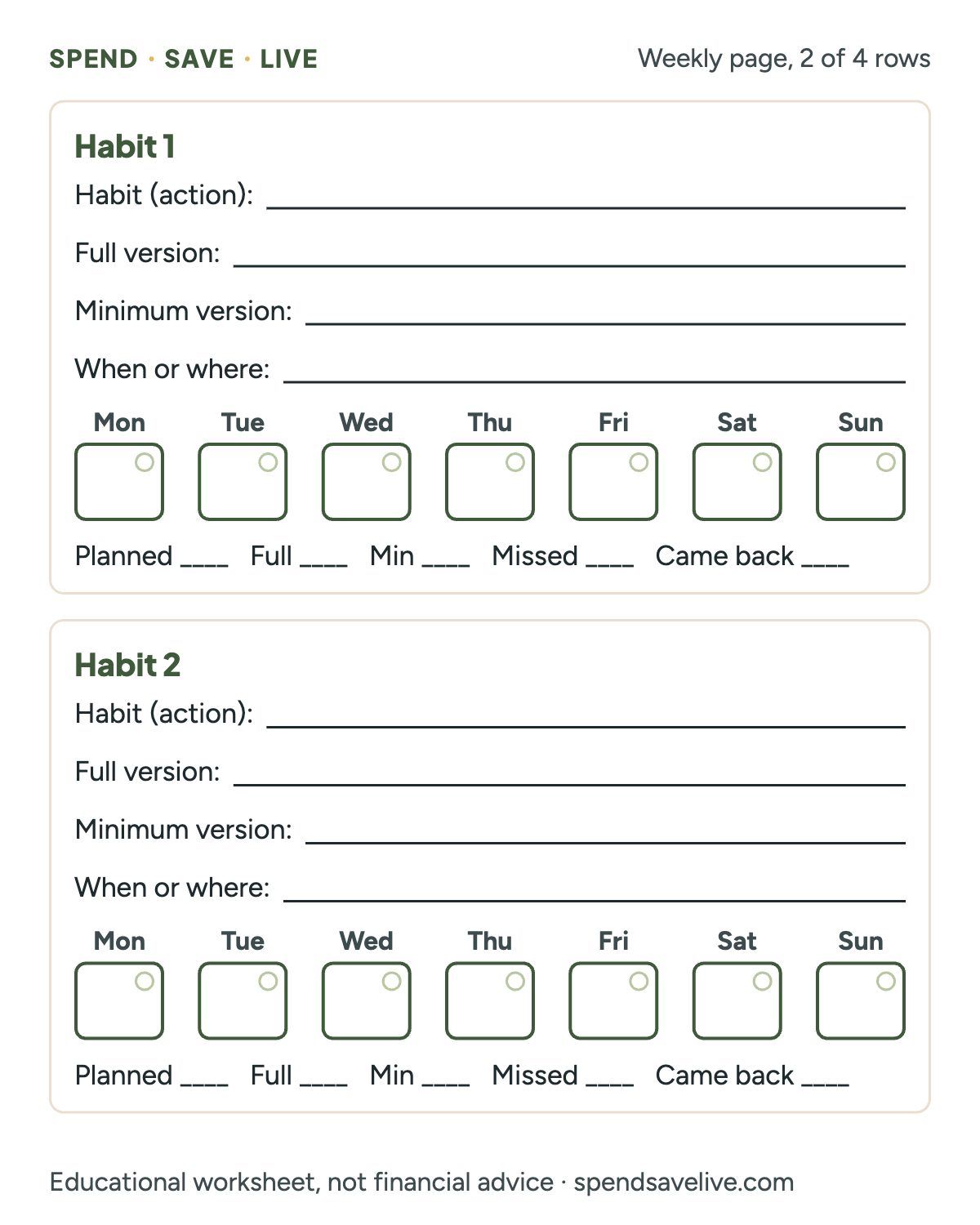
This is the main page and the one I’d start with. Each habit gets a row with its full and minimum version, a when-or-where line, Monday to Sunday boxes with a tiny dot to circle on planned days, and five totals at the end, and a short review box sits at the bottom of the sheet.
Monthly habit tracker printable
Here you get 31 numbered columns and a row on top where you write in the weekdays yourself, so it works for any month (and any year, I’m not dating it for you). Up to six habits fit, and it ends with a four-question monthly review.

Daily habit tracker printable
Two half-page days per sheet, three habits each, with Full, Minimum and Done? boxes and one line for what made the day easier. It’s the page for a messy week, when looking at seven boxes at once feels like too much.
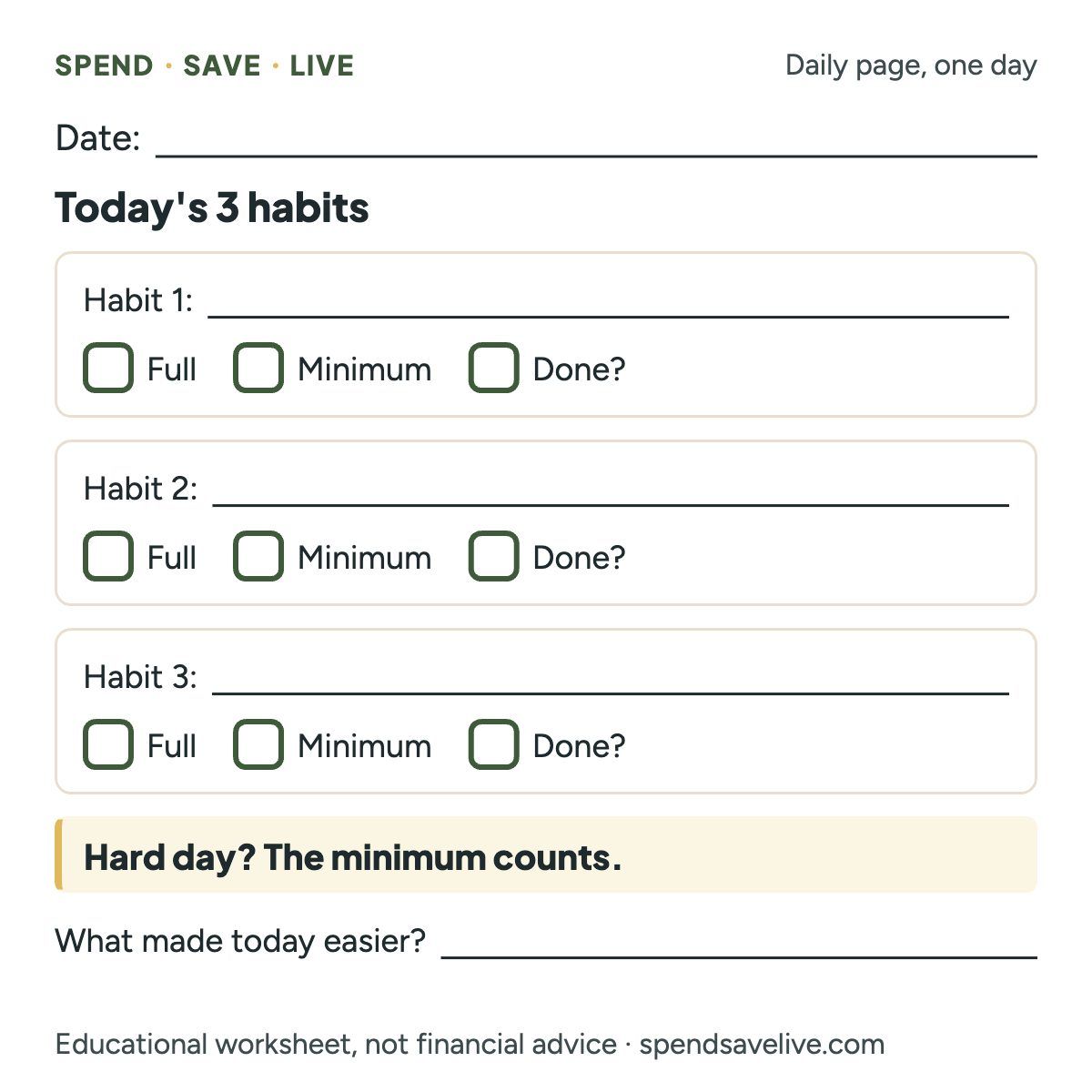
If you’re timing your start, a Monday or the first of the month is a natural moment. A study by Dai, Milkman and Riis found people were more likely to start goal-type behavior, like gym visits, right after a new week, month or year (it’s a pattern in the data, not magic). In 2027 the first Monday is January 4, and February starts on a Monday with exactly four full weeks, which is weirdly satisfying.
How Do You Set Up a Habit Tracker Before Day One?
Do five small things once, before you tick a single box.
- Choose two to four habits. Small, visible actions beat big wishes, and these habit tracker ideas tie each one to a goal you care about.
- Write the full version and the minimum version. Keep the minimum tiny, think under two minutes, like writing the day’s total instead of listing every purchase.
- Tie each habit to a time or a place you already have, like after dinner or when you get home from work. These habit stacking examples help if nothing comes to mind.
- Circle your planned days and write R on rest days. A habit doesn’t need all seven days to count.
- Pick a review time, for example during a Sunday reset, and write it at the top of the page. A weekly review checklist can catch the rest of the week’s loose ends at the same time.
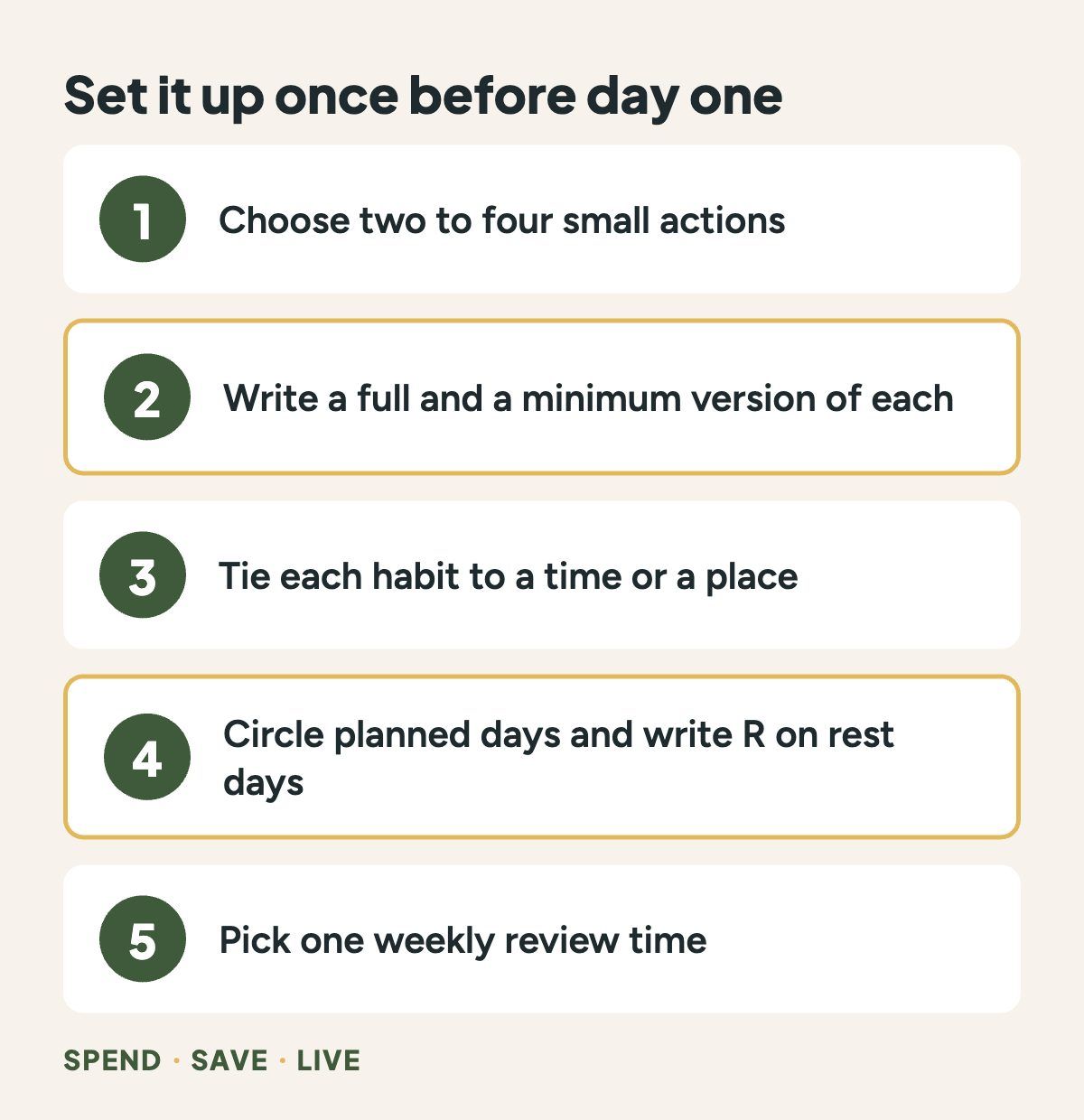
Steps 2 and 4 are the ones people skip, and they’re exactly the ones that save you on a bad Thursday, because the page already knows what a small day and a planned day off look like.
What Does an Imperfect Week Look Like on Paper?
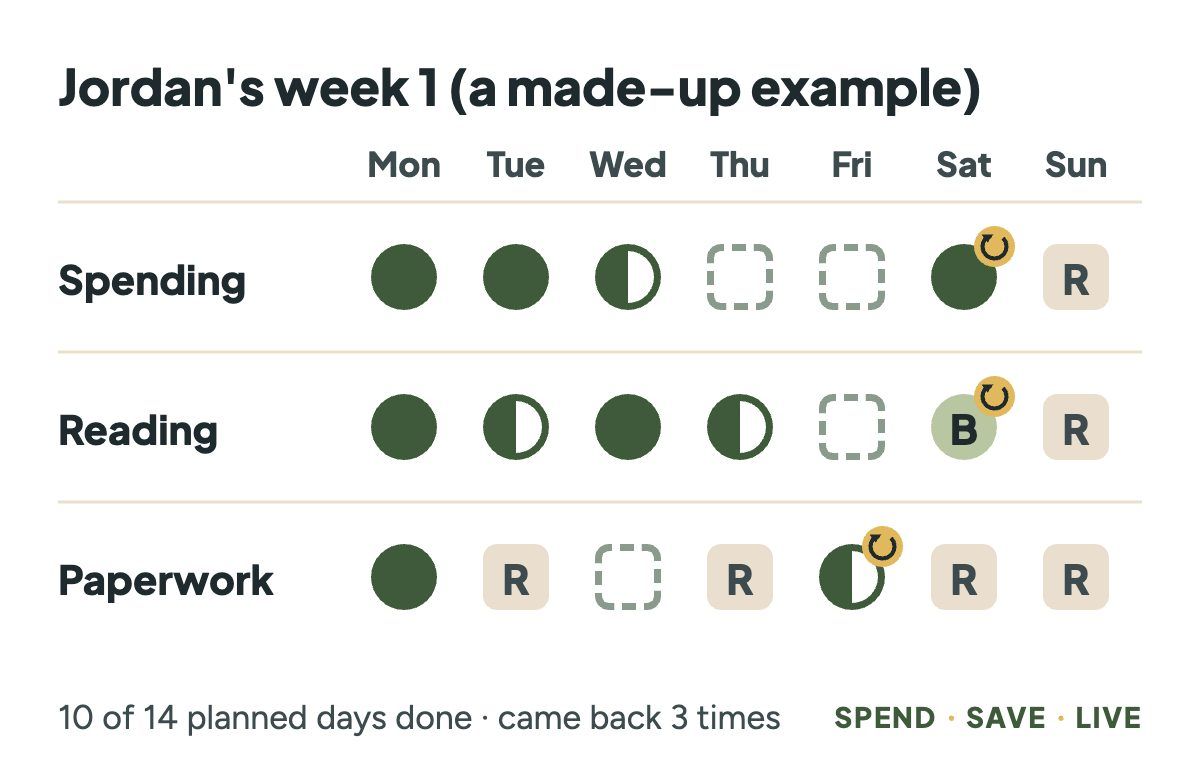
In this made-up example, Jordan showed up on 10 of 14 planned days in week 1, and the four misses stay blank on the page.
Jordan is fictional, a retail worker with a late shift every Thursday, and starts on Monday, January 4, 2027 with three habits:
| Habit | Full version | Minimum version |
|---|---|---|
| Write down spending | List every purchase | Write the day’s total |
| Read before bed | 20 minutes | One page |
| Sort mail and paperwork | 10 minutes | Drop the mail in the tray |
- Spending is planned Monday to Saturday (6 days).
- Reading is planned Monday to Friday (5 days).
- Paperwork is planned Monday, Wednesday and Friday (3 days).
That’s 14 planned days in total, and here’s how the week actually went:
| Habit | Showed up | Came back |
|---|---|---|
| Spending | 4 of 6 | 1 |
| Reading | 4 of 5 | 1 |
| Paperwork | 2 of 3 | 1 |
| Total | 10 of 14 | 3 |
That’s 71.4% of planned days. Only 6 of the 14 were the full version (42.9%), and Saturday’s reading was a bonus on a rest day. A streak-only tracker would have shown the spending streak at three days and then reset it to zero on Thursday, which is a pretty harsh way to describe a week where the habit happened four times.
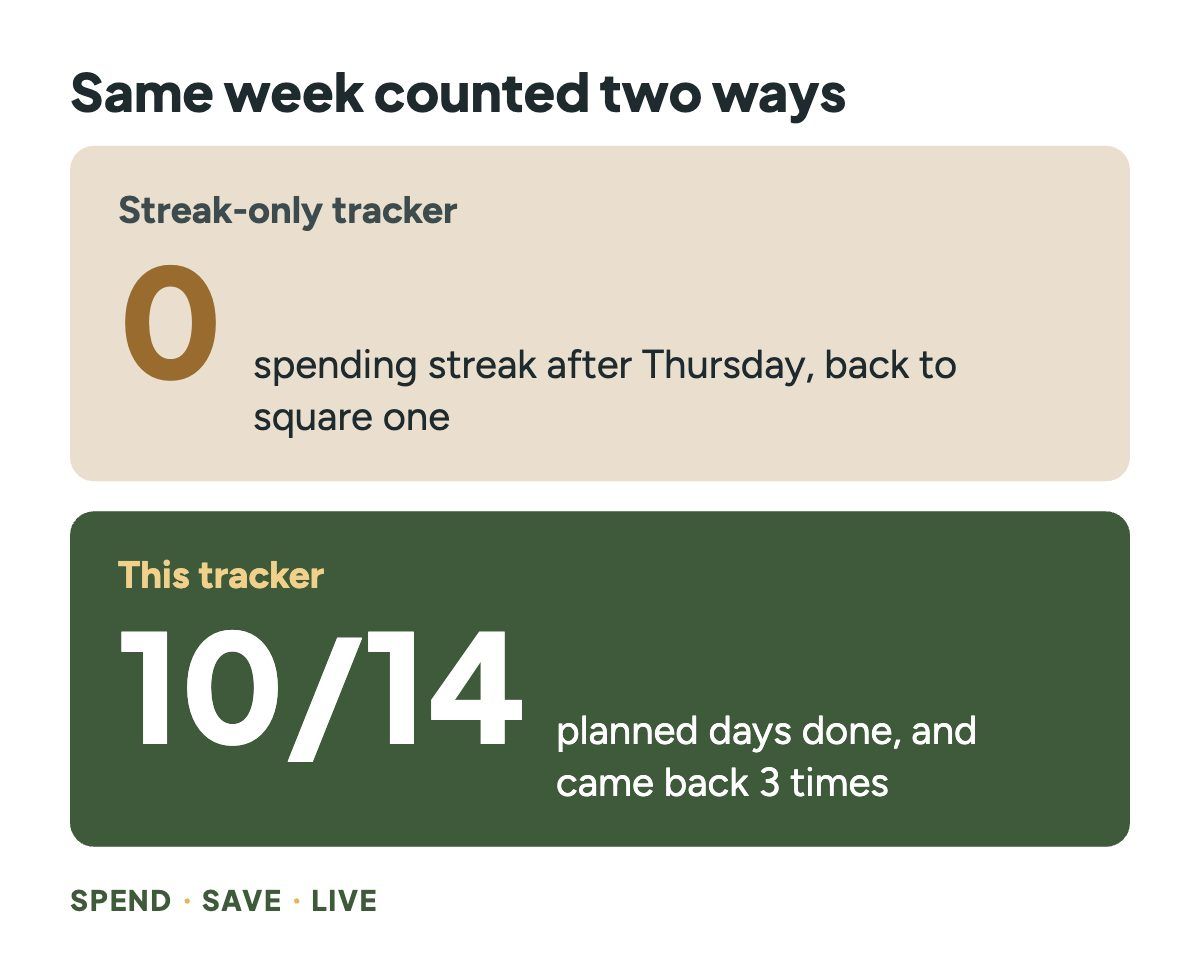
The spending habit is a good one to start with if money is your focus, and once writing things down feels normal, a proper spending tracker shows you where it all went.
How Do You Review the Week Without Erasing the Misses?
Answer four questions in about five minutes and change one thing for next week.
- What did I do?
- Where did the misses cluster?
- What made the done days easier?
- What one change will I try next week?
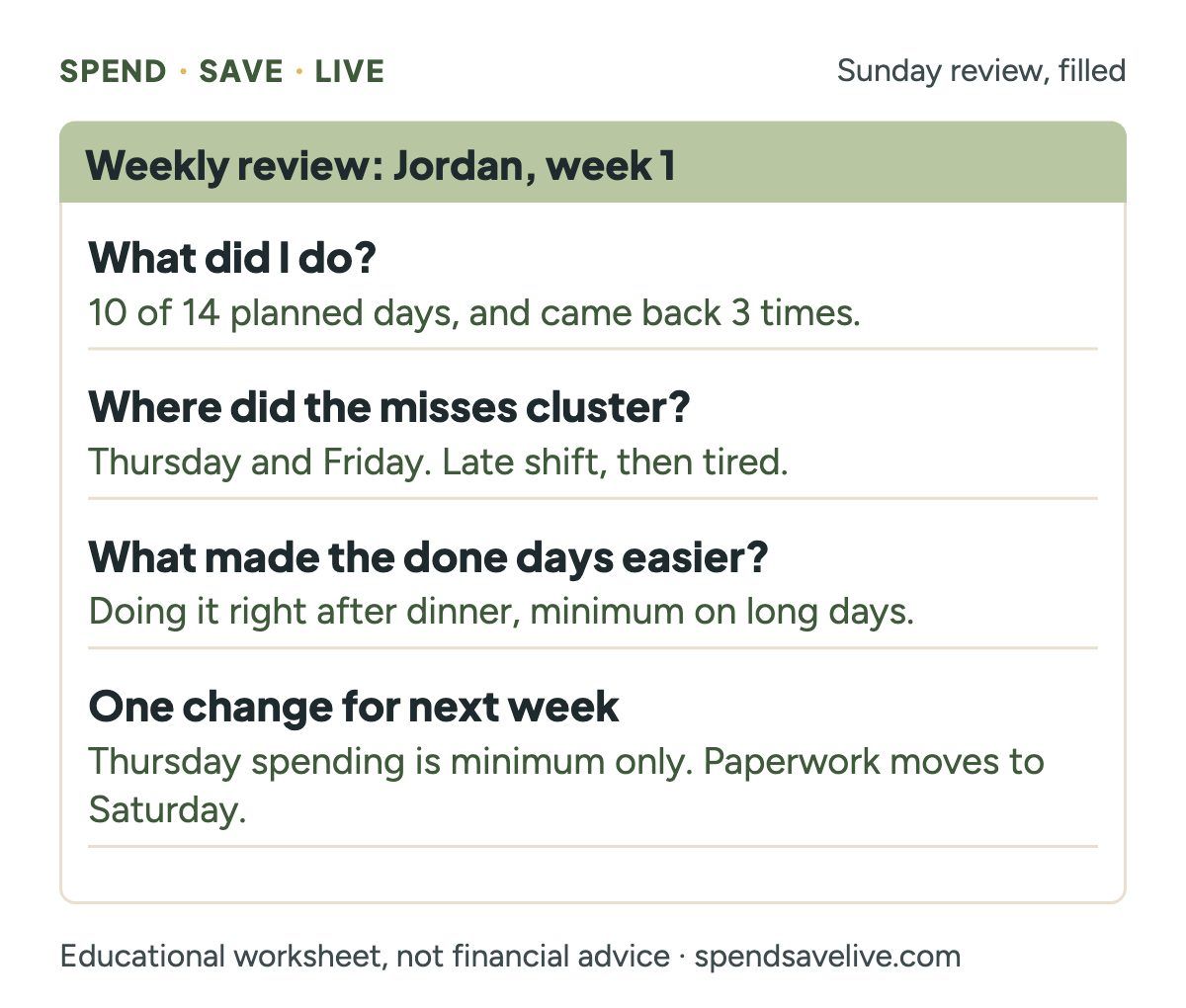
Jordan’s misses all landed on Thursday and Friday (late shift, then a tired Friday). So in week 2, Thursday spending is planned as a minimum-only day, paperwork moves from Wednesday to Saturday morning, and reading stays as it is.
| Week 2 | Showed up | Came back |
|---|---|---|
| Spending | 5 of 6 | 0 |
| Reading | 4 of 5 | 1 |
| Paperwork | 3 of 3 | 0 |
| Total | 12 of 14 | 1 |
That’s 85.7%, and still not perfect, on purpose. The Saturday spending miss stays on the page, the comeback is due on Monday, and the review didn’t prove some grand method, it just gave Jordan one concrete thing to try.
Why bother writing it down at all? In a review of 138 studies by Harkin and colleagues (2016), prompting people to monitor their progress helped them reach their goals, and the effect was bigger when progress was physically recorded. That review covered all kinds of goals, so it doesn’t prove any single tracker works, but it’s a nice reason to keep the pencil nearby.
For the record, I rarely miss my own habits, and when I do, I leave it be, because it’s not the end of the world. I don’t punish myself for it, I just make sure I don’t miss the next one, and if you want more on that part, here’s how to restart a habit after missing a day.
Read more: A Life Audit That Helps You Choose One Change for 2027
The Habit Tracker Printable, Page by Page
The set has four undated US letter pages: weekly, monthly, daily and a filled-in example.
- Page 1, weekly: four habit rows with full and minimum versions, planned-day dots, five totals and a weekly review box.
- Page 2, monthly: 31 day columns, a write-in weekday row, six habit rows and a monthly review.
- Page 3, daily: two half-page days with three habits each.
- Page 4, filled example: Jordan’s week 1, clearly labeled as made up.
- Print at 100% on US letter, or choose fit to page on A4.
- Pencil is completely fine.
- The blank boxes stay blank. That’s the point.
Get the Full Habit Tracker Printable
The full printable PDF is coming soon. It will be free to SPEND • SAVE • LIVE readers.
When the month is done, the monthly review box pairs nicely with these monthly reflection questions, so the sheet ends with a decision and not just a pile of ticks.
When a Habit Tracker Is the Wrong Tool for the Job
A habit tracker is a planning sheet, so it can’t diagnose anything, treat anything or fix a money crisis on its own.
If the habit is about your health, medication, eating, sleep or mood, use a tracker only alongside advice from your own doctor or care team. You won’t find health targets in this post, and a printable shouldn’t be where you get them anyway.
And if the habit you’re tracking is spending and the numbers simply don’t fit, these are better places to start:
- The CFPB spending tracker, a worksheet from the Consumer Financial Protection Bureau that has you record each expense and add it up week by week.
- The NFCC agency finder, to reach a nonprofit credit counselor near you.
- 211, a confidential service that connects you with local help.
- Start Here, if you’re new to SPEND • SAVE • LIVE and want the calm version of where to begin.
Frequently Asked Questions
Do habit trackers actually work?
No single tracker has been tested the way you’d want, but in a review of 138 studies, prompting people to monitor their progress helped them reach their goals, and recording that progress helped more. A tracker is one easy way to do that monitoring.
How many habits should you track at once?
Start with two to four. Add another only when one of them feels routine, because a crowded page makes one bad day look like a disaster.
What should I do when I miss a day on my habit tracker?
Leave the box blank and do the next planned day, even if it’s only the minimum version. In the Lally study, missing one opportunity didn’t materially affect how the habit formed.
Is a printable habit tracker better than an app?
Neither wins for everyone. Paper suits people who like ticking boxes by hand and reviewing one page a week, while an app suits people who need reminders, so pick the one you’ll still open in week three.
What are good habits to put on a habit tracker?
Small actions you can tick in seconds, like writing down the day’s spending, reading one page or sorting the mail. Skip vague wishes like being better with money, because a wish has nothing to tick.
How long does it take to form a habit?
In one well-known study the median was 66 days, with a range of 18 to 254 days. Anything past day 84 was an estimate, so treat it as a rough guide, not a deadline.
Key Takeaways
- Track two to four small actions you can see yourself do.
- Write a minimum version for each habit, and count it as done.
- Mark rest days before the week starts and leave misses blank.
- Mark the day you came back, because returns tell you more than a streak.
- Review once a week and change one thing.
Leave Thursday Blank and Show Up on Saturday
Remember that empty Thursday box from the start? Leave it exactly as it is. Print the weekly page, write two habits with a minimum version each, and if you’re still deciding which goals deserve a row, pick the goals worth tracking first with the New Year goal setting worksheet.
Sources (checked November 2026)
- Lally, P., van Jaarsveld, C. H. M., Potts, H. W. W., and Wardle, J. (2010). How are habits formed: Modelling habit formation in the real world. European Journal of Social Psychology
- Gardner, B., Lally, P., and Wardle, J. (2012). Making health habitual: the psychology of habit-formation and general practice. British Journal of General Practice
- Harkin, B., et al. (2016). Does monitoring goal progress promote goal attainment? A meta-analysis of the experimental evidence. Psychological Bulletin
- Dai, H., Milkman, K. L., and Riis, J. (2014). The fresh start effect: temporal landmarks motivate aspirational behavior. Management Science
- CFPB, Spending tracker
- NFCC, Agency finder
- 211.org
Educational content, not financial advice. Jordan is a fictional example.