

A monthly budget planner works in three passes. Before the month starts, write your take-home pay and give every dollar a planned job until nothing is left unplanned. During the month, write down what you actually spend. At month end, subtract planned from actual, and let each difference decide one change for next month.
Most monthly budget planners don’t die on day one, they die around the 20th, when the grocery line is already blown, a bill you forgot about shows up, and the neat numbers you wrote on the 1st start looking like fan fiction.
So this monthly budget planner printable comes with the part the pretty templates leave out: one fictional month filled in from start to finish, every subtotal explained, and then month two rebuilt from what went wrong. If you’ve never made a budget at all, start with your first budget from scratch and come back here for the monthly version.

Read this also:
- A Biweekly Budget Template for Bills Between Paydays
- How to Start Sinking Funds for Costs You Know Are Coming
- No-Spend January 2027 Rules That Leave Room for Real Life
- A 52-Week Savings Challenge That Fits Your 2027 Cash Flow
This planner fits you if:
- you get paid on a regular schedule (weekly, every two weeks or monthly all work) and want the whole month on one page
- you’ve tried a template before and stared at it not knowing what to write
- you don’t mind writing numbers by hand or on a tablet
It’s not the right tool yet if your income swings a lot from month to month, or if your bills already add up to more than your pay. For the second one, skip straight to the help section near the end.
What Should a Monthly Budget Planner Include (and What Can It Skip)?
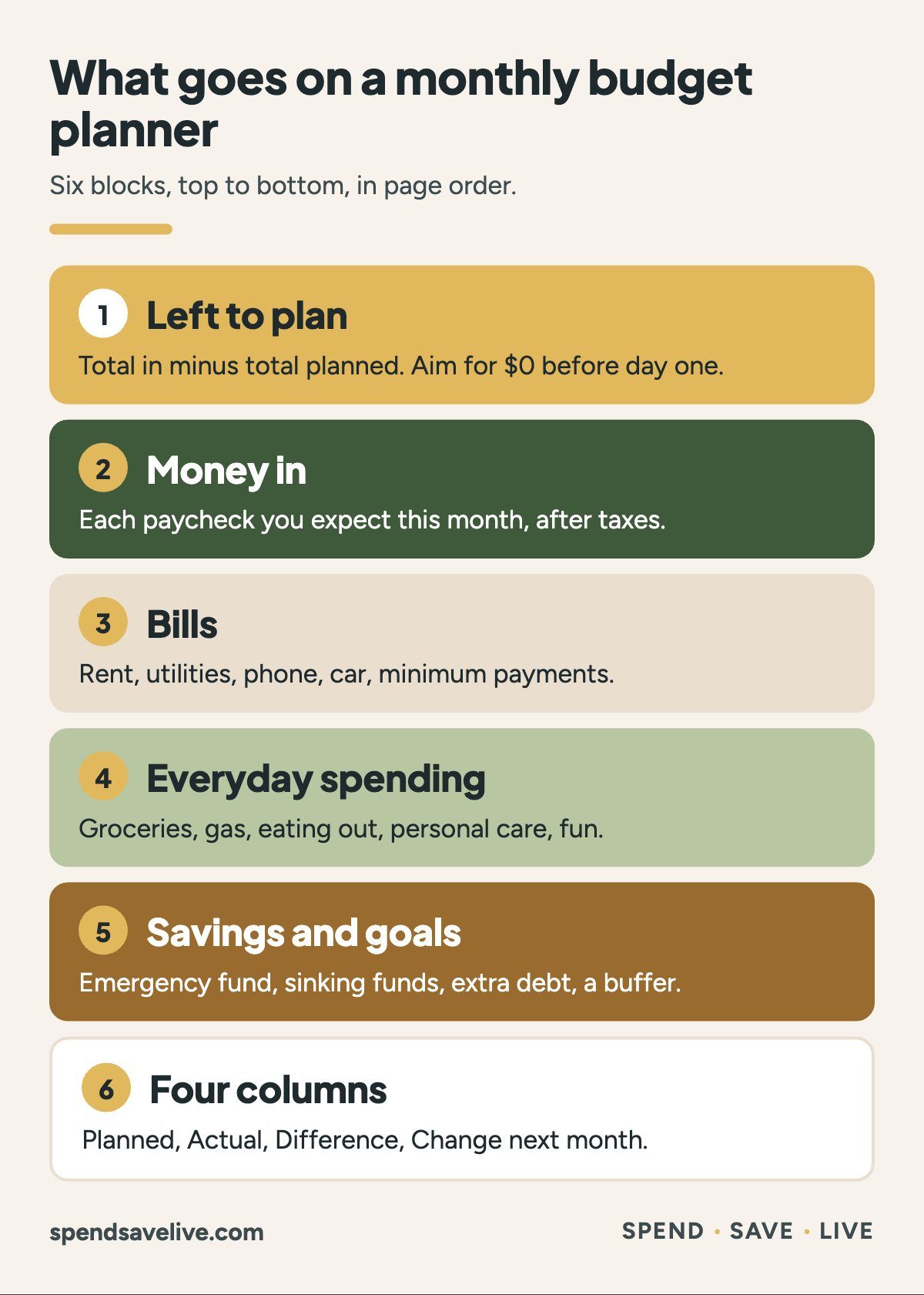
A good monthly budget planner needs four parts and four columns, and not much else.
The four parts are the money coming in, your bills, your everyday spending, and savings and goals. The CFPB spending tracker sorts spending into categories with a column for each week, and this planner borrows that idea, then adds the columns that make next month easier:
- Planned: what you decide before the month starts.
- Actual: what really happened, filled in as you go.
- Difference: actual minus planned, so a plus means you went over.
- Change next month: one word or number that tells future you what to do.
On top sits a box called Left to plan, which is your total take-home pay minus everything you planned. It should hit $0 before the month starts, because a dollar without a job usually ends up at the drive-through.
What can it skip? Pie charts, color-coded stickers and twenty-five category rows you’ll never use. Start with the categories you actually spend on and add a full budget categories list later if something keeps slipping through.
Read more: Budgeting for Beginners From the Money You Actually Have
How Do You Fill In a Monthly Budget Planner Before the Month Starts?
You fill it in from your pay stubs and last month’s statements, in a set order, and you stop when Left to plan reaches $0.
- Write your take-home pay per paycheck. Use the amount that lands in your account after taxes and deductions, not your salary. If you get paid every two weeks, write the paychecks that actually land in this month.
- List your fixed bills with their due dates. Rent, utilities, phone, internet, car payment, insurance and the minimum on any card. Pull the amounts from last month’s bills instead of remembering them.
- Plan everyday spending from your bank and card history. Groceries, gas, eating out and personal care get a number based on what you really spent last month, not what you wish you spent.
- Give the rest a job. Emergency fund, sinking funds, an extra debt payment, and a small buffer for surprises, until Left to plan is $0.
No history yet? The CFPB suggests tracking your spending for a whole month, and if that feels like too much, trying it for one or two weeks first (that’s on their spending tracker, and the Your Money, Your Goals toolkit has the rest of their free budgeting tools).

I learned the order part the hard way. In my low-pay chef years, what made money last was paying the bills first on payday and living on what was left, and these days I budget in my own dashboard (built with Claude, after years in Google Sheets), but the order hasn’t changed one bit.
How Do You Track Actual Spending Without Saving Every Receipt?
Write one total per category per week, straight from your bank or card app, and skip the shoebox of receipts entirely.
Page two of the planner has a weekly log with Week 1 to Week 5 columns, the same layout the CFPB uses on its tracker, because most months touch five weeks at least partly. Once a week, open your banking app, add up groceries, gas, eating out and the rest, and write one number in each box.
Then do one mid-month check, around the 15th, on the two lines most likely to run away from you. For most people that’s groceries and eating out. If one is already at 70% of its planned amount halfway through, you know now instead of on the 30th.
Bills are the other thing to watch, because a bill due on the 3rd and a payday on the 5th can wreck a month that looks fine on paper. Write each due date next to the bill on page one, and if the dates and paydays don’t line up, check the dates on a budget calendar before you blame the budget. If you want more detail than weekly totals, a detailed spending tracker can come later.
What Does a Filled-In Monthly Budget Example Look Like?
Here’s one full month for a fictional couple, with every subtotal adding up, so you can see what a real planner looks like on the 30th.
Fictional example: Jordan and Sam are two adults renting an apartment, with one car and no kids. Jordan is paid twice a month, $1,300 each time, and Sam is paid every two weeks, $875 per check, with two paychecks this month. That’s $4,350 of take-home pay.
Bills
| Line | Planned / actual | Diff. |
|---|---|---|
| Rent | $1,450 / $1,450 | $0 |
| Electric and gas | $150 / $184 | +$34 |
| Water and trash | $45 / $45 | $0 |
| Phones (2 lines) | $90 / $90 | $0 |
| Internet | $60 / $60 | $0 |
| Car payment | $285 / $285 | $0 |
| Car insurance | $140 / $140 | $0 |
| Credit card minimum | $60 / $60 | $0 |
| Streaming and apps | $35 / $49 | +$14 |
| Bills subtotal | $2,315 / $2,363 | +$48 |
Everyday spending
| Line | Planned / actual | Diff. |
|---|---|---|
| Groceries | $520 / $612 | +$92 |
| Household and toiletries | $60 / $58 | -$2 |
| Gas for car | $160 / $146 | -$14 |
| Eating out and coffee | $120 / $187 | +$67 |
| Health copays and prescriptions | $50 / $35 | -$15 |
| Haircuts and personal care | $60 / $60 | $0 |
| Fun money (both) | $150 / $150 | $0 |
| Gifts and birthdays | $40 / $40 | $0 |
| Car registration (not planned) | $0 / $96 | +$96 |
| Everyday subtotal | $1,160 / $1,384 | +$224 |

Savings and goals
| Line | Planned / actual | Diff. |
|---|---|---|
| Emergency fund | $400 / $400 | $0 |
| Car repair fund | $75 / $75 | $0 |
| Extra credit card payment | $250 / $128 | -$122 |
| Buffer for small surprises | $150 / $0 | -$150 |
| Savings and goals subtotal | $875 / $603 | -$272 |
Planned, the month added up to exactly $4,350, so Left to plan was $0 on day one. Actual also adds up to $4,350, because the overspending didn’t create new money, it moved money away from savings.

- Five spending lines went over by $303 in total, and three came in under by $31, so spending ran $272 over plan.
- The $150 buffer caught the first $150 of that (that’s literally its job, so its Actual reads $0).
- The other $122 came out of the planned $250 extra card payment, so only $128 went extra.
- Nothing went on a credit card, which is the whole point of having a buffer line.
Sam’s biweekly pay is also why this month had exactly two of his paychecks. A couple of months a year, a biweekly earner gets three, and a biweekly budget template shows how to plan around that.
What Do You Change Next Month When Planned and Actual Don’t Match?
Sort every difference into one-off, seasonal or pattern first, then change only the lines that will happen again.
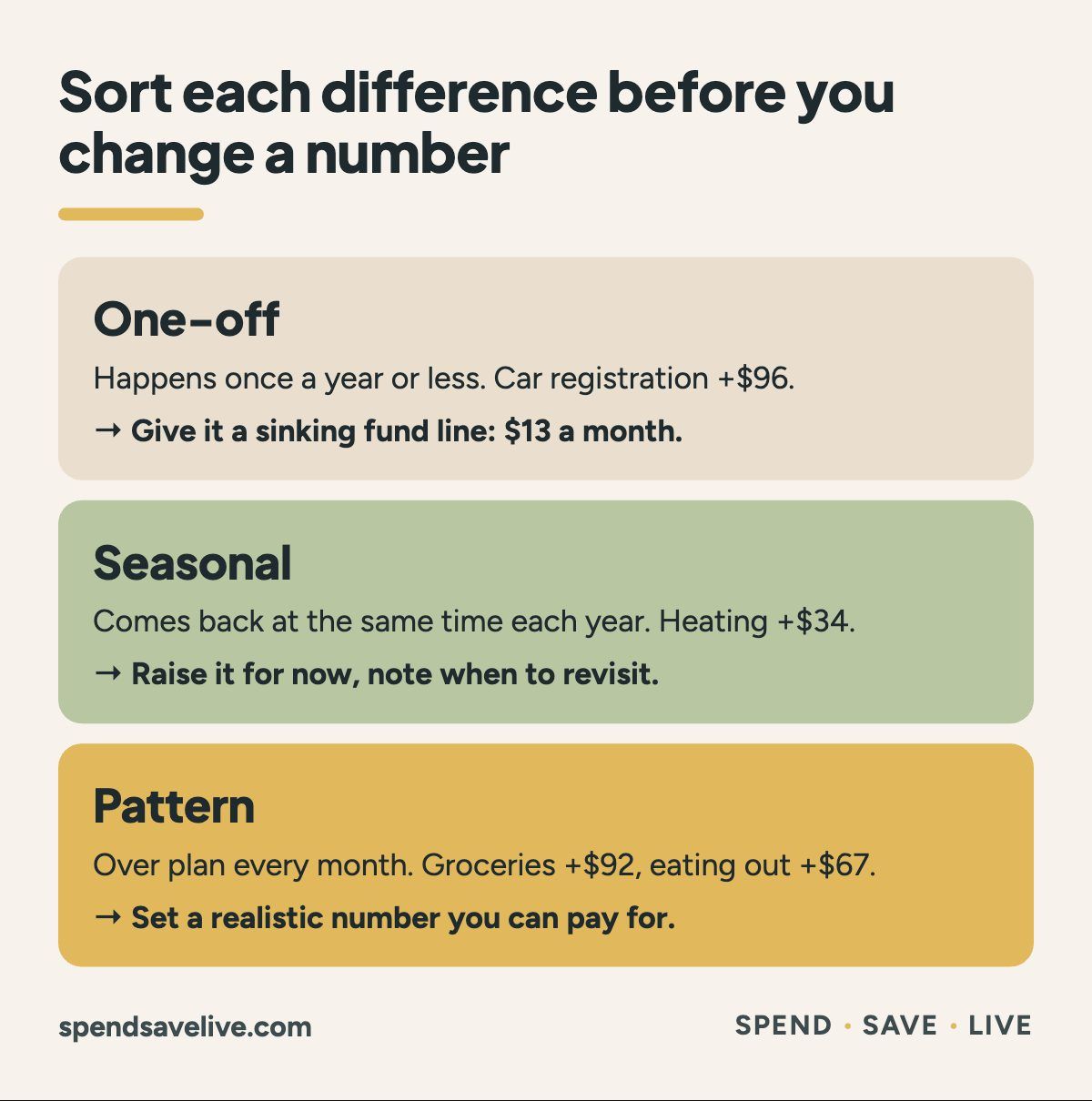
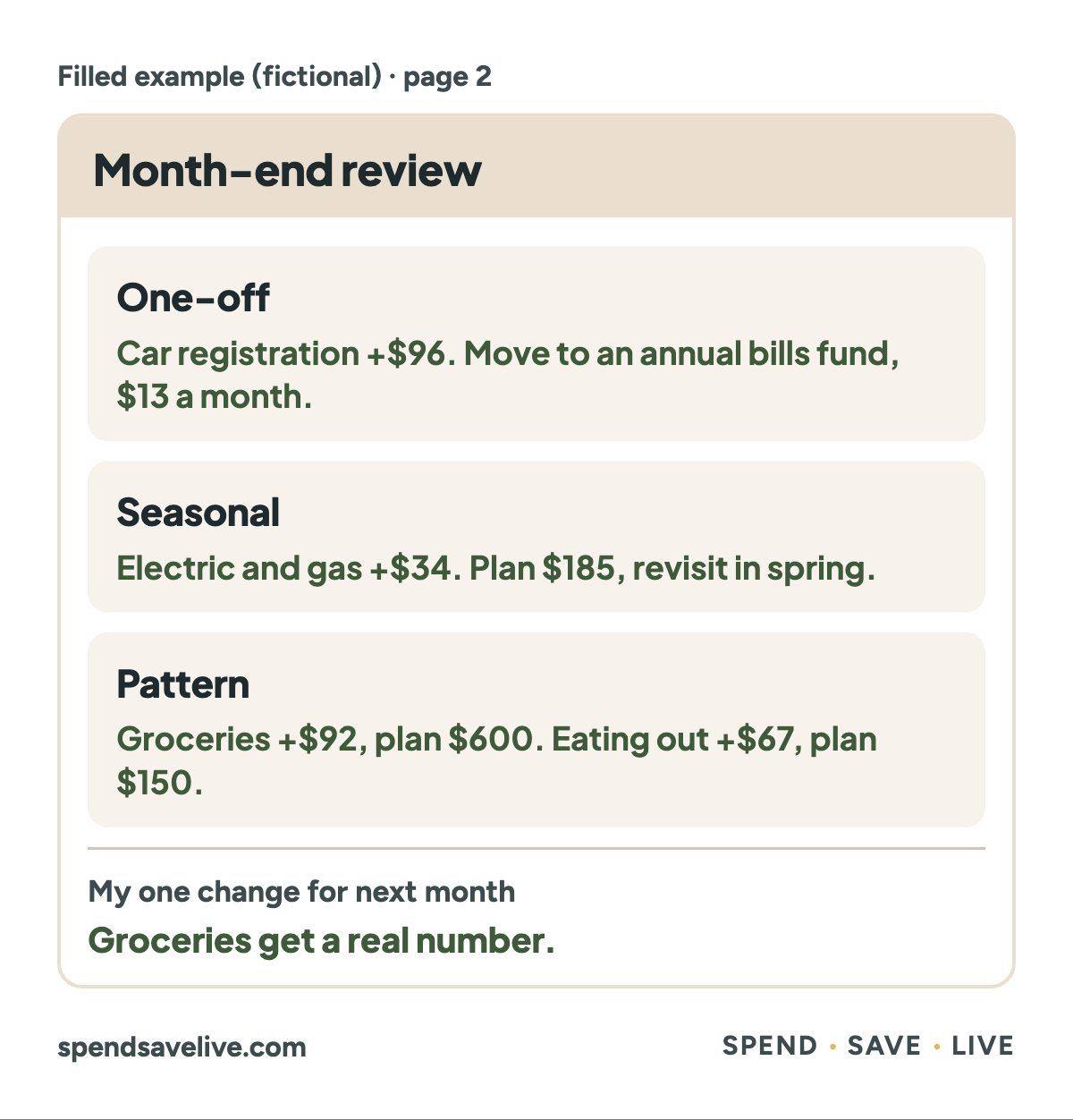
- One-off: the $96 car registration happens once a year. It gets its own line in an annual bills fund, together with a $60 yearly app renewal they found while checking. That’s ($96 + $60) / 12 = $13 a month, which is a sinking fund for once-a-year bills.
- Seasonal: electric and gas ran $34 over because it’s winter. It goes up to $185 for now, with a note to look again in spring.
- Pattern: groceries and eating out went over because the plan was wishful. Groceries move to $600, close to what they really spent, and eating out to $150 (about $35 a week).
Here’s what month two looks like, changed lines only:
| Line | Month two | Why |
|---|---|---|
| Groceries | $600 | +$80, close to real spending |
| Eating out and coffee | $150 | +$30, about $35 a week |
| Electric and gas | $185 | +$35, winter, revisit in spring |
| Annual bills fund | $13 | New: ($96 + $60) / 12 |
| Gas for car | $150 | -$10, ran under |
| Health copays | $40 | -$10, ran under |
| Emergency fund | $350 | -$50 to pay for the increases |
| Extra card payment | $162 | -$88 to pay for the increases |
Do the math and it balances: $158 of increases minus $20 of decreases is $138, and the lower emergency fund and card payment cover exactly that. Streaming goes back to $35 because the free trial that caused the extra $14 got cancelled.
Savings went down so the plan could match real life. That’s a trade-off, and Jordan and Sam should know they made it, but it still beats a plan that falls apart every month on the 20th.
For what it’s worth, this is roughly how I treat my own numbers. If plan and actual are only a little apart, I let it be, and if the gap is big, I adjust the next months instead of pretending it didn’t happen.
Read more: How to Start Sinking Funds for Costs You Know Are Coming
What’s in the Monthly Budget Planner Printable?
The planner is two US letter pages: page one plans the month and compares it with what happened, and page two holds your savings, the weekly log and the month-end review. There’s also a copy filled in with Jordan and Sam’s month, so you can check your own against it.


- Page 1, Plan and compare: month and year, the Left to plan box, Money in, Bills (with due dates) and Everyday spending.
- Page 2, Save, track and review: Savings and goals (the first row is already printed as “Buffer for small surprises”), a totals strip, the Week 1 to Week 5 log, a mid-month check for two lines, and a month-end review with One-off, Seasonal and Pattern boxes plus “My one change for next month.”
- The bills, everyday and savings tables each have Planned, Actual and Diff. columns, plus a Change next month column.
- A reminder in the footer not to write account numbers on the page, which the CFPB also recommends.
Get the full Monthly Budget Planner
The full printable PDF is coming soon. It will be free to SPEND • SAVE • LIVE readers.
When the Numbers Say You Need More Than a Planner
A planner shows you the gap, but it can’t close a gap between paydays or pay a bill your income doesn’t cover.
- If money runs out before payday even though the month balances, that’s a timing problem. The CFPB cash flow budget tracks your balance week by week, carrying each week’s ending balance into the next, so you can see which week runs short.
- If your bills add up to more than your pay, call 211 or visit 211.org to find local help with bills, utilities and food. 211 says every call is confidential.
- If debt payments are crowding everything else out, the National Foundation for Credit Counseling connects you with a nonprofit credit counselor at 877-360-6322.
- If you’re not sure where to start on the site, the Start Here page sorts the guides by what you’re working on.
None of this is personalized advice, and if your situation is complicated, a nonprofit counselor who sees your whole picture will help more than any template.
Frequently Asked Questions
What is the best monthly budget template?
The best one is the one you’ll actually fill in twice. It needs your take-home pay, every bill, Planned and Actual columns, and a place to write what changes next month. Which method you follow matters less than using the same page again next month.
How do you use a monthly budget planner?
Before the month, plan every dollar until Left to plan is $0. During the month, write weekly totals for each category. At month end, subtract planned from actual and change one or two lines for next month.
Is it better to budget weekly or monthly?
Monthly fits monthly bills like rent, and weekly shows what’s safe to spend between paydays. Many people plan the month and check it once a week, which is how this planner is set up.
If you are paid weekly, how do you budget monthly?
Plan the month on four paychecks and treat a fifth as extra. In 2027, a Friday payday gives five paychecks in January, April, July, October and December.
What bills do most adults pay monthly?
Housing, utilities, phone and internet, transportation costs like a car payment and insurance, debt payments and food. Housing is the biggest one: it was 33.9% of average household spending in 2025, according to the Bureau of Labor Statistics.
Is there a free monthly budget planner available?
Yes. The FTC’s two-page “Make a Budget” worksheet on consumer.gov and the CFPB spending tracker are both free. The planner in this post adds Planned, Actual and Difference columns and a filled-in example, and its full printable is coming soon.
Where can I find a free printable budget list?
The FTC’s “Make a Budget” worksheet lists income and seven expense groups: housing, food, transportation, health, personal and family, finance and other. It also has an “Other expenses this month” line for costs that don’t come every month.
Key Takeaways
- Plan every dollar until Left to plan reaches $0 before the month starts.
- Use take-home pay and last month’s real spending, not salary and hope.
- Track actual spending as weekly totals, not a pile of receipts.
- Sort each difference into one-off, seasonal or pattern before you change a number.
- Change one or two lines next month, and write down what you gave up to pay for them.
Month Two Is Where the Planner Starts Paying Rent
The first month on a planner is mostly a reality check, and that’s fine, because the Difference column is what turns the 20th-of-the-month panic into a number you can actually fix. Fill in month one honestly, rebuild month two from it, and if a once-a-year bill caught you off guard, give it a sinking fund so it never sneaks up on you again. More guides like this live in Budget basics.
Sources (checked November 2026)
- CFPB, Your Money, Your Goals toolkit
- CFPB, Spending tracker
- CFPB, Creating a cash flow budget
- BLS, Consumer Expenditures 2025 (survey data for October and November 2025 were not collected and were adjusted for)
- FTC, Make a Budget worksheet (consumer.gov)
- 211.org
- National Foundation for Credit Counseling
Jordan and Sam are a fictional example. All example totals were checked with a calculator script.
Educational content, not financial advice.