

The 50/30/20 rule splits take-home pay into 50% for needs, 30% for wants and 20% for savings and debt. Use it as a comparison point. If your essentials already cost more than half, list them first, set a small savings floor, give wants what is left and keep the gap written down where you can see it.
Take $3,600 of take-home pay, times 0.5, and the 50 30 20 budget gives you $1,800 for needs, which looks very tidy on paper right up until rent alone eats $1,450 of it and you still haven’t bought groceries, paid the electric bill or filled the car (cue the slow, sad scroll back up to the top of the spreadsheet).
That’s the month this 50 30 20 budget template is built for. You’ll work out the standard split, list the costs you really can’t skip, then build a revised month in percentages that adds up to exactly 100%, with the leftover gap shown plainly instead of hidden under a fake number. There’s a worked example, a one-page worksheet and links to our other spending and budgeting guides if you want to go deeper.

Read this also:
- Budgeting for Beginners From the Money You Actually Have
- A Budget Categories List That Catches Forgotten Expenses
- A Simple Monthly Budget Planner With a Filled-In Example
- A Zero-Based Budget That Gives Savings a Job
Quick confession before we start: my own budget isn’t a 50/30/20 budget at all. I give each pot a fixed percentage of my income, fixed costs first, and I set those percentages slowly over years of budgeting, so if your numbers look nothing like the textbook split, you’re in good company.
Is the 50/30/20 Rule Right for My Situation?
The 50/30/20 rule is right for you as a yardstick, and it may or may not be right as a target. It works well when your needs fit inside half your take-home pay, and it still helps when they don’t, because it shows you exactly where your month is different.
Where the rule came from
The split was made popular by Elizabeth Warren and her daughter Amelia Warren Tyagi in their book All Your Worth, where they called it the Balanced Money Formula: 50% for must-haves, 30% for wants and 20% for savings (MONEY Magazine interview with Warren and Tyagi). It was meant as a simple balance check for a household, and that’s still the best way to use it.
What it is good for
It gives a beginner three buckets instead of forty categories, which is a lot less scary on day one. It also gives you a fast reality check: if wants are at 45%, you know where to look, and if needs are at 70%, you know the problem isn’t your coffee habit (please keep your coffee, we’re not those people).
Self-check: do my needs add up to more than half?
Add up last month’s rent or mortgage, utilities, groceries, transport, insurance, phone, health costs and minimum debt payments, then divide by your take-home pay. Over 0.5 means the standard split won’t fit as it is, and that’s common: in the latest federal spending survey, housing alone was 33.9% of what the average household spent in 2025, before food, transport or healthcare (BLS Consumer Expenditures 2025 release). This post is for you if:
- Your fixed bills already take more than half of each paycheck
- You tried the 50 30 20 budget and quit because the numbers never worked
- You want a plan that still saves something, even if it isn’t 20% yet
Read more: Budgeting for Beginners From the Money You Actually Have
How Do I Work Out My Standard 50/30/20 Split?
Multiply your monthly take-home pay by 0.50, 0.30 and 0.20, and those three numbers are your standard split. Take-home pay is what actually lands in your account after taxes and anything your employer takes out, so use that number and not your salary.
Start with take-home pay
Look at your last two pay stubs or bank deposits and add them up for a month. If your pay changes, use a lower month so the plan doesn’t count on money that might not show up. Side income counts too, as long as it’s money you reliably get.
Multiply by 0.50, 0.30, 0.20
Here’s Rosa, a fictional reader we made up for this example. She takes home $3,600 a month, so her standard 50/30/20 budget example looks like this:
| Bucket | Share | Rosa’s standard split |
|---|---|---|
| Needs | 50% | $1,800 |
| Wants | 30% | $1,080 |
| Savings and debt | 20% | $720 |
| Total | 100% | $3,600 |

If you’re not sure what goes in each bucket, our full budget categories list has the lines people usually forget, like the yearly car registration and the dentist.
What Counts as a Need and What Counts as a Want?
A need is a cost you have to pay to live, keep your home and get to work, and a want is everything you could pause without serious trouble. Wants are allowed, and they’re also the bucket that can bend first when money is tight.
Needs vs wants
Needs are rent or mortgage, basic utilities, groceries (not takeout), the cheapest way you can get to work, insurance, basic phone and internet, and health costs. Wants are dining out, streaming, hobbies, travel, upgrades and most shopping. For the full sorting game, here’s needs versus wants in more depth.
Minimum debt payments
The minimum payment on a card or loan sits in needs, because missing it costs you late fees and can hurt your credit (Experian on minimum debt payments as essentials). Anything you pay above the minimum goes in the savings and debt bucket instead, since that’s you getting ahead.
Gray areas like phone and transport
A basic phone plan is a need; the newest phone on a monthly payment is partly a want. A car you need for work is a need; the gap between that and a fancier car is a want. You don’t have to be strict with yourself here, just honest, and if you’re unsure, put it in needs for now and look at it again when you review the plan next month.
What Does My Actual Month Look Like?
Your actual month is the list of costs you can’t skip, added up and divided by your take-home pay. This is the step most 50/30/20 templates skip, and it’s where the whole thing either starts working or falls apart.
List the costs you cannot skip
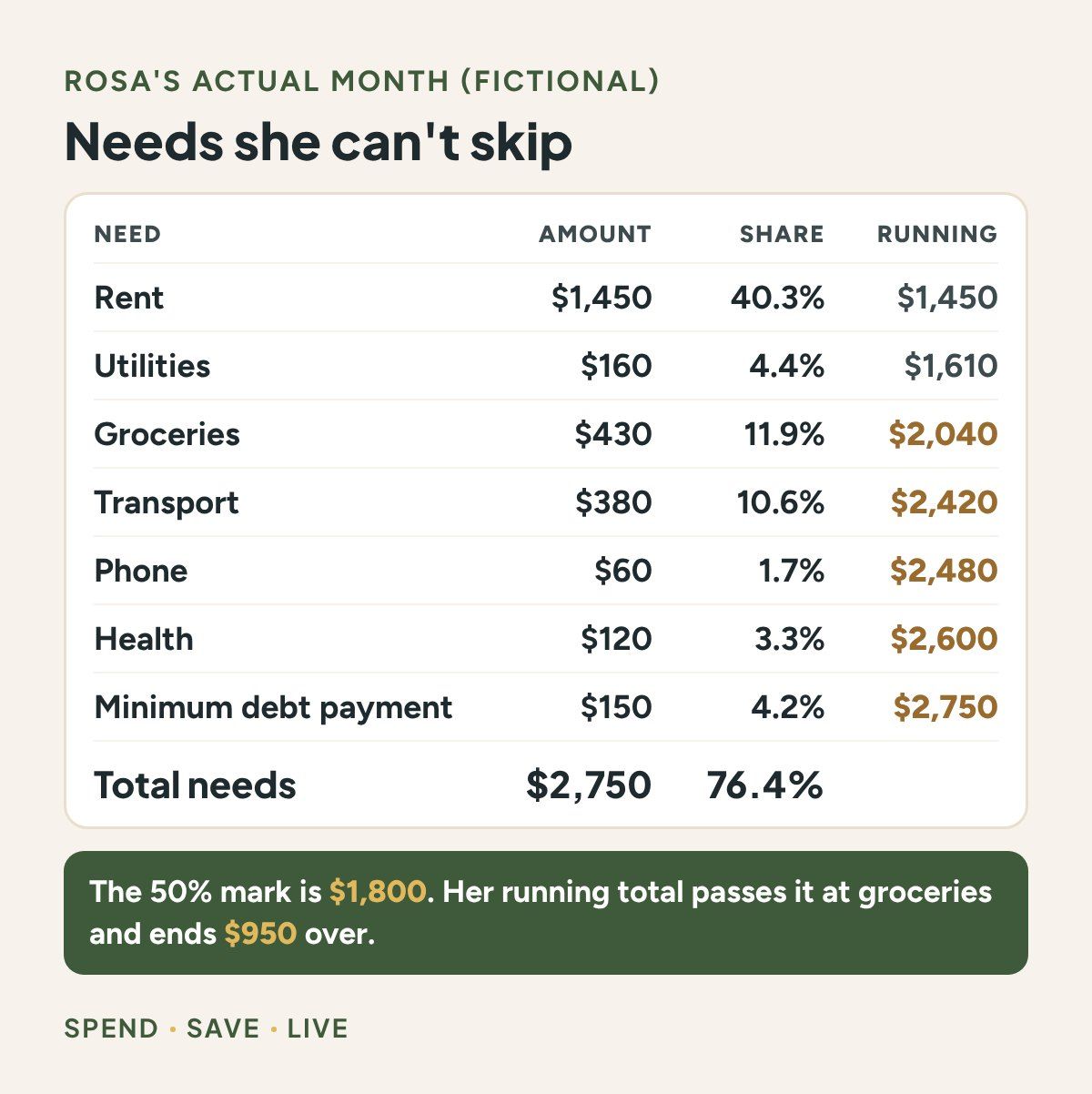
Here are Rosa’s unavoidable costs for one month, with each one shown as a share of her $3,600:
| Need | Amount | Share of take-home |
|---|---|---|
| Rent | $1,450 | 40.3% |
| Utilities | $160 | 4.4% |
| Groceries | $430 | 11.9% |
| Transport (car payment, insurance, gas) | $380 | 10.6% |
| Phone | $60 | 1.7% |
| Health | $120 | 3.3% |
| Minimum debt payment | $150 | 4.2% |
| Total needs | $2,750 | 76.4% |
Compare with the standard split
The standard split gave Rosa $1,800 for needs. Her real needs are $2,750, which is 76.4% of her take-home pay and $950 over the 50% mark. That leaves $850 for everything else, which is less than the $1,080 the rule wanted for wants alone.
See the gap
Write the gap down as a number: needs are $950 over the standard. That’s it. The number is about rent, groceries and car costs where Rosa lives this year, and nothing about how good she is with money, and you can’t plan around a number you refuse to look at.
How Do I Build a Revised Month That Works?
Build the revised month in a fixed order: needs first, then a savings floor, then wants from whatever is left, and the gap stays visible at the bottom. The order matters more than the exact percentages, because it stops savings from being whatever crumbs survive the month.
1. Fixed needs first
Put the full $2,750 in. Don’t shave the grocery line on paper to make the chart look prettier, because the store won’t charge you the pretend number.
2. Set a savings floor
Pick a small amount that goes to savings on payday, before wants. Rosa picks $250, which is 6.9%. It’s far from 20%, and it still builds her emergency fund every single month; here’s how to start building an emergency fund and why paying yourself first makes the floor stick.
3. Wants from what is left
$3,600 minus $2,750 minus $250 leaves $600 for wants, which is 16.7%. That covers a few dinners out, a streaming plan, a birthday gift and some fun money, and because it’s a real number, Rosa can actually spend it without guilt.
4. Keep the gap visible
| Bucket | Standard | Rosa’s revised month | Gap |
|---|---|---|---|
| Needs | $1,800 (50%) | $2,750 (76.4%) | +$950 |
| Wants | $1,080 (30%) | $600 (16.7%) | -$480 |
| Savings and debt | $720 (20%) | $250 (6.9%) | -$470 |
| Total | $3,600 | $3,600 (100%) |

Savings $470 under the 20% line is the number to watch. You can close it slowly from either side: a cheaper phone plan or insurance quote next renewal, a raise, a side gig, or simply raising the floor by $25 whenever a need gets cheaper. If money is very tight, a bare bones budget for tight months shows what to trim first, and typical percentages by category help you see which line is out of line.
This is also all a 70 20 10 budget or a 60/20/20 split is, by the way: a different comparison point. None of them is a rule you fail. Your real bills pick the percentages, and the named split just tells you how far off you are.
In my own budget the transfers go out on payday, and in an expensive month I sometimes lower or pause one, so I don’t treat the plan like a contract either. If I could tell younger me one thing, it would be to leave room in the budget for investments and for building the emergency fund from the start, even a small amount, because the habit matters more than the size.
What About Rent and the 30% Housing Rule?
Rent is part of your needs bucket, and the 30% rule is a separate yardstick for whether housing is squeezing everything else. The Census Bureau counts a household as cost burdened when it spends more than 30% of its income on rent, mortgage and other housing costs ({X(CEN,’Census Bureau on housing cost burden’)}).
The 30% yardstick
HUD uses the same 30% line for rent and utilities and calls more than half of income (51% or more) a severe burden (HUD PD&R Edge on cost burden). One catch: those measures use income before taxes, while the 50/30/20 rule uses take-home pay. Rosa’s rent is 40.3% of her take-home pay, so on the before-tax measure the share would be lower, but rent is still clearly her biggest need.
When rent is the biggest cost
Most of the gap usually comes from rent, and rent is also the hardest line to change quickly. So plan around it for now, and look at it at your next lease renewal (roommate, smaller place, different neighborhood, or asking about a longer lease at the same price). Here’s how to budget around rent in more detail.
I know this one from my chef years in Helsinki, where rent was always the biggest cost. After rent, my phone and a monthly transport ticket, I had about €600 a month to live on (roughly $655 at today’s rate), and no textbook split was ever going to fit that, so I stopped trying to make it fit and planned what I actually had.
Read more: A Simple Monthly Budget Planner With a Filled-In Example
What Is in the Adjustable Percentage Worksheet?
The Adjustable Percentage Worksheet is a one-page 50 30 20 budget template you can bend, laid out as a worksheet with four columns: the standard split, your actual amount, your actual percent and the gap. Under it sits a revised month section and a short list for the gap, and we tested it by filling it in with Rosa’s numbers, so every box adds up.

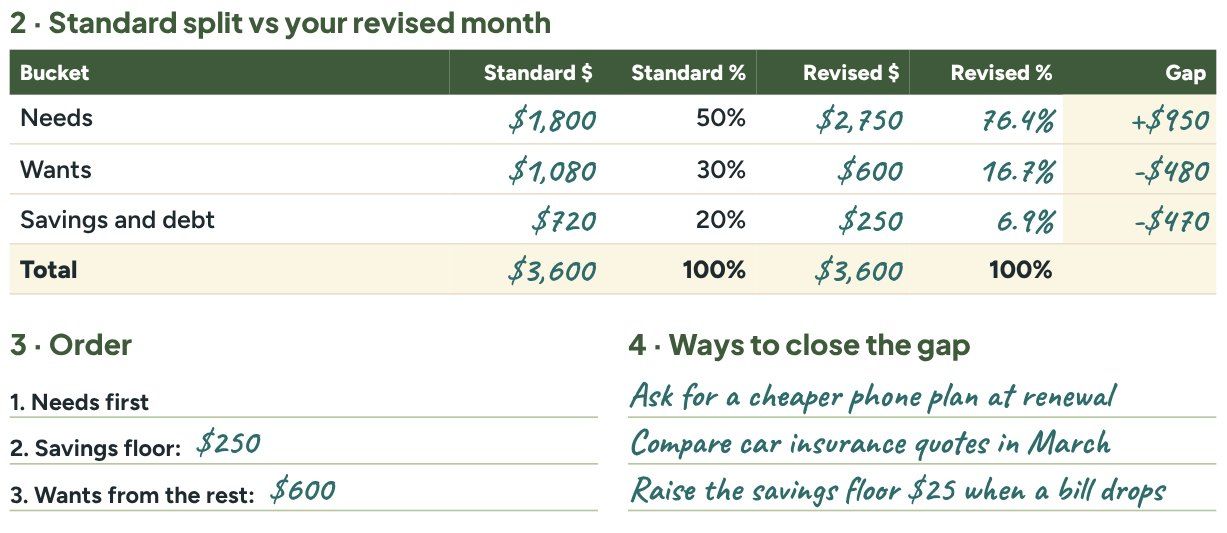
How to use this 50 30 20 budget worksheet each month: fill in take-home pay, list your needs, check the gap, then write the revised month. If you’d rather give every single dollar a job, a zero-based budget is the next step up, and the monthly budget planner works well alongside it.
Get the full Adjustable Percentage Worksheet
The full printable PDF is coming soon. It will be free to SPEND • SAVE • LIVE readers.
When Should I Get Help, and What Can This Not Do?
A budget can show a gap, but it can’t close an income gap by itself, and if needs are above 100% of take-home pay, no split will fix that. That’s a sign to look for help, and there’s no shame in it.
- For help paying bills, finding food or with housing costs near you, call 211 or visit 211.org. It’s free and confidential.
- The Consumer Financial Protection Bureau has free worksheets for a cash flow budget, a spending tracker, cutting expenses and prioritizing bills in its Your Money, Your Goals toolkit.
- If you live paycheck to paycheck, start with a paycheck to paycheck budget before you worry about percentages.
- This post is general education. For debt you can’t keep up with, talk to a qualified, nonprofit credit counselor before signing anything.
Key Takeaways
- Work out the standard split from take-home pay: times 0.50, 0.30 and 0.20.
- List every cost you can’t skip, including minimum debt payments, and divide by take-home pay.
- If needs top 50%, build the revised month in order: needs, a small savings floor, then wants.
- Write the gap down next to the standard split so you can close it slowly.
- Budget percentages are a comparison point; your real bills decide the plan you can use.
Frequently Asked Questions
How do you create a 50/30/20 budget?
Multiply your monthly take-home pay by 0.50, 0.30 and 0.20 to get the standard split. Sort your costs into needs, wants and savings and debt, then compare your actual totals with the standard. If needs run over, build a revised month: needs first, a small savings floor, then wants from what is left.
What is the 50/30/20 rule for rent?
Rent is a need, so it sits inside the 50% needs bucket. A separate yardstick, used by the Census Bureau and HUD, calls a household cost burdened when housing takes more than 30% of income before taxes. If rent alone eats most of your 50%, plan around it and review it at your next lease renewal.
Is the 50/30/20 budget rule still realistic?
It’s realistic as a comparison point and often not as a strict target. Housing was 33.9% of average household spending in 2025, according to BLS, so many people’s needs run past half of take-home pay. Use the split to see your gap, then set percentages that match your real bills.
Should bills be 50% of your income?
Fifty percent of take-home pay is a helpful guide, not a requirement. If your bills are higher, keep them in the plan at their real amount, set a small savings floor and give wants what is left. Write down how far you are from 50% so you can bring it down over time.
What are needs vs wants in budgeting?
Needs are costs you have to pay to live and work, like housing, utilities, groceries, transport, insurance, health costs and minimum debt payments. Wants are costs you could pause without serious trouble, like dining out, streaming, hobbies and travel.
Half Was Only Ever a Suggestion
Rosa’s $1,800 for needs was never going to cover $2,750 of real bills, and pretending it could would have cost her the $250 she now saves every month. So run the standard split, look at your real month, write the gap down and give it a few months to shrink. And if you’d like to see every dollar of that month mapped out, the budgeting for beginners guide walks you through it from the first paycheck.
Sources (checked November 2026)
- U.S. Bureau of Labor Statistics, Consumer Expenditures 2025 (housing 33.9% of average annual spending; released Oct 29, 2026)
- U.S. Census Bureau, Renters More Likely Than Homeowners to Spend More Than 30% of Income on Housing (Dec 8, 2022; cost burden definition)
- HUD Office of Policy Development and Research, PD&R Edge on rent burden (30% and severe burden thresholds)
- MONEY Magazine, interview with Elizabeth Warren and Amelia Warren Tyagi (Balanced Money Formula, 50/30/20)
- Experian, What Is the 50/30/20 Budget Rule? (minimum debt payments as essentials)
- Consumer Financial Protection Bureau, Your Money, Your Goals toolkit (budget and bill tools)
- 211.org (local help with bills, food and housing)
Educational content, not financial advice.