

To start budgeting as a beginner, add up the take-home pay you will actually receive this month, pull your last one to three months of bank and card transactions, and sort them into five broad groups. Subtract. If the answer is negative, cut flexible spending first, then check your plan every week.
Every budgeting method online seems to come with its own app, its own rules and its own fan club, so it’s no wonder budgeting for beginners feels like you have to pick a team before you’re even allowed to start. You don’t. You need this month’s take-home pay, a few weeks of real spending and one page.
This guide walks one made-up household through a whole first month, including the part most examples skip (the first try comes out short), and the worksheet matches it box for box.
Read this also:
- No-Spend January 2027 Rules That Leave Room for Real Life
- A 52-Week Savings Challenge That Fits Your 2027 Cash Flow
- A Life Audit That Helps You Choose One Change for 2027
My first real budget happened in my travel blogging years, when I was living in Thailand and blog income was all over the place. It was a Google Sheet with rent, daily spending, an emergency fund, my fixed business costs and whatever was left going to savings (these days I use a dashboard I built with Claude).
Is This Beginner Budget Guide Actually for You?
It is if you’re paid by paycheck or direct deposit and you’ve either never written a budget or keep quitting the ones you start.
- You get paid by paycheck or direct deposit, weekly, every two weeks or monthly.
- You’ve never written a budget, or you start one every January and it’s gone by February.
- You couldn’t say where last month’s money went.
- You’d rather start with one page than download another app.
If your pay changes a lot from month to month, the same five steps still work. Plan with the amount that actually landed in your account, not the amount you hope for, and give any extra a job when it arrives. Already picked a method? Skip down to which method to try after your first month.
What Do You Need Before You Start a Budget (Hint, It Isn’t an App)?
You need four things, and none of them cost money: proof of what you get paid, a record of what you spent, your bill due dates and something to write on.
- One pay stub or the list of deposits from your bank app.
- One to three months of bank and card statements (more months smooth out the weird ones).
- Your bills with their due dates, from the account pages or the paper bills.
- A notebook, a blank spreadsheet or a sheet of paper. Whatever you’ll actually open.
Use take-home pay, meaning the amount that actually lands in your account after taxes and deductions, not your salary. A budget built on the salary number is a budget built on money you never see.
The CFPB’s cash flow budget tool says to track your income and spending for at least a month before you build the budget. If that feels like a lot, its spending tracker suggests trying it for just one or two weeks to start, which is a fine first step too.
How to Start a Budget From Your Real Numbers in 5 Steps
Add up the pay that will land this month, total what you spent in five groups, subtract, balance it, then put dates on it.
- Write down this month’s take-home pay. Most people paid every two weeks get two paychecks a month, but some months have three (in 2027, if your first payday is Friday January 8, April and October get a third), so check your own pay dates before you plan.
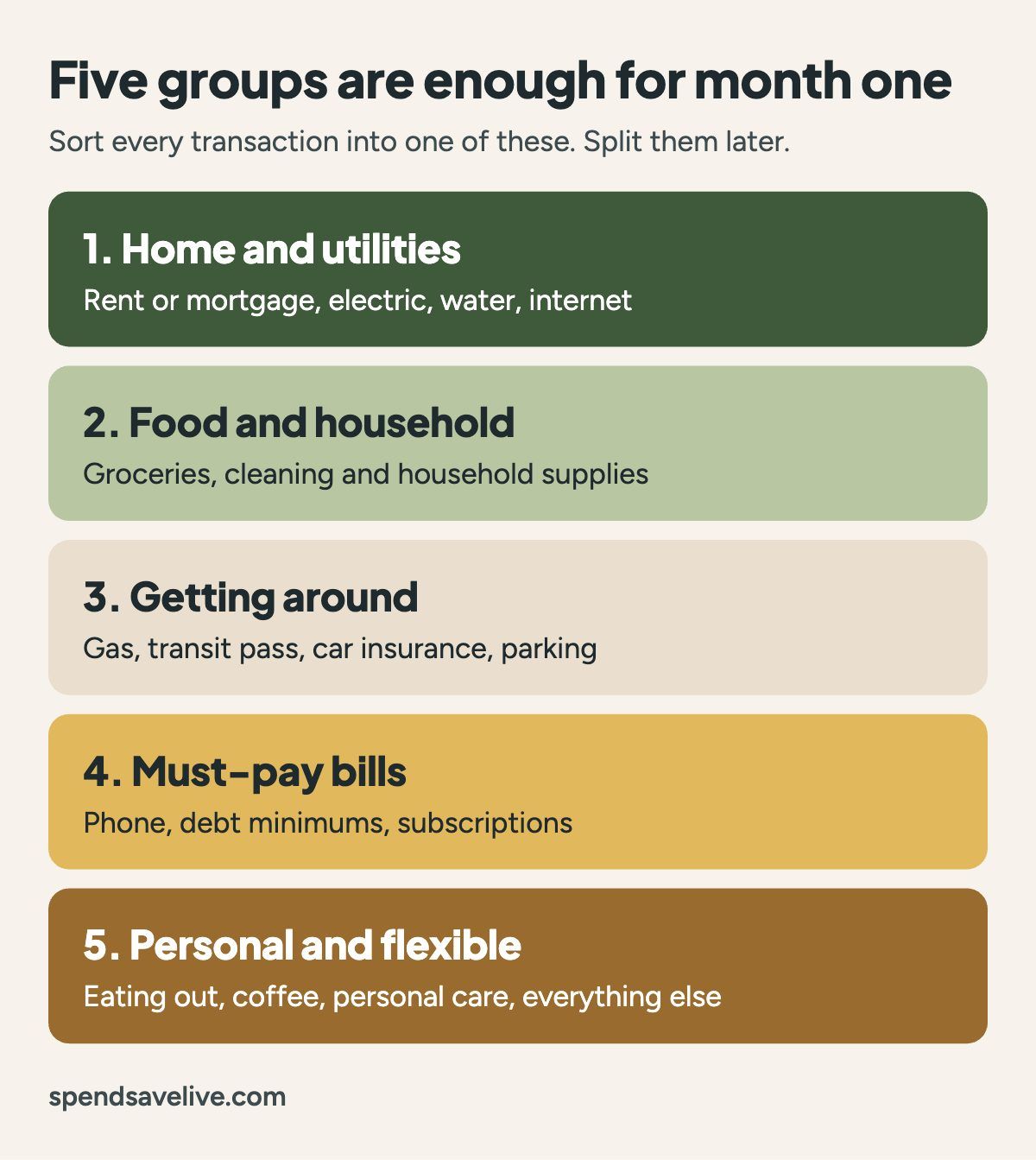
- Sort your spending into five groups. Home and utilities, Food and household, Getting around, Must-pay bills, Personal and flexible. The CFPB tracker uses 12 lines if you want more detail later, once your first month balances.
- Subtract. Take-home pay minus total spending. Positive, zero and negative are all normal answers on a first try. consumer.gov puts it plainly, a result under zero means you’re spending more than you make.
- Balance it. If there’s money left, give it a job. If it’s short, use the order in the next section.
- Put dates on it. Write each bill’s due date next to your paydays, because a month can look fine on paper and still run short in week two if the big bills land before the paycheck does. Writing both on one calendar makes this very obvious.
For context only: in 2025 the average US household spent 33.9% of its spending on housing, 16.5% on transportation and 13.0% on food, according to the Bureau of Labor Statistics. These are national averages across every income level, not targets for your budget.
What If Your Budget Comes Out Negative on the First Try?
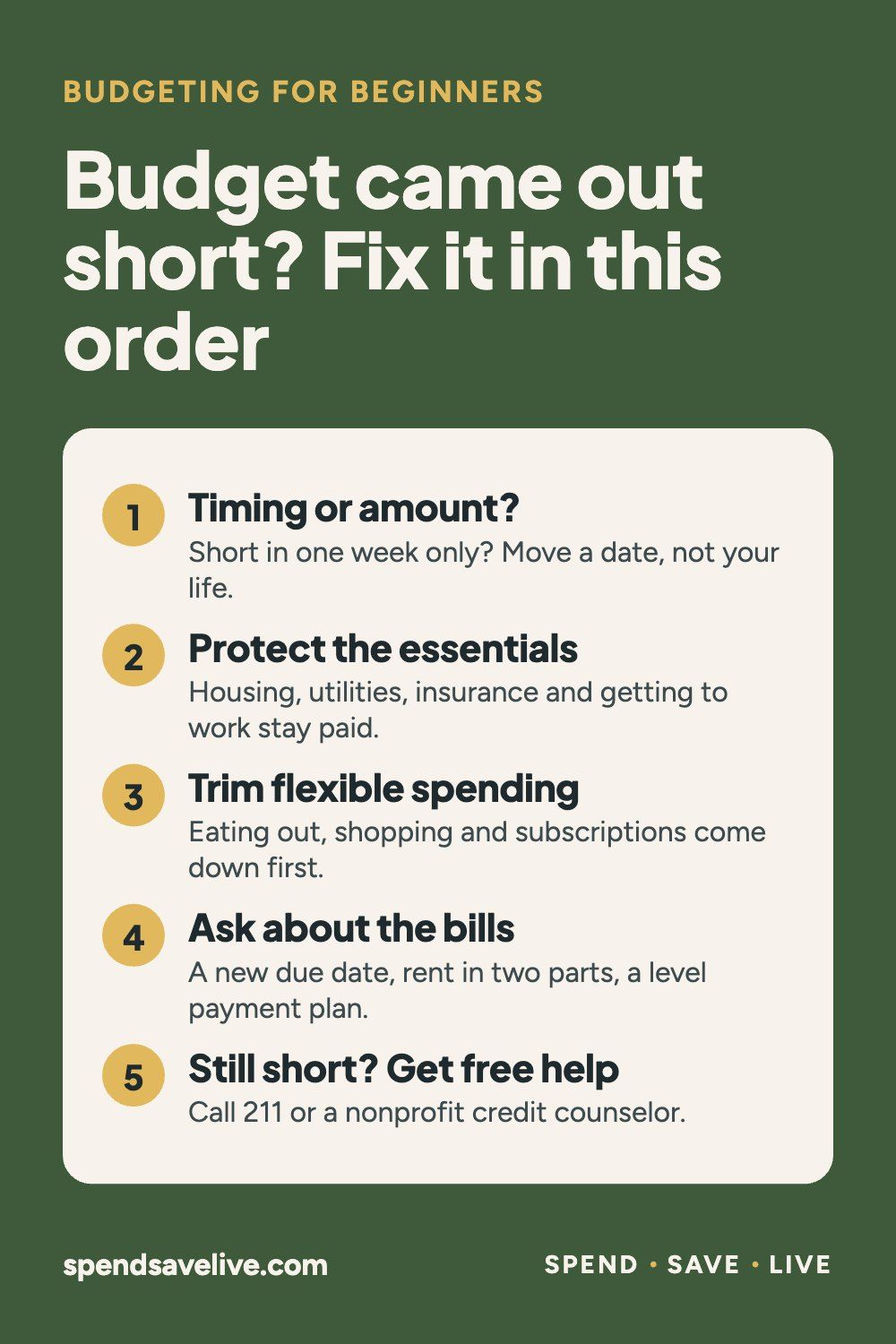
Work through it in a set order and protect the bills that keep a roof over you and get you to work before you touch anything else.
A short first result doesn’t mean you’re bad with money. It usually means the budget is finally telling the truth, which is the whole point of writing one (annoying, I know).
- Check if it’s timing or amount. If you’re only short in one week because rent and the car insurance land together, that’s a timing problem, and step 4 can fix it.
- Protect the essentials first. The CFPB’s guide to prioritizing bills puts housing, utilities, insurance and the things that protect your income (like getting to work) at the top. Child support and other court-ordered payments belong up there too.
- Trim personal and flexible spending. Eating out, coffee, shopping and subscriptions come down first, by an amount you can actually live with.
- Ask about the bills themselves. The CFPB’s ideas for improving cash flow include asking to move a due date to after payday, asking your landlord to split rent into two payments and level payment plans for utilities.
- Still short? Then it’s an income or debt problem, not a you problem. Keep the essentials covered and use the free help further down.

One more thing from that CFPB guide: don’t automatically pay whoever calls the most. The loudest creditor isn’t always the bill that matters most this week, and if you know you’ll miss a payment, call that company before the due date and explain.
Read more: More budget basics guides
Worked Example of One First Month, Start to Finish (Fictional, Real Math)
Jordan’s first pass comes out $89 short, and three cuts to personal and flexible spending turn it into $76 left over.
Jordan is a made-up example, not a real reader. Jordan is single, shares a two-bedroom apartment, gets paid every other Friday and takes home $1,240 per paycheck. In January 2027 the paydays are Friday January 8 and Friday January 22, so that’s $2,480 coming in. January’s rent was already covered by December pay, so the two January checks build February’s rent.
| Group | First pass | Second pass |
|---|---|---|
| Home and utilities | $1,190 | $1,190 |
| Food and household | $445 | $445 |
| Getting around | $288 | $288 |
| Must-pay bills | $120 | $120 |
| Personal and flexible | $526 | $361 |
| Total out | $2,569 | $2,404 |
| Result ($2,480 in) | minus $89 | $76 left |
Where those group totals come from, in Jordan’s three-month averages:
- Home and utilities: rent share $1,050, electric $85, internet $55.
- Food and household: groceries $400, household supplies $45.
- Getting around: gas $160, car insurance $128.
- Must-pay bills: phone $45, credit card minimum $75.
- Personal and flexible: eating out and coffee $320, personal care $45, two streaming services $31, everything else $130.
What changed between the two passes, and what didn’t:
- Eating out and coffee went from $320 to $200 (minus $120).
- Everything else went from $130 to $100 (minus $30).
- One streaming service got cancelled, so $31 became $16 (minus $15).
- Rent, utilities, car insurance, gas, phone and the card minimum didn’t move at all.
That’s $165 cut, and $2,480 minus $2,404 leaves $76. Jordan puts it aside as a starter buffer, the first step toward money to set aside for costs you know are coming, and later Jordan can grow the buffer into an emergency fund. Giving the buffer its own line from the very first month works better than waiting to see if anything is left.
What Should You Do on Payday Before You Spend a Cent?
Set aside this paycheck’s share of rent, pay the bills due before the next payday, move the buffer, and divide what’s left by the number of weeks.
| Line | Paycheck 1, Jan 8 | Paycheck 2, Jan 22 |
|---|---|---|
| Take-home | $1,240 | $1,240 |
| Rent set-aside | $525 | $525 |
| Bills due before next payday | $201 | $203 |
| Buffer | $38 | $38 |
| Spending money | $476 | $474 |
| Per week | $238 | $237 |
- Paycheck 1 covers January 8 to 21: streaming $16 (Jan 9), phone $45 (Jan 12), electric $85 (Jan 15), internet $55 (Jan 20). Total $201.
- Paycheck 2 covers January 22 to February 4: car insurance $128 (Jan 26), card minimum $75 (Jan 28). Total $203.
- Check: $476 plus $474 is $950, which is exactly groceries, household, gas and the personal spending left after the streaming bill. Nothing got lost.
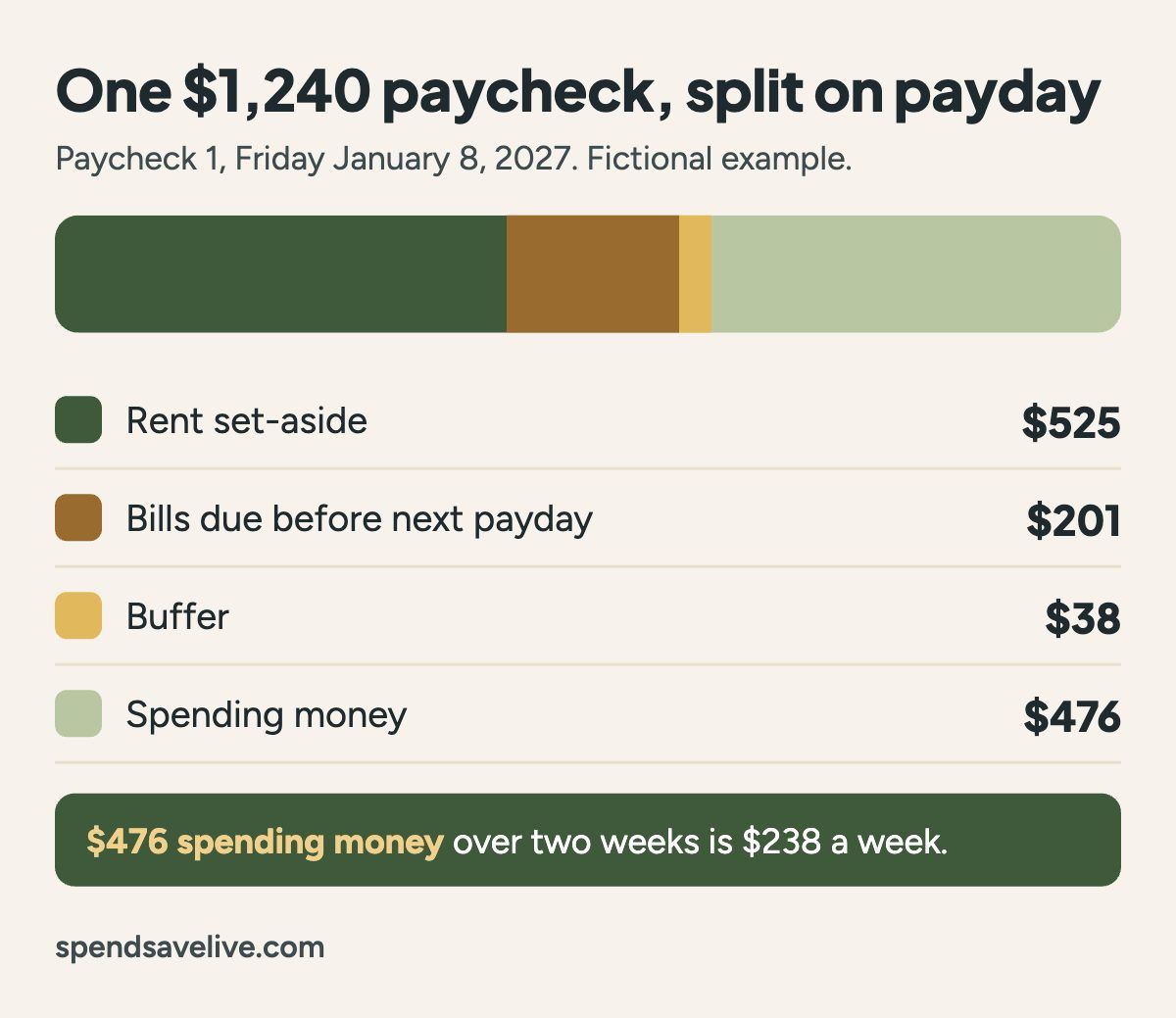
Setting aside half the rent from each check works a lot like the CFPB’s idea of splitting rent into two payments, without having to ask your landlord, and the first-of-the-month rent bill stops being a monthly heart attack.
Paid once a month? Use one column instead of two. Jordan’s numbers would be take-home $2,480, rent $1,050, bills $404, buffer $76 and spending money $950. If that check lands on January 29 and has to last through February 2027 (exactly four weeks), that’s $237.50 a week. Paid weekly? Do the same split on every check, with a quarter of the rent each time in a four-payday month.
Paying the bills first on payday is what made my money last in my chef years in Helsinki (I live in Finland, so my numbers are in euros). Bills first, then I lived on what was left. After rent, my phone and a monthly transport ticket, that was about €600 a month (roughly $660). Tracking it taught me two things. Chef pay is low, and the main reason I managed to save at all was that I was working so many hours I barely had time to spend anything.
Read more: All Spending and Budgeting guides
How Do You Check Your Budget Each Week Without Hating It?
Give it about ten minutes on the same day every week, and if you went over, take the extra off next week instead of starting over.
- Add up what you spent from your spending money since the last check.
- Compare it to the weekly amount.
- Adjust next week’s number by the difference, and carry the ending balance forward.
| Week | Plan | Spent |
|---|---|---|
| Jan 8 to 14 | $238 | $261 |
| Jan 15 to 21 | $215 | (next check) |
On Sunday January 17, Jordan sees $261 spent against $238, so $23 over. The next week drops to $215, and nothing else in the budget moves. That carry-forward is how the CFPB’s weekly cash flow budget works too: each week’s ending balance becomes the next week’s starting point.
Ten minutes is plenty to start. If a week goes badly off, don’t start a new budget, just make the next week’s number smaller and keep going.
What’s in the One-Page Budgeting for Beginners Worksheet?
The budgeting for beginners worksheet is one US letter page that follows Jordan’s month box for box, so you can fill in your own numbers in the same order.


What each part is for:
- Month and paydays. Three payday slots, for those three-paycheck months.
- Money in. Up to three paychecks plus other money, then total take-home.
- Money out. The five groups, three lines each, with a total for each group.
- Result. Take-home minus total out, with a tick for room left, exactly zero or short.
- If short. The five-step order from above as a tick list.
- Payday plan. Take-home, big bill set-aside, bills due, buffer, spending money and per week, for two paychecks.
- Weekly check. Five rows with weekly amount, spent, over or under and next week’s amount.
- Footer. A reminder to change it when real life changes.
And here are Jordan’s totals filled in:

Get the full one-page starter worksheet
The full printable PDF is coming soon. It will be free to SPEND • SAVE • LIVE readers.
Which Budgeting Method Should You Try After Your First Month?
Pick a method only after one month balances, because by then you know your real numbers and can tell which style fits them.
| Method | Who it suits |
|---|---|
| Zero-based | People who like giving every dollar a job |
| 50/30/20 | Anyone who wants three big buckets instead of many small ones |
| Cash envelopes | People who overspend on cards and like seeing money run out |
| Weekly | Anyone who spends most of their money in small daily amounts |
| Biweekly | People paid every other week who want bills matched to paychecks |
| Monthly planner | Paid monthly, or happy to plan the whole month at once |
What a Budget Can’t Do, and Where to Get Free Help
A budget shows you the gap, but it can’t close an income gap on its own, so if the numbers still don’t work after the cuts, it’s time to bring in help.
- Call 211 or search 211.org for local help with rent, utilities and food. United Way describes 211 as free, confidential and available 24/7.
- Talk to a nonprofit credit counselor through the NFCC agency finder. The CFPB explains what credit counseling is and the red flags to watch for, like being pushed into a debt plan before anyone looks at your budget.
- If you have to miss a payment, contact the creditor before it’s due, not after.
- If the gap is income, the budget has done its job by showing how big the gap is. The fix is more income or a lower fixed cost, not a tighter grocery list.
- New here? Start Here shows where everything on SPEND • SAVE • LIVE lives.
Cutting the extras first, like shopping and eating out, is the right order, but it only stretches so far, and there’s no shame in asking for help when it runs out.
Frequently Asked Questions
Do I need a budgeting app to start?
No. A notebook, a spreadsheet or one sheet of paper is enough for your first month. Once a month balances you can try an app if it saves you time, but check what it costs and what access to your accounts it asks for before you connect anything.
What are the 7 categories of a budget?
There’s no official set of seven. The CFPB’s spending tracker uses 12 lines and the Bureau of Labor Statistics uses its own groups. For a first budget, five broad groups are enough, and you can split them into more categories once a month balances.
How do I budget if I’m paid once a month?
Use one column instead of one per paycheck. From the single check, set aside all of next month’s rent, pay the month’s bills, move the buffer, then divide what’s left by the number of weeks until the next payday, four or five depending on the month.
How do I budget paycheck to paycheck?
Plan by paycheck instead of by month. From each check, set aside part of rent and pay the bills due before the next payday, protecting housing, utilities, insurance and getting to work first. The CFPB also suggests asking to move due dates to after payday.
How do I stick to a budget?
Keep it small enough to keep doing. A ten-minute weekly check, adjusting next week instead of quitting after a bad one, and updating the plan whenever your income or bills change will keep it going longer than a perfect plan you never open.
How do I start a budget when I’m already behind?
List everything that’s due, cover housing, utilities, insurance and getting to work first, and call any creditor you can’t pay before the due date. If you’re still short, call 211 for local help or talk to a nonprofit credit counselor through the NFCC.
What is the 50/20/30 budget rule?
It splits income into 50% for fixed expenses, 20% for financial goals like savings and 30% for flexible spending, as MIT Student Financial Services describes it. It’s easier to try once your first month balances and you know your real fixed costs.
What bills do most adults pay monthly?
Common monthly bills are housing and utilities, phone, internet, insurance, debt payments, groceries and transportation. In 2025 housing, transportation and food were the biggest shares of average US household spending, at 33.9%, 16.5% and 13.0%, according to the BLS.
Key Takeaways
- Start with take-home pay and what you really spent, not with a method.
- Five broad groups are enough for your first month.
- A short first result is normal. Trim flexible spending first and keep housing, utilities, insurance and getting to work covered.
- Plan by paycheck, then check in once a week and adjust the next week instead of quitting.
- Put bill due dates next to your paydays, so a month that balances on paper doesn’t run short in week two.
Your First Budget Only Has to Survive One Month
Remember all those apps with their own fan clubs? You didn’t need any of them. Take-home pay, a few weeks of real spending and one page got Jordan from $89 short to $76 left over, and the same order can work with your numbers too. When you’re ready for the next habit, start setting money aside for the costs you already know are coming. Then do it all again in February, a little faster this time.
Sources (checked November 2026)
- consumer.gov, Making a Budget
- CFPB, Spending tracker
- CFPB, Cash flow budget
- CFPB, Prioritizing bills
- CFPB, Improving cash flow
- CFPB, What is credit counseling?
- BLS, Consumer Expenditures in 2025
- MIT Student Financial Services, 50/20/30 strategy
- NFCC, Agency finder
- 211.org, Your local 211
- United Way, 211 overview
Jordan is a fictional example. All example totals were checked with a calculator script. Euro amounts are converted at the ECB rate of 16 November 2026 and are approximate.
Educational content, not financial advice.