

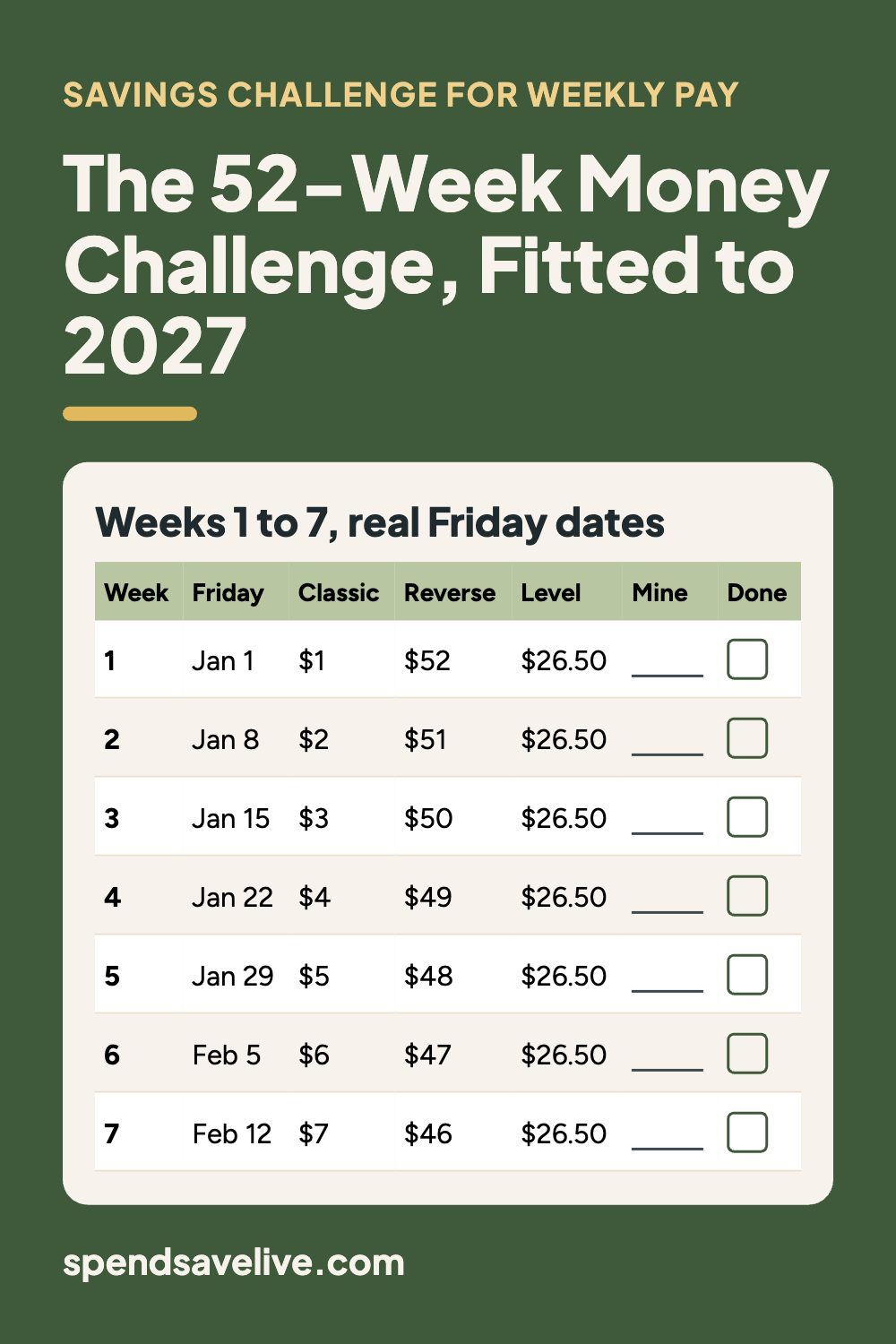
The classic 52-week savings challenge saves $1 in week 1, $2 in week 2, up to $52 in week 52, for $1,378 in total. Reverse, pick-a-box and level ($26.50 a week) orders reach the same $1,378. In the classic order, starting Friday, January 1, 2027, the $52 week lands on Christmas Eve, so pick the order your expensive months can carry.
The 52-week savings challenge is the one where you save $1 in the first week, $2 in the second and so on until week 52, and if you’ve ever tried it you probably know exactly where it falls apart (hint: somewhere around the week you’re buying gifts and the challenge suddenly wants $50 from you).
It’s also called the 52-week money challenge, and in this guide I put every version of it on the real 2027 calendar, show you what each one costs month by month, and give you a quick way to check it against your own months before January 1. There’s a preview of the 2027 tracker too (the full printable is coming soon).
Read this also:
- No-Spend January 2027 Rules That Leave Room for Real Life
- Budgeting for Beginners From the Money You Actually Have
- A Life Audit That Helps You Choose One Change for 2027
Is This Challenge for You? A Two-Minute Check
- You have a weekly or every-other-week payday you can tie a transfer to.
- You know roughly how much is left most weeks after bills.
- You know which months of your year are the expensive ones.
- You keep a small cushion in checking, so a $52 week won’t push you into an overdraft.
Answered no to two or more? Start smaller first, then come back. The half version ($689) in the table below, or a level amount you pick yourself, is a gentler way in.
What Is the 52-Week Savings Challenge, and How Much Does It Really Add Up To?
You save the week number in dollars, $1 up to $52, and after 52 weeks you have $1,378.
That number surprises people because the first weeks feel like nothing (a dollar, two dollars, who even notices), but 1 + 2 + 3 all the way to 52 adds up fast. If the classic version is too small or too big for you, scale the step instead of starting from scratch.
| Step size | Biggest week | Year total |
|---|---|---|
| $0.50 | $26 | $689 |
| $1 (classic) | $52 | $1,378 |
| $2 | $104 | $2,756 |
| $5 | $260 | $6,890 |
| $10 | $520 | $13,780 |
| Level $96.16 a week | $96.16 | $5,000.32 |
| Level $192.31 a week | $192.31 | $10,000.12 |
And here’s where the classic version stands at each quarter, which is a nice reality check because it shows how back-loaded it is:
- Week 13 (end of March): $91 saved
- Week 26 (end of June): $351 saved
- Week 39 (end of September): $780 saved
- Week 52 (Christmas Eve): $1,378 saved
So by the end of June you’ve saved about a quarter of the money, and the last three months bring in $598 of it. Keep that in mind for the next part.
Which 52-Week Order Won’t Wreck Your December?
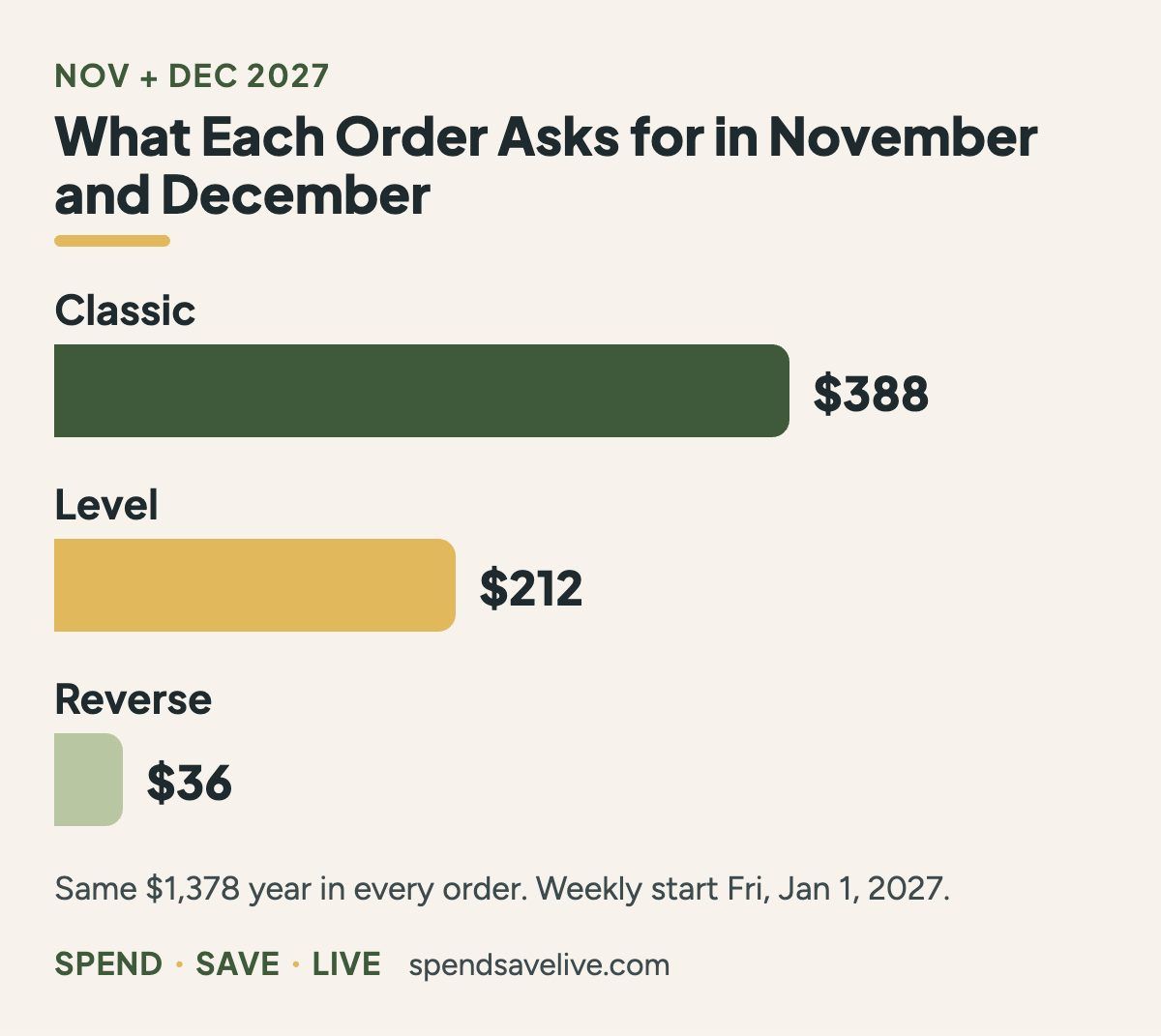
All four orders reach $1,378, they just move the heavy weeks to different months.
| Order | Biggest deposit | Nov + Dec 2027 |
|---|---|---|
| Classic ($1 up to $52) | $52 | $388 |
| Reverse ($52 down to $1) | $52 | $36 |
| Level ($26.50 a week) | $26.50 | $212 |
| Pick-a-box | $52 | Depends on your picks |
Classic, the Easy Start With a Heavy Finish
Week 1 is a single dollar, which is why most people start here. The catch is that November and December 2027 together ask for $388, which is 28% of the whole year, landing right when gifts and holiday plans want the same money.
The Reverse 52-Week Savings Challenge, for People Who’d Rather Suffer in January
You start with $52 and end with $1, so December is almost free ($10 for the four December weeks). The pain moves to January instead, when reverse asks for $250, right after the holiday bills arrive. If your January is calm and your December is chaos, this one is for you.
Level, the Boring One That Actually Works
You save $26.50 every single week, which also lands on $1,378. It has no spikes at all, and it’s the only order you can set up once in your bank app and then forget about.
Pick-a-Box, Fun but Needs a Cap
Each week you choose any amount from $1 to $52 that you haven’t used yet and cross it off. It’s flexible and kind of fun, but without a monthly cap it’s very easy to pick all the small boxes first and leave yourself $40 and $50 weeks in December, which is exactly what we’re trying to avoid.
What About Biweekly Pay?
If you’re paid every other week, you can pair the weeks up: 26 deposits from $3 up to $103, or a level $53 every payday, still $1,378 in total. Before you pick an order, count which months of 2027 bring you a third payday, because those months have extra room for the bigger boxes.
What Does Each Order Cost in Every Month of 2027?
2027 has 53 Fridays, so a challenge that starts Friday, January 1 ends Friday, December 24 and leaves December 31 as a spare.
January, April, July, October and December each have five Fridays, but only four of December’s Fridays are challenge weeks. This is the cost of the two uneven orders, month by month:
| Month | Classic | Reverse |
|---|---|---|
| Jan | $15 | $250 |
| Feb | $30 | $182 |
| Mar | $46 | $166 |
| Apr | $80 | $185 |
| May | $82 | $130 |
| Jun | $98 | $114 |
| Jul | $145 | $120 |
| Aug | $134 | $78 |
| Sep | $150 | $62 |
| Oct | $210 | $55 |
| Nov | $186 | $26 |
| Dec | $202 | $10 |
Level is easy to work out in your head. It’s $106 in a four-Friday month and $132.50 in a five-Friday month.
One calendar note. January 1, 2027 is a Federal Reserve holiday, so a transfer set for that day may only post on the next business day, Monday, January 4. Since Christmas falls on a Saturday, the Federal Reserve holiday schedule has Fed banks open on Friday, December 24. Your own bank sets its own posting rules, so check them before you schedule anything.
How Do You Check What Your Own Months Can Actually Afford?
Work out each month’s room, add the twelve numbers up, then hold every order next to your room and see which one never goes over.
- Write down what’s normally left in a week after rent, bills, food and gas. That’s your weekly spare.
- For each month, multiply your paydays by your weekly spare, then subtract the extra costs you already know are coming (gifts, renewals, registration). That’s the month’s room. If a bill is big and predictable, a sinking fund for each cost you can see coming keeps it from eating your challenge money.
- Add the twelve rooms together. Under $1,378? Choose the half version ($689), or take your room total and divide it by 52 for a level weekly amount. That’s the same ‘divide the total by the number of weeks’ method in the CFPB savings plan tool.
- Compare each order’s monthly cost with your room, and circle every month where it goes over. Putting your bills and paydays on a 2027 calendar next to it makes this much faster.
- Optional: build your own calendar-matched order with the pick-a-box grid. Write each month’s room at the top and only cross off boxes that fit.
The 2027 tracker has a fit-check page for exactly this (see the preview).
Worked Example With Jordan’s 2027 Challenge
Jordan has $1,470 of room over the year, which is more than $1,378, but only a calendar-matched order fits every single month.
Jordan is fictional, but the math is real. Jordan is a single renter paid every Friday, and after rent, bills, food and gas a normal week leaves $40. Jordan also knows a few extra costs are coming: $120 in January, $30 each in March, May, June and July, $90 in August, $40 each in September and October, $100 in November and $140 in December.
Room for each month is paydays times $40, minus those extra costs. Here’s how the four orders do against that room:
| Order | Months over room | Short by |
|---|---|---|
| Classic | 5 (Aug to Dec) | $412 |
| Reverse | 4 (Jan, Feb, Mar, Aug) | $236 |
| Level | 4 (Jan, Aug, Nov, Dec) | $180.50 |
| Calendar-matched | 0 | $0 |
So Jordan builds a calendar-matched order instead. Starting with $52 and working down, each amount goes into whichever month has the most room left, and inside each month the smaller amounts come first.
| Month | Room | Calendar-matched cost |
|---|---|---|
| Jan | $80 | $75 |
| Feb | $160 | $144 |
| Mar | $130 | $124 |
| Apr | $200 | $188 |
| May | $130 | $124 |
| Jun | $130 | $124 |
| Jul | $170 | $163 |
| Aug | $70 | $65 |
| Sep | $120 | $112 |
| Oct | $160 | $151 |
| Nov | $60 | $54 |
| Dec | $60 | $54 |
| Year | $1,470 | $1,378 |
Every month ends $5 to $16 ahead, and all 52 amounts get used exactly once. These are the boxes Jordan crosses off each month:
- Jan: $1, $4, $10, $24, $36
- Feb: $20, $32, $42, $50
- Mar: $13, $27, $37, $47
- Apr: $18, $30, $40, $48, $52
- May: $14, $26, $38, $46
- Jun: $15, $25, $39, $45
- Jul: $12, $22, $35, $43, $51
- Aug: $5, $8, $21, $31
- Sep: $11, $23, $34, $44
- Oct: $9, $19, $33, $41, $49
- Nov: $2, $7, $16, $29
- Dec: $3, $6, $17, $28
It looks a bit chaotic on paper, but it’s the only plan where Jordan never has to say ‘not this week’ to the challenge.
Missed a Week of the 52-Week Money Challenge? Here’s the Plan
A missed week doesn’t end the challenge, as long as you pick one of three fixes and write it down.
Back to Jordan. A car repair in August means skipping week 34 (Friday, August 20), which was a $21 box. Jordan has three options:
- Spread it. Add $5 to one week each in September, October and November, plus $6 on the spare Friday, December 31. Every month still stays inside its room, and the year total stays $1,378.
- Put it all on December 31. Tempting, but December only has $6 of room left in Jordan’s plan, so $21 would overdraw it. Jordan skips this one.
- Let it go. Jordan ends the year with $1,357 instead of $1,378, which is still $1,357 more than nothing.
Spreading it is the one I’d pick, but only because Jordan’s later months have room for it. Two rules either way: never double up in a month that has no room, and never take the catch-up money from your bill money.
And if missed weeks keep happening because life keeps throwing repairs at you, that’s a sign you need an emergency fund before (or next to) a savings challenge.
How Do You Set Up the Weekly Transfer So You Never Have to Remember It?
Set a recurring transfer for payday or the next business day, so the money moves before you can spend it.
- In your bank app, set up a recurring transfer from checking to savings. The CFPB notes you usually choose the amount and the date, often weekly or monthly.
- Pick a weekday. If you’re paid on a Friday, a transfer dated for Saturday may not post until Monday, so check your bank’s rules.
- If your employer offers it, you may also be able to split your direct deposit so part of each paycheck lands in savings automatically.
- Level is the only order you set once. For classic or reverse, change the amount each week, or move a monthly batch with the month’s total from the table above.
- Keep a small cushion in checking. If a transfer leaves too little behind, you can end up paying overdraft fees, and check any terms or fees your bank has for recurring transfers.
I don’t do a formal savings challenge myself. I’m paid monthly, and on payday itself scheduled transfers move money from my income account into separate pots, each a fixed percentage of my income: about half to the shared account for bills and the mortgage, a quarter to investing (that’s all I’ll say about investing here), and smaller shares for travel, gifts and my own spending. To me those are ‘no brainer things’, and in an expensive month I sometimes lower or pause one, but not always.
The point is the same as a weekly challenge though: the money moves before there’s a chance to spend it.
Where Should the Challenge Money Live (Hint, Not Next to Your Spending)?
Keep it in a separate, insured account you can reach in an emergency but won’t spend from by accident.
- Look at three things before you pick a place: how safe it is, what it costs to keep money there, and how quickly you can get to it. These are the same three the CFPB’s place-for-savings worksheet uses.
- Bank deposits are insured up to $250,000 per depositor, per FDIC-insured bank, for each account ownership category (FDIC). Federally insured credit unions cover accounts up to $250,000 too (NCUA).
- Any interest your savings earns is taxable income, and the IRS says you report it even if you don’t get a Form 1099-INT (IRS Topic 403).
My own pots (emergency fund, travel, gifts, self-care and the rest) are all separate for the same reason.
What’s in the 2027 52-Week Savings Challenge Printable Tracker?
It’s two US letter pages, a dated weekly tracker on page 1 and a monthly fit check with the pick-a-box grid and a missed-week log on page 2.
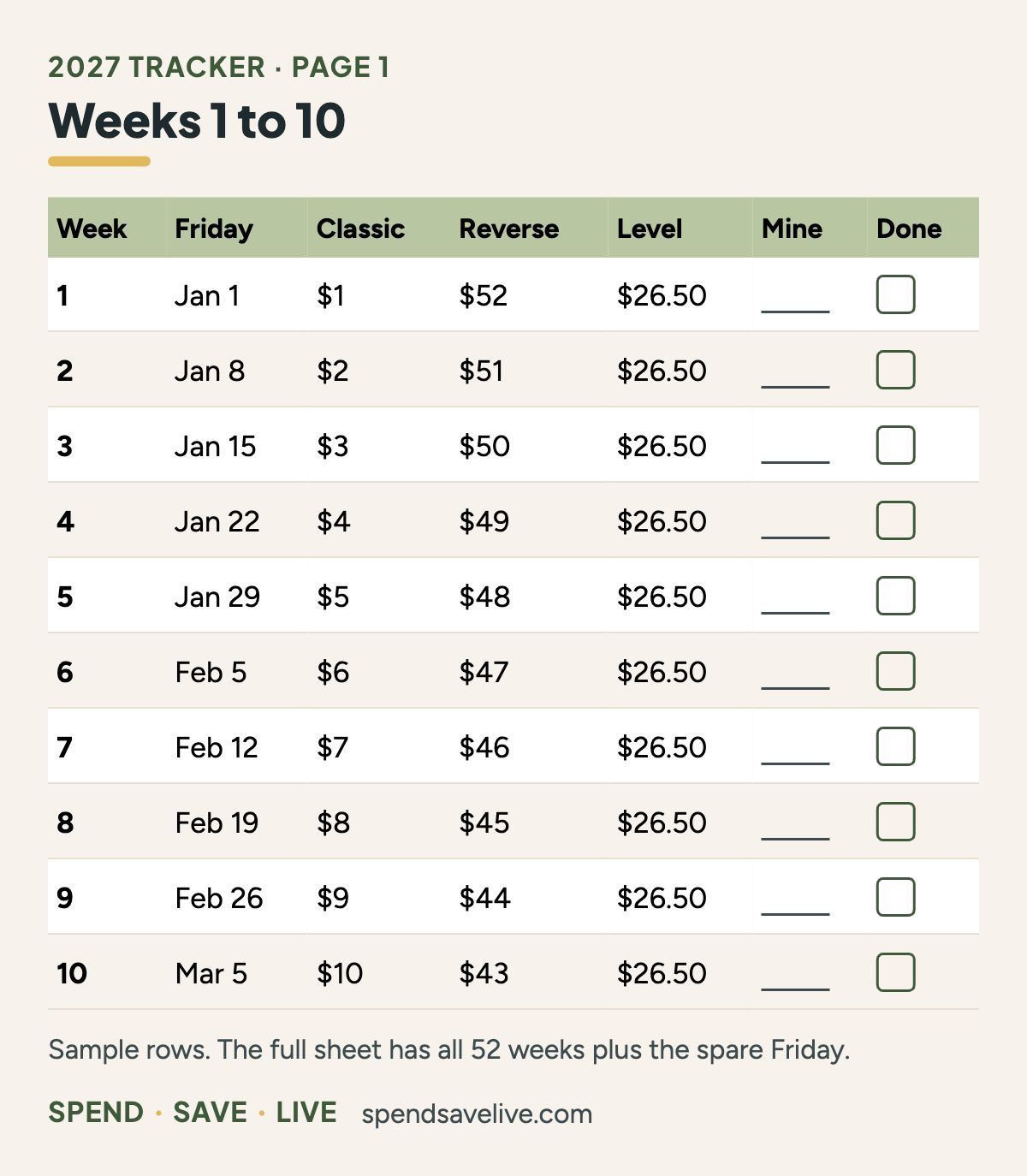
Page 1 has:
- All 52 Friday dates from January 1 to December 24, 2027
- The classic, reverse and level amount for every week, side by side
- A blank ‘mine’ column for pick-a-box or your own calendar-matched order
- A done box and a running total for each week
- A spare Friday row for December 31, for catching up
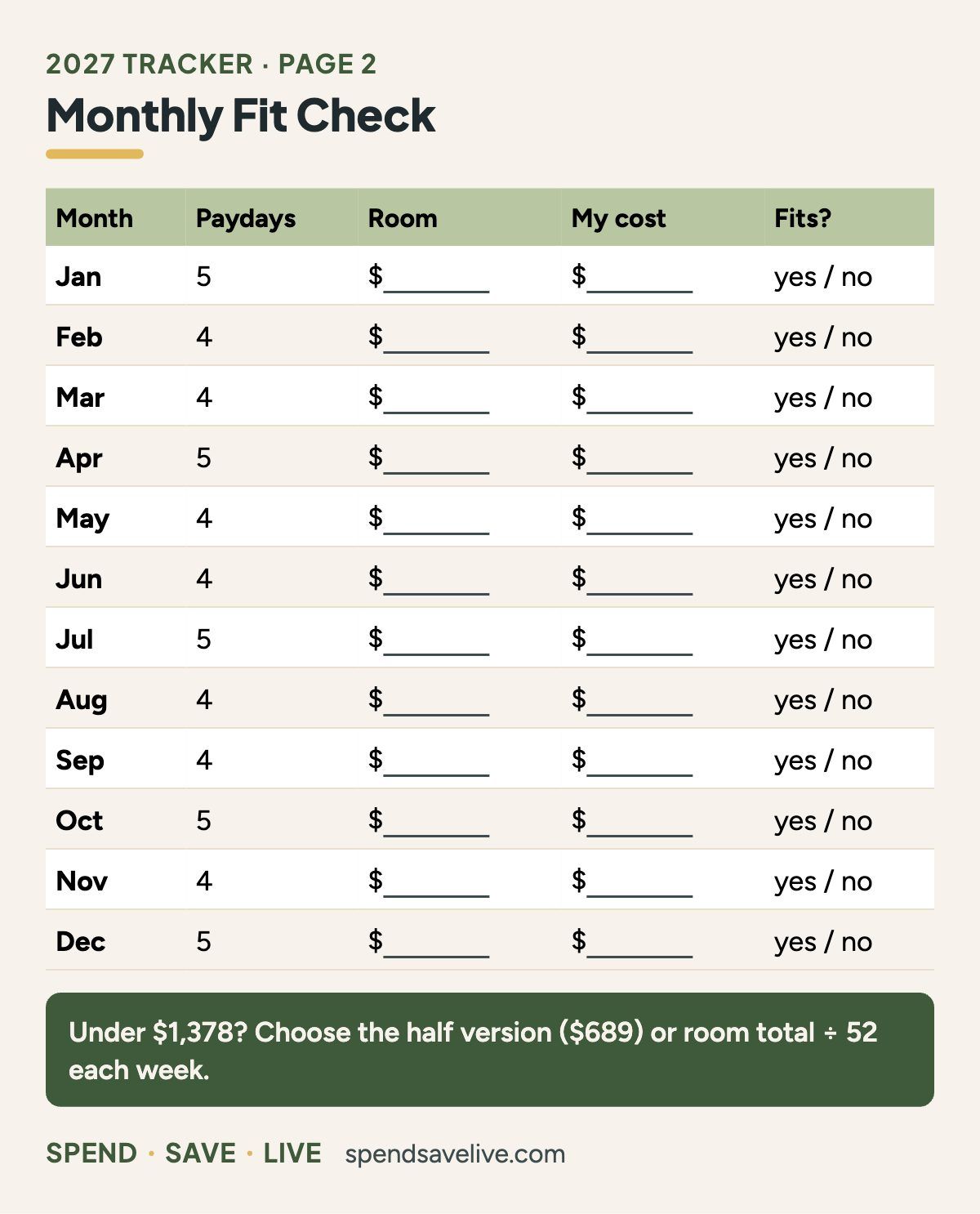

Page 2 has:
- A monthly fit check with weekly paydays for 2027 already filled in, plus columns for your spare, extra costs, room and your order’s cost
- A room-total box with the ‘under $1,378’ rule
- The pick-a-box grid, $1 to $52
- A missed-week log with the three catch-up options
How to use it:
- Fill in the fit check on page 2 before January 1.
- Circle the order that fits every month, or build your own with the grid.
- Write your goal total at the top of page 1.
- Set up your transfer and tick each week as it goes.
- If you miss a week, log it and pick a catch-up plan the same day.
The Full 2027 Tracker Is Coming Soon
The full printable PDF is coming soon. It will be free to SPEND • SAVE • LIVE readers.
What This Challenge Can’t Do, and Where to Get Real Help
A savings challenge builds a habit, but it can’t fix bills that already don’t fit, and $1,378 isn’t a full emergency fund.
If you’re short every month before the challenge even starts, these are better first steps:
- Call 211 or visit 211.org to look up local resources by zip code. It’s available 24/7.
- Talk to a nonprofit financial counselor through the NFCC agency finder.
- If you get public benefits, check the asset limits first, because savings can count. SSI’s resource limit is $2,000 for one person and $3,000 for a couple (SSA), and the CFPB asset limits worksheet lists other programs whose limits you can look up. A smaller plan, like the half version ($689), might fit better.
- New here? Start Here walks you through the basics, and the Saving and Money Goals and savings challenges pages collect everything in one place.
Frequently Asked Questions
How much is a 52 week savings challenge?
The classic version adds up to $1,378 over 52 weeks. With $2 steps it’s $2,756, and with $5 steps it’s $6,890. Changing the order (classic, reverse, level or pick-a-box) never changes the total, only which months carry the big deposits.
Is there a challenge to save $10,000 in 52 weeks?
Yes. Save a level $192.31 every week and you’ll have $10,000.12 after 52 weeks. Run the month check from this guide first, because that’s more than seven times what the classic version asks for.
How do you save $5,000 in 52 weeks?
Divide the goal by the number of weeks, which is the method the CFPB savings plan tool uses. $5,000 divided by 52 is $96.16 a week, which comes to $5,000.32 by the end of the year.
What is the best savings challenge?
The best one is the one you can still fund in your most expensive months. If the 52-week version doesn’t fit your room after bills, a smaller or shorter challenge that you finish beats a big one you drop in October.
How do I set up an automatic transfer from checking to savings?
Set a recurring transfer in your bank app for payday or the next business day, or ask your employer whether you can split your direct deposit. Keep a small cushion in checking, because a transfer that leaves too little behind can lead to overdraft fees.
What if I’m paid monthly?
Move each month’s total in one transfer on payday instead of 52 small ones. In the classic order that’s $15 in January 2027 up to $202 in December, and the level order is $106 in a four-Friday month and $132.50 in a five-Friday month.
Can I start the 52-week challenge later than January?
Yes. Any 52 weeks in a row work, so a start in early March ends in late February or early March 2028. Write your own Friday dates on the tracker and check your expensive months the same way.
What is the $27.39 rule?
It means saving $27.39 a day, which comes to $9,997.35 over 365 days. That’s $191.73 a week, so it’s almost the same as the level $10,000 version of the 52-week challenge, just counted daily.
Key Takeaways
- Every order saves the same $1,378. The order only changes when the money is due.
- The classic order asks for $388 in November and December 2027, while reverse asks for $250 in January.
- Test the orders against your own monthly room before January 1, not in October.
- A missed week has a plan, and the 53rd Friday of 2027 (December 31) is a free catch-up week.
Fifty-Two Fridays and a Calmer Christmas Eve
Set it up once in December, look at your fit check when the expensive months come around, and remember that a challenge you adjust in August still counts. See you on Christmas Eve with $1,378 (or $1,357, no judgment). If the full $1,378 feels like a stretch, the half version ($689) uses the same calendar with smaller boxes.
Sources (Checked November 2026)
- Federal Reserve Financial Services, holiday schedules
- CFPB, savings plan tool
- CFPB, make saving automatic
- CFPB, what is an overdraft
- CFPB, finding a place for savings
- FDIC, understanding deposit insurance
- NCUA, share insurance coverage
- IRS Topic 403, interest received
- SSA, SSI eligibility
- CFPB, savings and asset limits
- 211.org
- NFCC agency finder
- CFPB, Your Money, Your Goals toolkit
- All 52-week totals, 2027 dates and the worked example were calculated for this guide in November 2026.
Educational content, not financial advice.