

A life audit is a short check of the main areas of your life. On a life audit worksheet you score each area on how well it’s working and how much it matters right now, pick the biggest gap that fits your spare time and money, then write one dated next action for the coming week.
I start my own year-end review around the beginning of December, by hand, in a journal, and it takes me most of the month to think it all through. You don’t need a month. You need about 30 minutes, a pencil and a plan that ends somewhere small.
Below you’ll find the score key, a filled-in example from a fictional household, what’s on each page of the worksheet, and where to get help if a low score is really a crisis. It sits with our other resets and reviews in the Habits & Lifeplanning guides.

Read this also:
- No-Spend January 2027 Rules That Leave Room for Real Life
- A 52-Week Savings Challenge That Fits Your 2027 Cash Flow
- How to Start Sinking Funds for Costs You Know Are Coming
Set a timer before you start, because the whole point of this audit is that it actually ends.
In a crisis right now, with your safety, housing or money? Skip the scoring and go straight to where to get help.
Is This Life Audit for You, or Just One More Project?
It’s for you if your list of things to fix is longer than your week and you’d like one clear decision instead of a shiny new system.
Quick check. Answer yes or no:
- You want to change more than three things at once.
- You’ve started big plans before and quietly dropped them by February.
- You have 30 minutes and a pen this week.
- You’d rather leave with one clear decision than a color-coded system.
Two or more yeses and you’re in the right place. The usual trap with a big life review is that it turns into one more project, with ten goals and no first step, and this version is built to stop that from happening.
What Is a Life Audit, and What Does It Actually Decide?
A life audit is a short check of the main areas of your life that ends in one change for the next few weeks, not a verdict on your whole life.
You go through each area, give it a straight rating, and look for the spot where the distance between how it’s going and how much you care about it is biggest. If you’ve seen a wheel of life before, this is a close cousin, with a second score, a time-and-money check and a hard stop added on.
Why one change with a date? Because a plan that says when and where you’ll act tends to help more than a goal on its own. A review of 94 independent tests by psychologists Peter Gollwitzer and Paschal Sheeran found that these if-then plans (they call them implementation intentions) had a medium-to-large effect on reaching goals. One change is a lot easier to plan that carefully than ten.

Which Life Audit Categories Should You Score?
Score eight everyday areas, each with one plain question, and rename any that don’t fit your life.
- Money: Do I know what’s due this month?
- Work: Does my work, paid or unpaid, feel doable right now?
- Health and energy: How rested do I feel on most days?
- Home and admin: Are paperwork and routine chores under control? (A simple life admin checklist helps if this one scores low.)
- Relationships: Do I feel close to the people who matter to me?
- Time and rest: Do I get time that’s actually mine? (A time audit shows where the hours go.)
- Learning: Am I learning something I care about?
- Fun: When did I last do something just because it was fun?
Swap or merge any area that doesn’t fit, and there’s a blank “Other” row on the worksheet for the one we missed, but keep it to eight or fewer or the 30 minutes turn into an afternoon. If you want to go deeper on one area, a longer set of year-end reflection questions gives you more prompts than one line can.
Two boundaries keep this practical. Health and energy is how rested you feel, as you feel it, not a medical check. Home and admin means paperwork and chores, not a room makeover.
Health and energy is often the hardest area to score fairly, because it’s easy to be too hard on yourself there. If one area makes you want to argue with yourself, write the evidence line first and the score second. It’s a lot harder to be dramatic once the facts are on paper.
Read more: Goals and New Year guides
How Do You Do a Life Audit in 30 Minutes (Timer Included)?
Four timed steps, about 30 minutes in total, and then you stop.

- Score (10 minutes). For each area, give two scores from 1 to 5. Working now: 1 = not working, 3 = okay, 5 = working well. Matters now: 1 = not a focus this season, 5 = top of mind. Add one line of evidence, something that happened, not a feeling about yourself.
- Find the gap (5 minutes). Gap = Matters minus Working. Circle the biggest number. A tie is fine, step 3 sorts it out.
- Check time and money (10 minutes). Write how much spare time you have per week and how much spare money per month (zero is an honest answer). Then run the four-box tie-break on your biggest gap, or on each area if two tie: it fits my spare time, it fits my spare money, it makes another area easier, and I can start it this week. The area with the most ticks wins.
- Write one action (5 minutes). One change, one next action with a day, time and place, and a review date four weeks later. The CFPB’s Putting goals into action tool suggests the same moves for money goals: small steps, a deadline for each, and someone to check in with.
Then stop. I know, the other seven areas are still sitting there looking at you. They’ll keep until your review date.
What Does a Filled-In Life Audit Look Like?
Here’s a filled example from Jordan, a fictional household we made up for this guide, where two areas tie and the tie-break picks Money.
Jordan is 34, a shift lead at a distribution center, rents an apartment with a partner and has one child in first grade. Jordan does the audit on Sunday, December 27, 2026, and writes two limits at the top of the sheet: about 90 minutes of spare time a week, and $0 extra money a month, so whatever the change is, it has to be free.
| Area | Working / Matters | Gap |
|---|---|---|
| Money | 2 / 5 | 3 |
| Work | 3 / 3 | 0 |
| Health and energy | 2 / 4 | 2 |
| Home and admin | 2 / 4 | 2 |
| Relationships | 4 / 5 | 1 |
| Time and rest | 2 / 5 | 3 |
| Learning | 3 / 2 | -1 |
| Fun | 3 / 3 | 0 |
Jordan’s evidence lines, one per area:
- Money: “Paid two bills late in the fall because I didn’t see them coming.”
- Work: “Fine. Not where I want to spend energy right now.”
- Health and energy: “Tired most evenings.”
- Home and admin: “Paper mail piles up.”
- Relationships: “Good, want to keep it that way.”
- Time and rest: “Weekends disappear.”
- Learning: “Not a priority this year.”
- Fun: “Okay.”

Money and Time and rest both have a gap of 3, and both fit inside 90 minutes and $0. Money gets all four ticks, because knowing what’s due would also make weekends calmer, so Jordan picks Money and one change helps two areas at once.
- One change: a 20-minute bill check every Sunday evening in January.
- Next action: Sunday, January 3, 2027, 7:00 pm, kitchen table. List every bill due in January with its date and amount.
- Time cost: 20 minutes a week, well inside the 90-minute weekly limit (January 2027 has 5 Sundays, so 100 minutes in all).
- Review date: Sunday, January 31, 2027.
On January 3, Jordan’s list looks like this (fictional amounts):
| Bill | Amount |
|---|---|
| Rent | $1,250 |
| Electric | $96 |
| Phone | $65 |
| Car insurance | $142 |
| Streaming | $18 |
| Total due in January | $1,571 |
If Money ends up being your area too, put those due dates on a calendar where you’ll see them, and you can build your first budget once the bills stop surprising you. What Jordan did not do: start a budget app, a gym plan and a decluttering project in the same week.
How I Use This Myself
Goals do come out of my own review, just not always in the shape I planned. For 2026 I wanted to dress better without spending more money, so I built my vision board around that. I didn’t end up looking like my vision board, but I did look a lot better, and a lot more like me.
What’s in the Life Audit Worksheet?
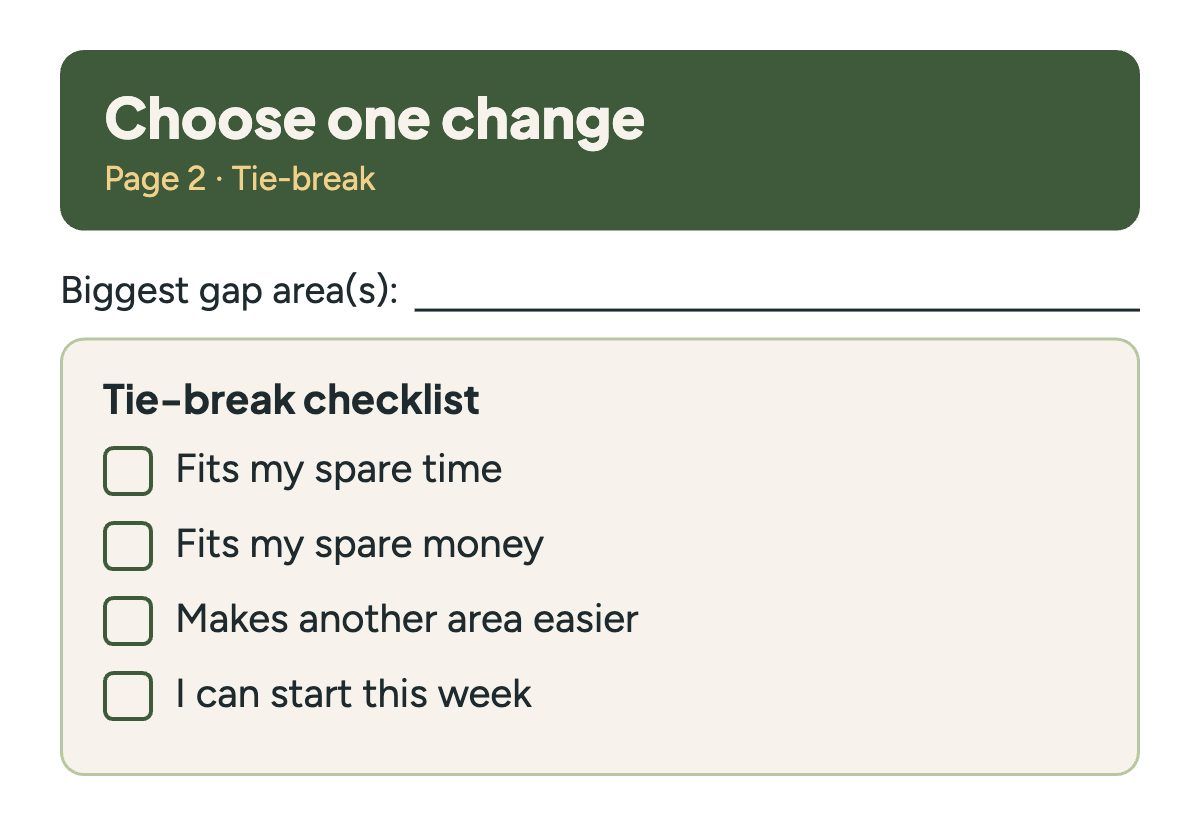
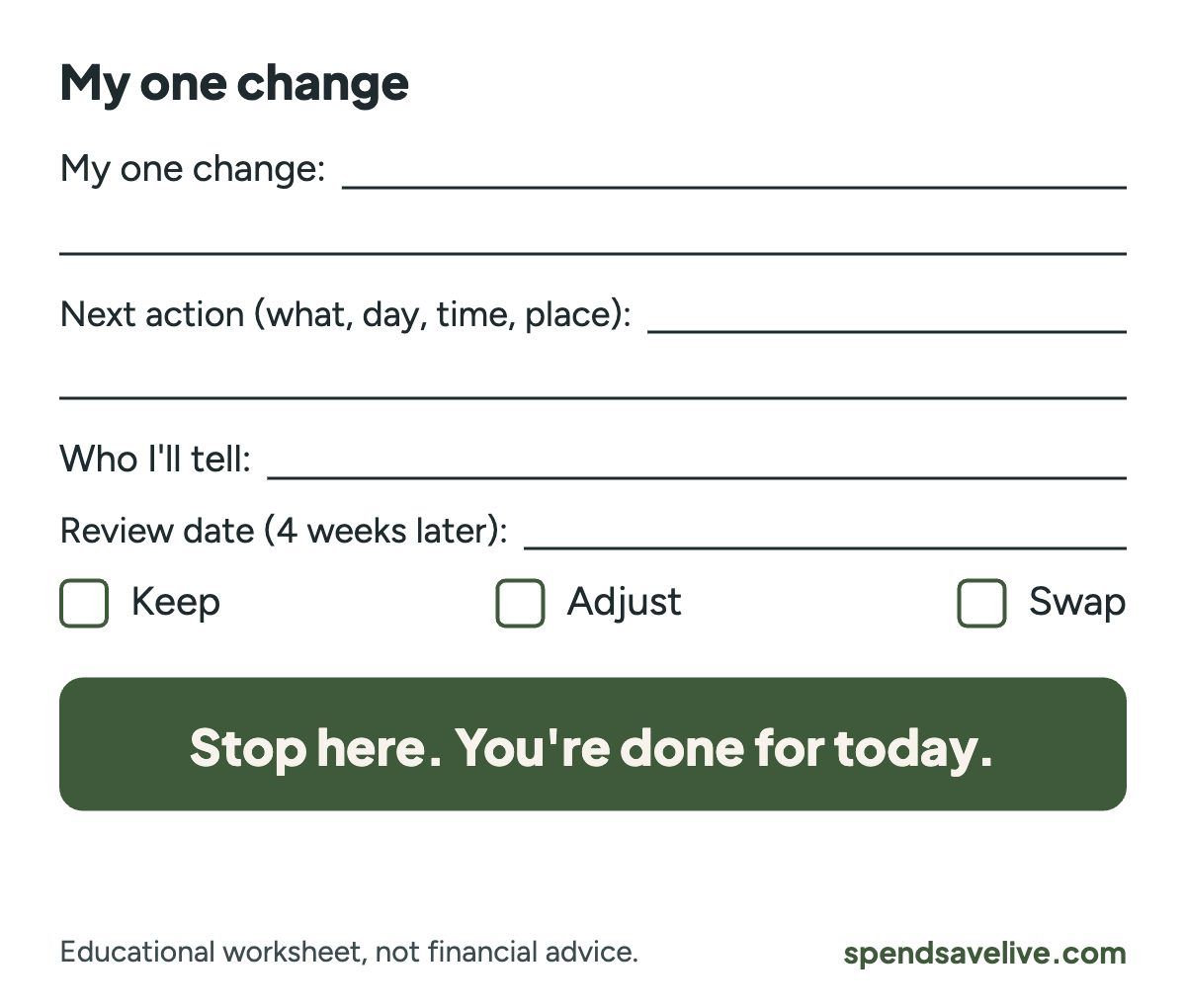
The life audit worksheet is two US letter pages: page 1 scores your areas, page 2 helps you choose one change and then tells you to stop.
- Page 1, Score your areas: lines for spare time per week and spare money per month, the 1 to 5 score key, the 8 areas plus a blank “Other” row, a one-line prompt for each, two scores, the gap and an evidence line.
- Page 2, Choose one change: your biggest gap, a four-box tie-break checklist, your one change, the next action, who you’ll tell, a review date with Keep, Adjust or Swap boxes, and an olive stop bar.
Get the Full Life Audit Worksheet
The full printable PDF is coming soon. It will be free to SPEND • SAVE • LIVE readers.
A small tip for when you have the printable: fill it in with a pencil, print at 100% scale, and keep a blank copy for your four-week review, because the second round is usually a lot quicker.
What If Every Area Scores Low (or None Do)?
When everything is low, start with the change that’s cheapest in time and money, not the one that matters most.
- Every area scores low? That usually means you’re in a tough season. Pick the smallest change you could do this week with the time and money you have, and let the big fixes wait until you have a bit more room. If the low scores come from a crisis, use the help list below first.
- No big gaps at all? Pick the area you most want to protect and give it one small maintenance action, like a standing call with a friend or a monthly check of your accounts.
- Can’t tell what matters? If every Matters score comes out a 4, write down what you’d protect first if your week got cut in half, and score again. And if your problem is a long wish list rather than low scores, circle three wishes before you audit and let the rest wait.
How Do You Make One Change Last Past January?
Put the next action in your calendar, tell one person, and check it on the review date before you even think about a second change.
- Put the day, time and place in your calendar right now, while the worksheet is still on the table.
- Tell one person what you’re doing and when you’ll check in.
- Track it lightly. A tick on a habit tracker or a calendar is plenty.
- Glance at it once a week. A short weekly review keeps that to a few minutes.
On your review date, pick one:
- Keep it if it’s working and still fits your week.
- Adjust it if the idea is right but the time or day isn’t.
- Swap it for the next gap on your sheet if it no longer matters.
Only after that do you add a second change.
If your change is about money, give it a number and a payday plan before you start. If it’s about time, find room in your week before you promise anything new.
Read more: Habits guides
What a Life Audit Can’t Do, and When to Get Help
A worksheet can’t fix a crisis, so if a low score comes from your safety, your health, your housing or your debt, talk to someone first and audit later.
- Your safety, mental health or substance use: call or text 988, or chat online, 24 hours a day. You don’t need to give payment or insurance information (988 Lifeline key messages, SAMHSA).
- Bills, housing, utilities or food: call 211 or search online for local help. It’s confidential and available 24/7 (211.org).
- Debt or a budget you can’t make work: an NFCC-certified nonprofit credit counselor offers a confidential session with no upfront fees (NFCC agency finder).
- Money goal worksheets: the CFPB has downloadable tools for setting and revising goals and tracking spending (CFPB Your Money, Your Goals tools).
- New here? Start Here shows you around SPEND • SAVE • LIVE.
Frequently Asked Questions
How do I do an audit of my life?
Score eight areas of your life twice, once for how well each is working and once for how much it matters right now. Circle the biggest gap that fits your spare time and money, write one next action with a date, then stop.
Is a life audit worth it?
It’s worth it when it ends in one action you actually take this week. A long list of everything that’s wrong isn’t the goal. One dated change you can check in four weeks is.
What are the categories for a life audit?
A simple set is money, work, health and energy, home and admin, relationships, time and rest, learning and fun. Rename or merge any that don’t fit your life, and keep it to eight or fewer.
How long does a life audit take?
About 30 minutes with this method: 10 to score, 5 to find the gap, 10 to check your time and money, and 5 to write one action. A deeper year-end review can take much longer, so set a timer if you want this one to end.
Can I use a worksheet to organize a life audit?
Yes, a worksheet keeps it short and makes it easy to compare with your next round. The SPEND • SAVE • LIVE life audit worksheet is coming soon, and this guide shows what’s on both pages.
How often should you do a life audit?
A full audit once or twice a year is plenty for most people. In between, check your one change on its review date every four weeks, or look back every quarter.
Key Takeaways
- Score each area twice: how well it’s working now, and how much it matters now.
- Pick the biggest gap that fits your real spare time and spare money.
- Write one next action with a day, time and place in the coming week.
- Review in four weeks, then decide Keep, Adjust or Swap. A second change waits until then.
One Change, One Date, Then Put the Pencil Down
A life audit is only useful if it ends, and ends small. Score your areas, circle one gap, write the date, and leave the other seven areas for your review day. If your one change turns out to be about saving for something, our money goals guides pick up right where this one stops.
Sources (checked November 2026)
- Gollwitzer, P. M., and Sheeran, P. (2006). Implementation intentions and goal achievement: a meta-analysis of effects and processes. Advances in Experimental Social Psychology, 38 (open copy)
- CFPB, Putting goals into action
- CFPB, Your Money, Your Goals tools
- SAMHSA, 988 key messages
- 211.org, Your local 211
- NFCC, Agency finder
Educational content, not financial advice.