

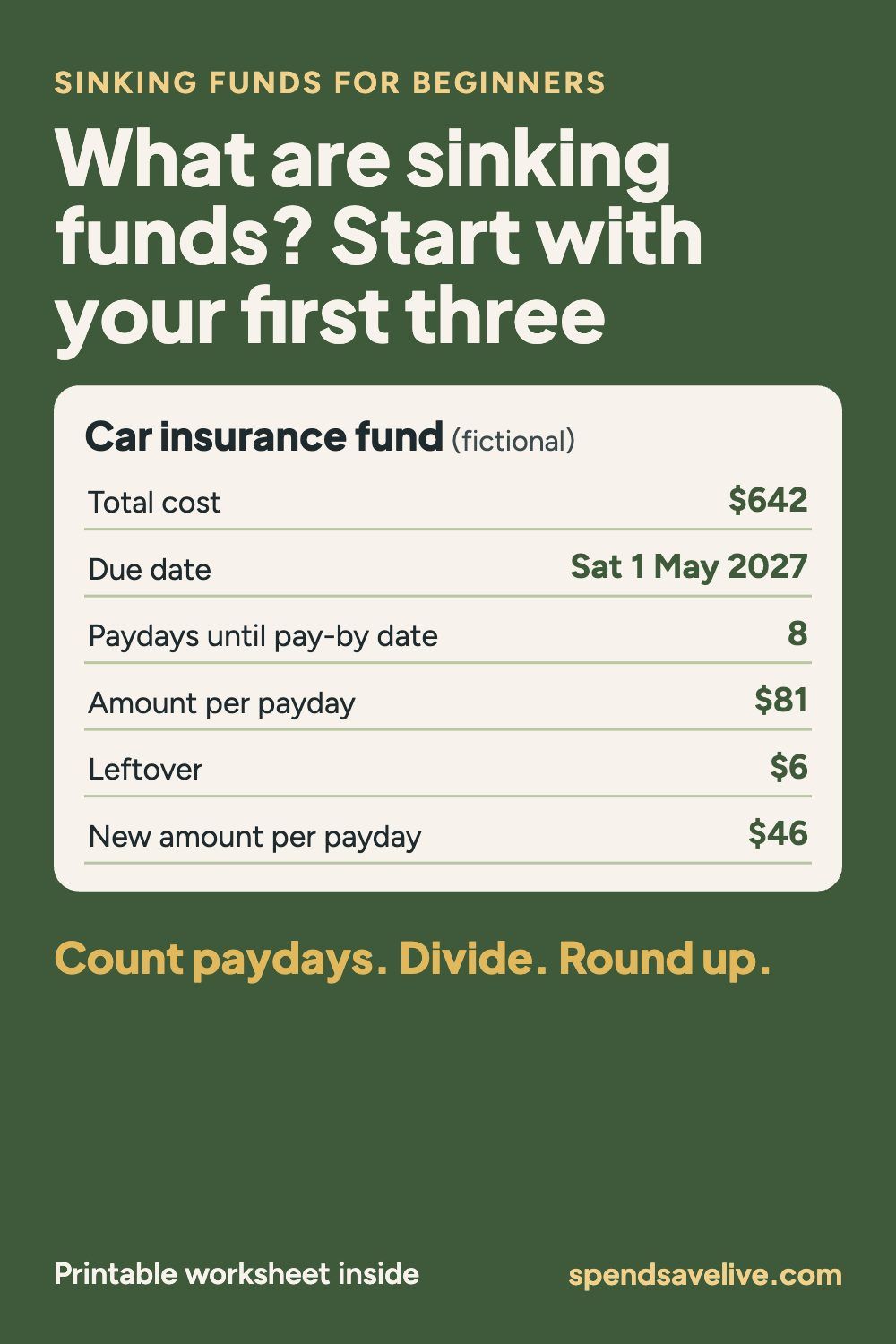
A sinking fund is money you set aside in small, regular amounts for a cost you know is coming. Start with three. Write each cost and its due date, count the paydays before it, divide, round up and move that amount every payday. When the bill comes, pay it from the fund and restart the count.
Car insurance renewals, back-to-school shopping, holiday gifts: you can see them on the calendar months ahead, and they still manage to land like an emergency. This guide to sinking funds for beginners spreads each one across your paydays, using a fictional family and real 2027 dates.
I learned this the expensive way (hello, yearly bills that caught me off guard). The worst one was tax. I live in Finland, and in the years I forgot to adjust my tax card and earned a bit more than I estimated, I didn’t get a refund, I got a bill the next year. One year it was €2,000 (about $2,200 at today’s rate).
Read this also:
- A Life Audit That Helps You Choose One Change for 2027
- A 52-Week Savings Challenge That Fits Your 2027 Cash Flow
- No-Spend January 2027 Rules That Leave Room for Real Life
You don’t need my exact tax story to get the point, because the Federal Reserve’s latest household survey found that 63% of US adults would cover a surprise $400 expense with cash or its equivalent, which means more than a third would not (Fed SHED 2025). A cost you could have seen coming shouldn’t be fighting your real emergencies for that same thin cushion.
Is this for you? A 30-second check. If you say yes to two or more of these, keep reading:
- In the last year you paid a bill you knew was coming from your savings or a credit card.
- You have at least one cost that isn’t monthly (insurance, school costs, gifts, renewals).
- You get paid on a schedule, weekly, every other week, twice a month or monthly.
- You can spare even $10 a paycheck without missing rent or groceries.
If you’re already behind on rent, utilities or debt payments, start with the help section first, because a sinking fund can’t fix a gap that big and you deserve proper help with that.
What Are Sinking Funds in Budgeting (Not the Bond Kind)?
In a budget, a sinking fund is money you save in regular amounts for one planned cost that has a date attached to it.
That date is the whole difference between a sinking fund and a general “I should save more” goal. A vague savings goal can wait until next month, but a six-month car insurance premium or the back-to-school shopping trip arrives whether you’re ready or not, and there’s an actual bill waiting at the end of it.
You’ll also see “sinking fund” in finance news, where it means money a company or government puts aside to pay back a bond over time. Same idea, totally different scale, and not what this post is about.
How Is a Sinking Fund Different From Your Emergency Fund (and Why It Matters)?
An emergency fund covers costs you can’t plan for, while a sinking fund covers planned costs with a due date.
The CFPB describes an emergency fund as cash set aside for unplanned expenses or financial emergencies (CFPB emergency fund guide), think a surprise car repair or a job loss. Your car insurance renewal isn’t a surprise, though. It usually arrives with a renewal letter that has the date and the amount right there on it.
When the known bills get paid out of the emergency money, the cushion shrinks every few months for things that were never emergencies, and then the real surprise hits an account that’s already half empty. Giving each dated cost its own fund keeps sinking funds apart from emergency savings, so each pile of money has one job.
How to Start Sinking Funds for Beginners Without a Spreadsheet Habit
You start sinking funds in five steps, and only step 4 has any math in it.
- List the costs that aren’t monthly. Go through last year’s bank statements or calendar and write down anything that hit once, twice or a few times a year. A few prompts to jog your memory:
- car insurance paid every 6 or 12 months
- car registration
- school costs
- holiday gifts
- annual subscriptions
- copays you can predict
- a yearly vet checkup
- birthdays
- Pick your first three. Start with the nearest due dates and the costs that can’t move (a fixed date and a fixed amount means high priority). If your list is long, park the rest and add them one at a time later.
- Write down the cost, what you’ve already saved and the due date. If the bill gets paid online, your real deadline is a few days earlier, which is why the worksheet has a pay-by date.
- Count your paydays, divide and round up. The CFPB savings plan tool divides a goal by the number of weeks you have to save (CFPB Savings plan tool). We do the same thing with paydays, counted up to 3 days before the due date, because the CFPB bill calendar suggests marking online payments 3 days early (CFPB Bill calendar). Round up to the next dollar so you finish slightly ahead, not slightly short. A full year usually has 52 paydays if you’re paid weekly, 26 every other week, 24 twice a month and 12 monthly, so count your own pay dates instead of assuming every other week.
- Automate the transfer. Set a recurring transfer for payday and a balance alert, both of which the CFPB guide suggests (it also warns not to leave your checking account short, so pick an amount that still covers your bills).

This last step is how I do it myself. On payday, automatic transfers go from my income account to separate pots, each a fixed percentage of my pay, so it’s a no-brainer. The fixed costs came first, and as I earned more I added percentages for fun stuff like a “self-love” budget. Whatever is left in a pot after a bill just stays there.
What Does a Sinking Fund Example Look Like on Real Paydays?
Three funds cost the fictional Carters $122 a payday until their first bill is paid.
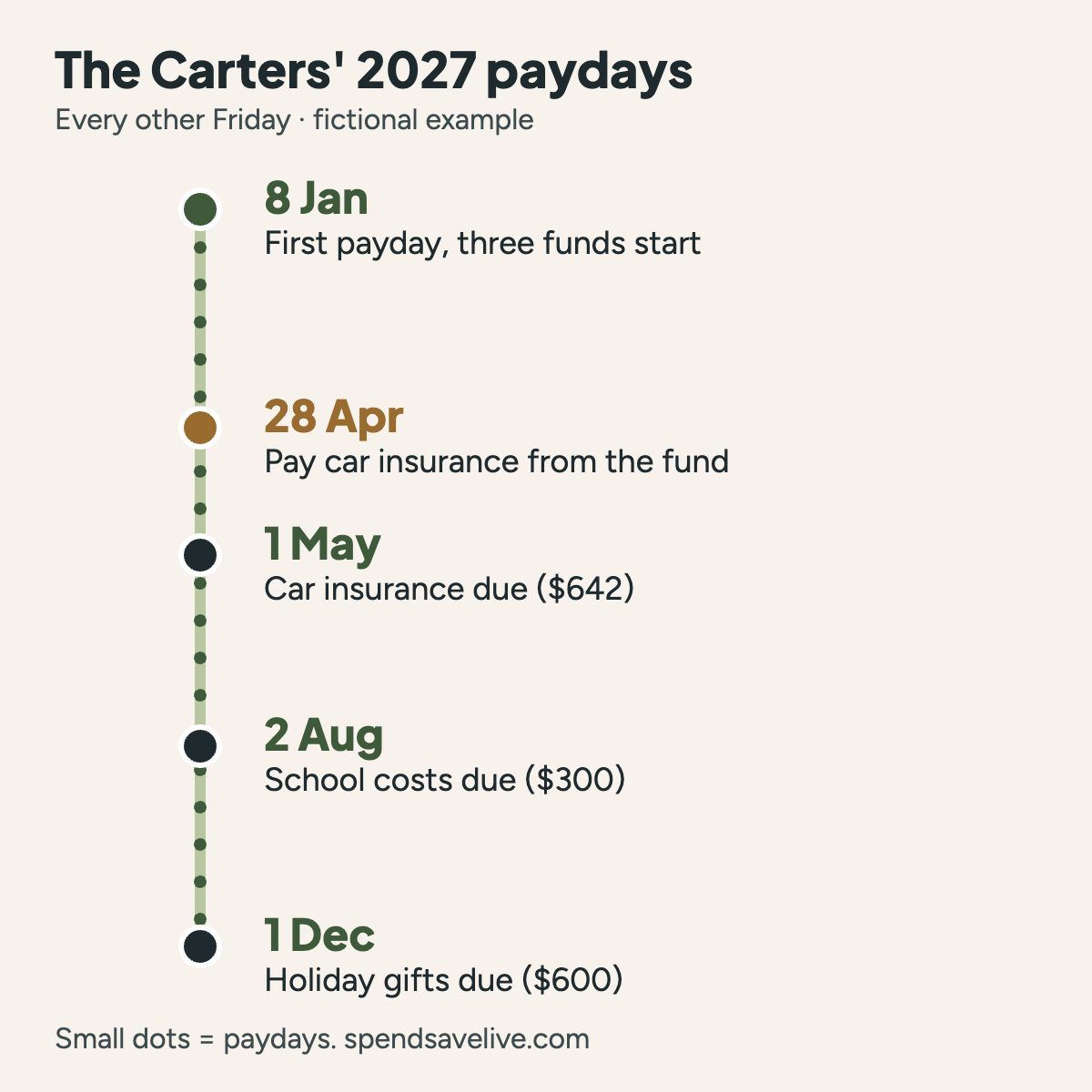
Fictional numbers, your costs will differ. The Carters are two adults and one school-age child with a combined $2,400 take-home pay every other Friday, and their first payday of 2027 is Friday, January 8. They start three funds that day.
| Fund | Cost left | Due date |
|---|---|---|
| Car insurance | $642 | Sat, May 1, 2027 |
| Back-to-school | $300 | Mon, Aug 2, 2027 |
| Holiday gifts | $500 ($600 minus $100 already saved) | Wed, Dec 1, 2027 |
Next, they count the paydays from January 8 up to 3 days before each due date, divide the cost left and round up:
| Fund | Paydays | Per payday |
|---|---|---|
| Car insurance | 8 | $81 ($642 ÷ 8 = $80.25) |
| Back-to-school | 15 | $20 |
| Holiday gifts | 24 | $21 ($500 ÷ 24 = $20.83) |
| Total | $122 |
Saved by each due date:
- Car insurance: $648 (8 × $81)
- Back-to-school: $300 (15 × $20)
- Holiday gifts: $604 ($100 + 24 × $21)
That $122 is about 5.1% of their $2,400 paycheck. Notice the car insurance fund costs four times more per payday than the other two, only because it’s due first. Once that bill is paid, the total drops a lot (more on that in a second).
Paid monthly instead? Say the Carters were paid on the last business day of each month. Only three paydays (January 29, February 26 and March 31) land before the April 28 pay-by date, so the car insurance fund would need $642 ÷ 3 = $214 a payday. Fewer paydays means bigger transfers, which is why the soonest fund deserves the earliest start.
What’s in the First Three Sinking Funds Worksheet?
It’s one page that turns your first three funds into one number per payday, with room to track the bill and restart the count.
Here’s what each part of the sheet looks like, shown in big readable pieces so you can see the details on your phone.

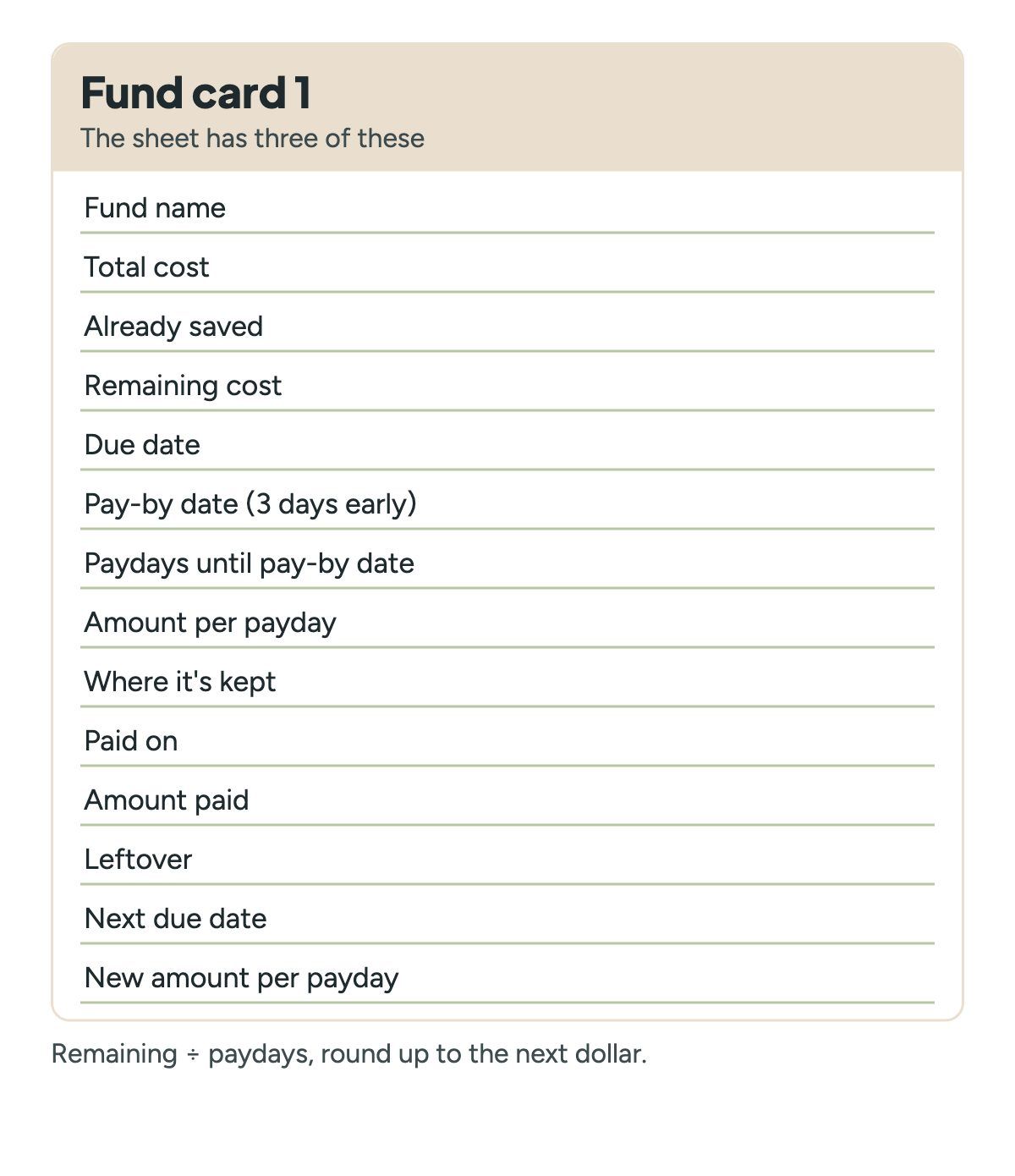
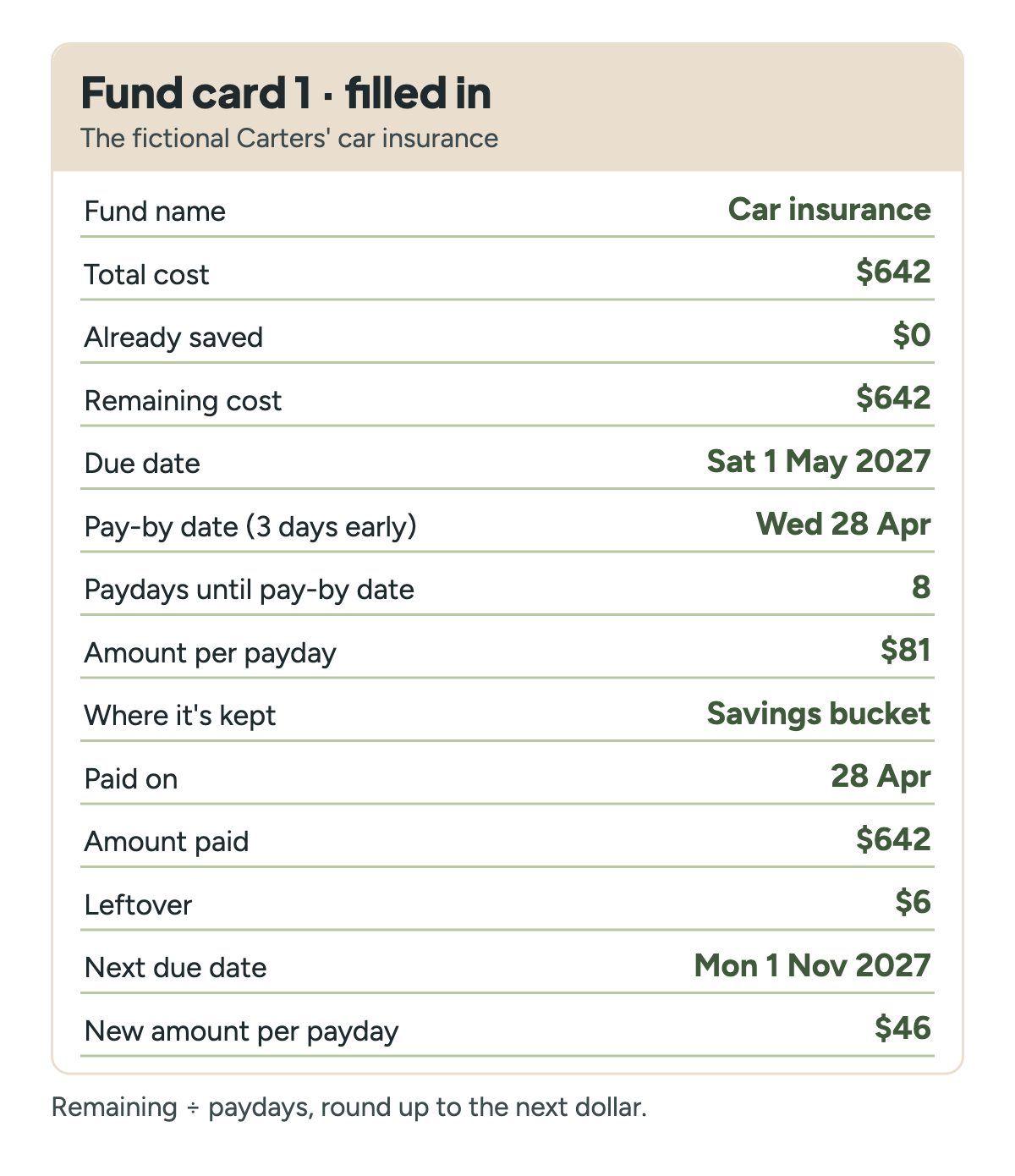
To try it, copy the Carter numbers into the first card before you use your own: write $642 as the total cost, $0 already saved, May 1 as the due date and April 28 as the pay-by date, then count 8 paydays and you land on $81. Here’s that card filled in:
What’s on the page:
- At the top: your start date, how often you’re paid (weekly, every other week, twice a month or monthly) and your next payday, plus a “costs that aren’t monthly” checklist.
- In the middle: three fund cards, each running from total cost to new amount per payday, so one card covers a full lap of the fund.
- At the bottom: your total per payday, a “does this fit?” check and a reminder to set the recurring transfer.
Get the full First Three Sinking Funds Worksheet
The full printable PDF is coming soon. It will be free to SPEND • SAVE • LIVE readers.
What Happens When the Bill Finally Shows Up?
You pay it from the fund, keep whatever’s left in there and restart the count for the next due date.
Here’s one full lap of the Carters’ car insurance fund:
- By April 16 the fund holds $648 (8 paydays × $81).
- They pay the $642 premium from the fund by April 28, 3 days early.
- The $6 left over stays in the fund.
- The next premium is due November 1, 2027, which gives them 14 paydays (April 30 to October 29).
- New amount: ($642 − $6) ÷ 14 = $45.43, rounded up to $46 a payday.

If the renewal letter shows a higher price, do the math again. Say the premium goes up 4% to $667.68: ($667.68 − $6) ÷ 14 = $47.26, so the new amount is $48 a payday. Mildly annoying, but it’s one quick recount.
And because the car fund dropped from $81 to $46, the Carters’ total per payday drops too:
- From April 30 to July 23: $46 + $20 + $21 = $87
- From July 30, when the school fund is done: $46 + $21 = $67
Leftovers can simply stay in the fund and count toward the next round, which is the easiest way to handle them. If you want a record of every deposit and withdrawal, a simple ledger with the date, amount in, amount out and balance does the job.
What If I Have to Use the Money Early?
If it’s a real emergency and you have nothing else to cover it, use it, write down what you took and rebuild it over the paydays you have left.
Say the Carters have a $200 car repair in June and no emergency fund yet. The holiday fund holds $352 by then ($100 + 12 paydays × $21), so they take the $200 from it. Twelve paydays are left before the November 28 pay-by date (June 25 to November 26), so they add $200 ÷ 12 = $16.67, rounded up to $17, to the usual $21:
- New holiday amount: $21 + $17 = $38 a payday until November 26
- Balance by then: $352 − $200 + 12 × $38 = $608, enough for the $600 budget
Two other things that trip people up:
- The bill is bigger than the fund. Pay the gap from checking if you can, then recount the next round with the new price, the same way as the insurance renewal above.
- You’re starting mid-year. Count only the paydays you have left before each due date. If a bill is due soon and the amount per payday is too high, save what you can for this one and start the full count right after it.
What If the Total Doesn’t Fit My Budget?
Shrink or move the flexible funds first and keep the fixed-date one whole, because that’s the bill that won’t wait.
If $122 a payday made you choke on your coffee, that’s normal for the first few months, when the soonest bill is eating most of the total. A few ways to make it fit:
- Order by due date: fund the nearest fixed bill fully and let the later ones start smaller (they’ll need a little more per payday once the first bill is paid).
- Cut a flexible target. If the Carters lower the holiday budget from $600 to $400, they need $300 more instead of $500. $300 ÷ 24 = $12.50, rounded up to $13, and the total drops from $122 to $114.
- Push a flexible date where you can. A gift budget usually has more give than an insurance bill.
- Start with one or two funds instead of three. Three is a good target, but nobody is grading you.
- Use an extra paycheck. If you’re paid every other week, two months of the year usually have three paydays (for the Carters in 2027, that’s April and October), and that third check can top up a fund.
The CFPB savings plan tool suggests brainstorming ways to spend less or earn more to hit a savings target (CFPB Savings plan tool), and you can redo this math any time a price or a date changes. If you keep a monthly budget, give each fund its own line next to your regular categories.
Where Should I Keep My First Sinking Funds?
A separate savings account, or labeled savings buckets at your bank or credit union, works well for most beginners.
The point is that the money sits out of your everyday spending account, so you don’t accidentally eat the car insurance money at the grocery store. At an FDIC-insured bank, deposit insurance covers $250,000 per depositor, per insured bank, for each account ownership category, and investments like stocks and crypto aren’t deposits, so they aren’t covered (FDIC deposit insurance). At a federally insured credit union, the NCUA’s Share Insurance Fund insures individual accounts up to $250,000 (NCUA Share Insurance Fund). Sinking fund money is for short-term, dated bills, so keep it somewhere simple and boring.
Paying each bill straight from its fund keeps things simple, and a shared bill can come from a shared account. You don’t need ten accounts for this: one savings account with labeled buckets, if your bank offers them, is often enough.
What a Sinking Fund Can’t Do, and When to Get Help
A sinking fund can’t fix income that doesn’t cover your essentials, and if that’s where you are, free help is a better first step.
If you’re behind on rent, utilities or a debt payment, or the math above only works if you skip groceries, please don’t force it. These are good places to start:
- The CFPB Prioritizing bills tool helps you decide which bills to pay first, and it says plainly: “Don’t ignore bills you can’t pay.”
- NFCC connects you with nonprofit credit counseling (877-360-6322).
- 211 connects you with local help with bills, housing and food.
- If a tax bill is your yearly surprise, the IRS Tax Withholding Estimator helps you check how much tax your employer should withhold.
Once things feel steadier, the Start Here page shows where to go next.
Frequently Asked Questions
Can I use a sinking fund for an emergency?
If it’s a real emergency and you have no emergency fund yet, yes. Write down what you took and add it back over the paydays left before that fund’s bill, so the bill is still covered.
What is a sinking fund?
In a budget, a sinking fund is money you save in regular amounts for a planned cost with a due date. In finance news, the term also means money set aside to repay a bond.
What are some good sinking funds to have?
Start with the costs that aren’t monthly from last year, like car insurance, school costs, holiday gifts and annual subscriptions, and pick the three with the nearest fixed due dates.
What if I’m paid monthly?
Count your monthly paydays the same way. You’ll have fewer of them before each due date, so each transfer is bigger. In the Carter example, monthly pay leaves three paydays before the car insurance pay-by date, so that fund needs $214 a month instead of $81 every other week.
How many sinking funds should I have?
There’s no official number. Three is a good start because it’s enough to cover your nearest bills and few enough to manage. If you already have too many, simplify before you add more.
Do sinking funds count as savings?
Yes, they’re savings, but the money already has a job. Don’t count it as your emergency cushion, because it’s promised to a bill.
How much money should you have in a sinking fund?
Enough to pay its bill on the due date. Divide the cost left by the paydays until then and round up, so the fund is full a little before the bill arrives.
Key Takeaways
- A sinking fund is for a cost with a date. An emergency fund is for the stuff you can’t see coming.
- Start with three funds: count the paydays to each due date, divide the cost left and round up.
- The fund due soonest costs the most per payday, so don’t panic when that number looks big.
- When the bill comes, pay it from the fund, keep the leftover and restart the count for the next due date.
One Bill, One Count and a Very Smug Future You
Remember that bill you knew about all year that still landed like an emergency? Here’s your homework (the fun kind, I promise): grab one bill you know is coming in 2027, count the paydays until it’s due, divide, round up and set that transfer before your next payday. Your future self, standing there with a renewal letter, will be very smug about it, and if you don’t have a budget to put these funds in yet, start with budgeting for beginners.
Sources (checked November 2026)
- Federal Reserve, Economic Well-Being of U.S. Households in 2025 (May 2026)
- CFPB, An essential guide to building an emergency fund
- CFPB, Your Money, Your Goals: Savings plan tool
- CFPB, Your Money, Your Goals: Bill calendar
- CFPB, Your Money, Your Goals: Prioritizing bills
- FDIC, Understanding deposit insurance
- NCUA, Share Insurance Fund overview
- National Foundation for Credit Counseling
- 211.org
- IRS, Tax Withholding Estimator
- Worked example and 2027 payday calendar: SPEND • SAVE • LIVE calculations, fictional household.
Educational content, not financial advice. The Carters are a fictional household and their numbers are examples only.