

No spend January is a 31-day pause on non-essential spending. You still pay bills, buy groceries and replace things that break, but you write those exceptions down first. At the end of January, you count what you actually kept, subtract anything you only postponed, and move that money to one named goal.
Plan a no spend January on January 2nd, right after the holiday card bill lands, and it usually falls apart by the second weekend (the plan was “buy nothing”, and then the kid’s boots split). This guide sets the rules up before January 1, with your essentials protected and a short list of real-life exceptions written down in advance.
Then comes the part most challenge posts skip, which is a February 1 money check that counts only the cash you actually kept, so the month ends with a real number moved to one goal instead of a vague “I think I saved?” If you want the printable first, see what’s in the No Spend January 2027 printable.

Read this also:
- Budgeting for Beginners From the Money You Actually Have
- A 52-Week Savings Challenge That Fits Your 2027 Cash Flow
- A Life Audit That Helps You Choose One Change for 2027
Before you write a single rule, grab your November bank statement and a pen, because the whole month hangs on one number you’ll find there (your baseline), and everything below builds on it.
What Is No Spend January (and Is No Buy January the Same Thing)?
No spend January is a month you set for yourself where you only spend on essentials and on the exceptions you wrote down beforehand, and “no buy January” is the same idea under another name.
Nobody runs it and there’s no official rulebook, which is good news, because it means you get to write rules that fit your actual life.
- A no-spend day is a day with no spending outside your essentials and your written exceptions. Paying rent on the 1st still counts as a no-spend day.
- Essentials are the bills and basics that keep your life running (more on those below).
- Extras are everything you could pause for 31 days without anything breaking, like takeout, online shopping or one more lipstick.
Some people stretch the idea over a whole year or go for a softer low-buy version with limits instead of a full pause, and if that sounds more like you, here’s how to choose between a low-spend or no-spend year. This post stays with January, and it lives in our no-spend and impulse buys guides, part of Spending & Budgeting.
Is a No Spend January Right for You This Year?
It fits if your January income covers your bills and you can name one thing the saved money is for.
Run through these five before you commit. If you can say yes to all of them, you’re ready, and if one is a no, fix that first.
Is this for you?
- My January income covers my bills and minimum payments.
- I know my January due dates, including any estimated tax payment due January 15, 2027 if I pay estimated tax.
- I can name one goal for the money, with a dollar target.
- I’m not carrying a credit card balance to cover groceries or bills right now.
- Everyone I share money with has agreed to try it.
If your essentials already cost more than your income, a spending pause won’t close that gap, and that’s not a willpower problem. Start with a bare-bones budget instead, and look at where to get help below.
What Do You Need to Set Up Before January 1?
Before the month starts, you need a baseline number and one goal, plus your January dates on paper.
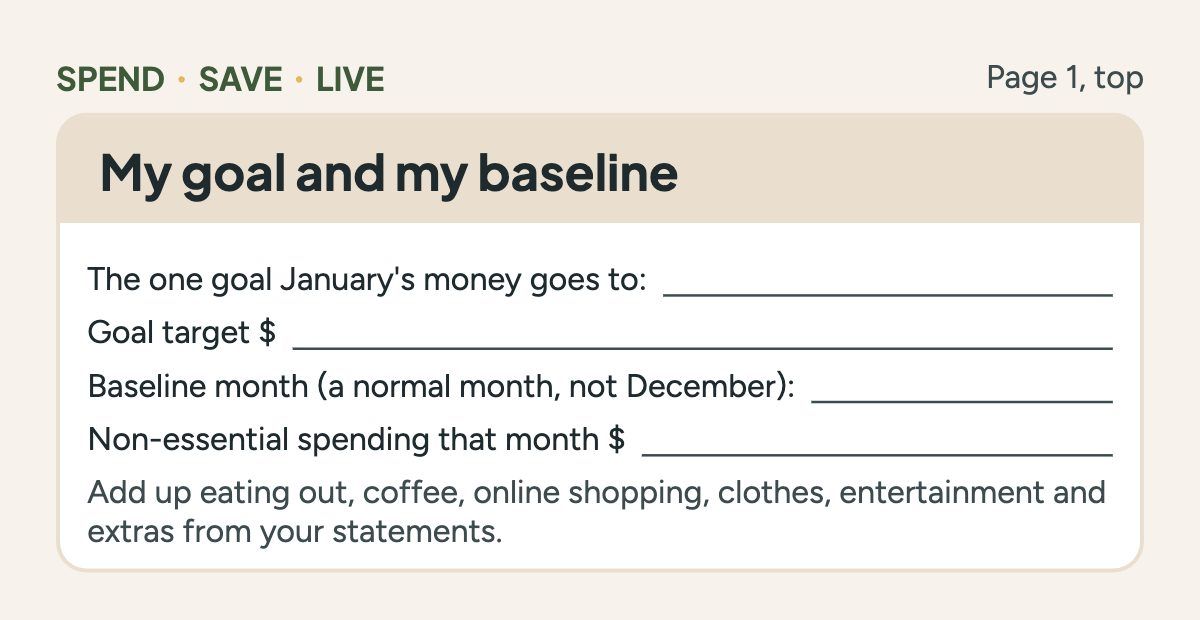
- Find your baseline. Add up last month’s extras from your bank and card statements. Use a normal month like November, not December, because December lies (gifts, parties, the whole circus). The CFPB’s spending tracker suggests tracking a full month, or one to two weeks if a month feels like too much, and you can track a normal month first if you don’t have the numbers yet.
- Pick one goal and a dollar target. A car repair fund or a first $500 buffer, say. One goal, not four, and if you can’t decide, name one goal with a quick worksheet first.
- Mark your January dates. Paydays, bill due dates and anything unusual. Some people paid every other Friday get three paydays in January 2027, so check your own pay dates rather than assuming (if that’s you, here’s how to handle three-paycheck months in 2027).
- List renewals that will hit anyway. Annual memberships and app renewals don’t care about your challenge, so list your January renewals now and decide which ones stay.
- Note any buy now, pay later payments still due. These plans usually split a purchase into four or fewer payments, and the CFPB notes that most charge late fees for missed ones, so keep paying them in January.
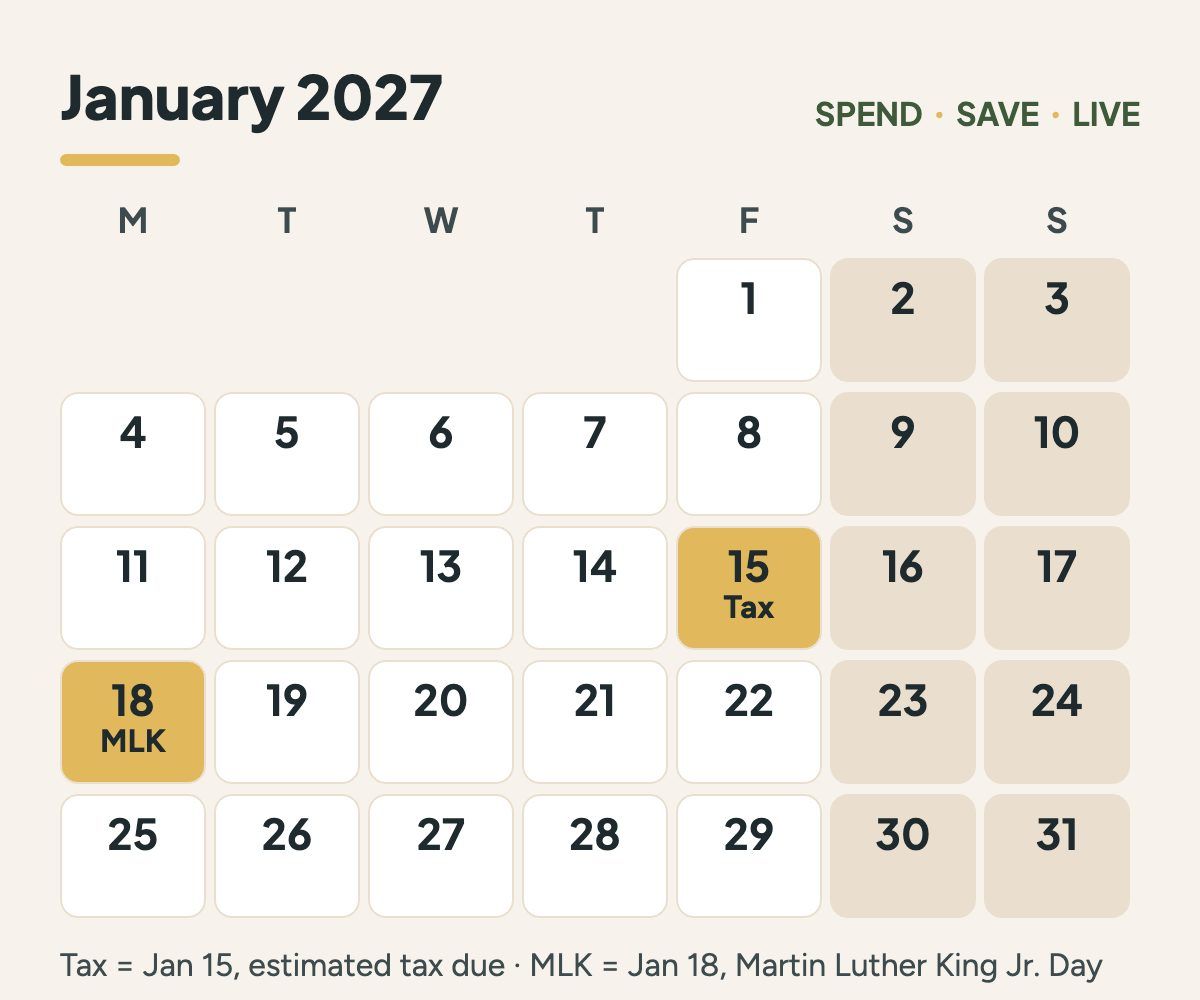
January 2027 starts on a Friday, which is handy, because you get a full weekend of practice right away before the first work week. Monday, January 18 is Martin Luther King Jr. Day, a federal holiday, and the Federal Reserve’s holiday schedule lists it too, so a bill payment or transfer set for that day may not land until the next business day.
What Are the No Spend January Rules (Minus the All-or-Nothing Drama)?
Protect your essentials, pause your extras, and settle the gray areas in writing before January 1.
This is the same thing any no spend challenge asks of you, just with the escape hatches built in. The CFPB’s cutting expenses tool frames it nicely, because cutting back is there to help you afford “the necessities you can’t live without”, and those necessities stay on the list.
Keep Paying
- Rent or mortgage
- Utilities
- Groceries, with a budget set at your November grocery total
- Gas or transit to work
- Medication and medical care
- Childcare
- Insurance
- Phone and internet
- Minimum debt payments
- Required work or school costs
Pause for January
- Eating out and takeout
- Coffee and snacks out
- Online shopping
- Clothing and shoes
- Beauty and personal care extras
- Entertainment and app add-ons
- Home and hobby upgrades
Then there are the gray areas, and they’re easier to decide on a calm December evening than at 9 pm on January 14th. A few defaults you can copy or change:
- A friend’s birthday dinner: go, set a dollar limit before you sit down, and log it as an exception.
- A gym or app you already paid for: use it. That money is already spent, so it isn’t part of January.
- A streaming service that renews in January: keep one, pause the rest, and write down which one stays.
- Weekend plans: say yes to the free ones (a walk, the library, a potluck) and put the paid ones on the wish list.
Starting late? If you find this on January 5, start that day. On February 1, compare what you spent against the matching share of your baseline, so for 27 days that’s 27/31 of it.
Got gift cards from the holidays? Decide now whether they count. Most store gift cards can’t expire within five years of when they were issued or last loaded (Regulation E, 12 CFR 1005.20), but promotional or bonus cards, like the ones a store hands out with a purchase, are excluded and can expire much sooner, so check the dates on those first.
I’ve done this myself, in January, and it worked well enough that I let it run into February. My rule was bills and groceries only, and the money I didn’t spend went straight to savings, about €500 in total (roughly $550; I live in Finland). The hardest moment was skin care, of all things. A few products ran out at once and I panicked, then found plenty of half-used pots and decided to finish the old ones before buying anything new.
What Counts as a Real Life Exception (and What Is Just a Sale)?
A real life exception is a necessary cost you wrote down in advance, with a dollar cap on the total.
My real-life exceptions
- Replacing something essential that breaks (shoes, a charger, a coat zipper that gives up)
- A gift you already planned for
- A required school or work cost
- A medical cost
- Cap for the month: $____
When an exception happens, you log it with the amount. That’s it, nobody fails, the month keeps going, and the cap stops “exception” from quietly turning into “anything I feel like”.
What doesn’t count is “it was on sale” and “I’ll need it someday”. A sale is a reason to put something on the wish list, and someday can wait until February.
What Should You Do When You Slip? Log It and Keep Going
Log the slip with the amount and what set it off, then carry on the next day as if nothing happened.
The takeout on a terrible Tuesday tells you that terrible Tuesdays are a risk for you, and that’s useful to know before the next one.
- Write it down, with the date, item, amount and the trigger (tired, bored, a sale email, a friend’s plans).
- Keep going tomorrow. Don’t restart the count or “start fresh on Monday”, just do the next day.
- If the same trigger shows up three times, change something around it, like unsubscribing from the store emails or keeping an easy dinner at home, and wait a few days before any online order.
Read more: Resets and reviews for getting back on track
How Do You Know You Actually Saved Anything?
On February 1, take your baseline, subtract what you spent in January, then subtract anything you only delayed and will still buy.
This is the step that turns a nice month into actual money, because skipped purchases have a sneaky habit of all happening in the first week of February.
- Work out what you didn’t spend by taking your baseline minus January’s extras and exceptions. If your grocery bill went up because takeout moved home, subtract that increase too.
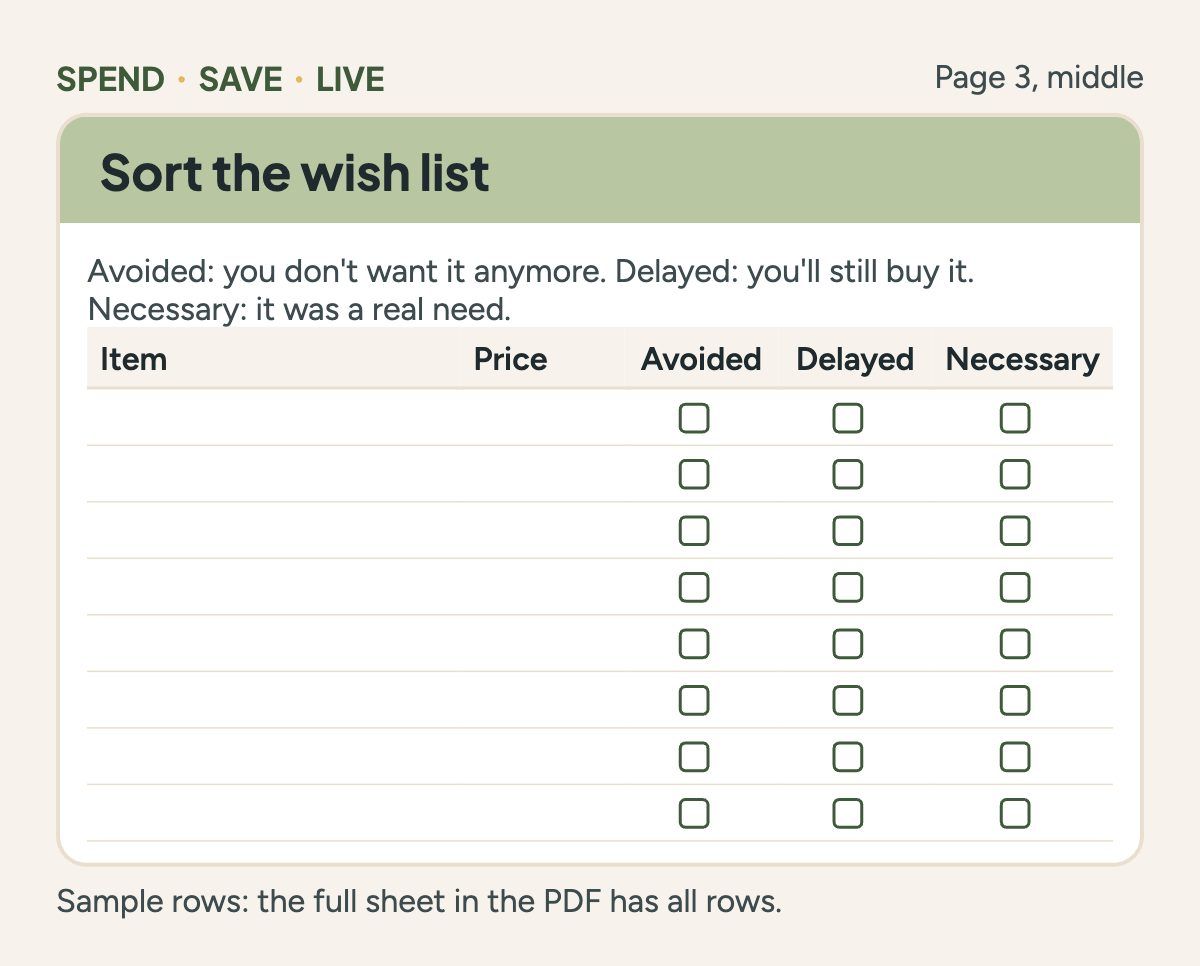
- Sort your wish list. Every item goes into one pile, avoided (you don’t want it anymore), delayed (you’ll still buy it) or necessary (it was a real need).
- Count what you kept, meaning what you didn’t spend minus the delayed items you’ll still buy.

Or, in one line, retained = not spent minus delayed purchases you will still make.
A Worked Example of One Household’s No Spend January 2027
The Riveras are a fictional household (two adults and a child, renting), and they didn’t spend $474 of their usual extras but kept $405, because one wish-list item still got bought.
Step 1. The November Baseline
| Paused category | November |
|---|---|
| Eating out and takeout | $210 |
| Coffee and snacks out | $56 |
| Online shopping | $145 |
| Clothing and shoes | $80 |
| Entertainment and app add-ons | $38 |
| Personal care extras | $45 |
| Baseline total | $574 |
Step 2. The Rules
On December 31 they wrote their essentials, a $75 exceptions cap and one goal, which was a $600 car repair fund. Their rent, utilities, groceries budget, gas, childcare, phone and minimum card payment stayed exactly as normal and aren’t part of this math. Their grocery bill stayed at its November level, so no takeout money quietly moved into groceries.
Step 3. What January Cost
| Item | Type | Amount |
|---|---|---|
| Child’s winter boots (old pair split) | Exception | $44 |
| Birthday gift for a party | Exception | $25 |
| Takeout on a hard night | Slip, logged | $31 |
| Total | $100 |
Exceptions used were $69 of the $75 cap, so the cap did its job.

Step 4. The February 1 Check
- Not spent: $574 baseline minus $100 in January leaves $474.
- The wish list holds earbuds ($69), jeans ($42) and a video game ($30), so $141 in all.
- They still want the earbuds and have room for them in February’s budget, so those get bought.
- The jeans and the game get dropped ($72 nobody misses).
- Retained: $474 minus the $69 earbuds leaves $405, moved to the car repair fund on February 1.
- That covers 67.5% of their $600 goal in one month.
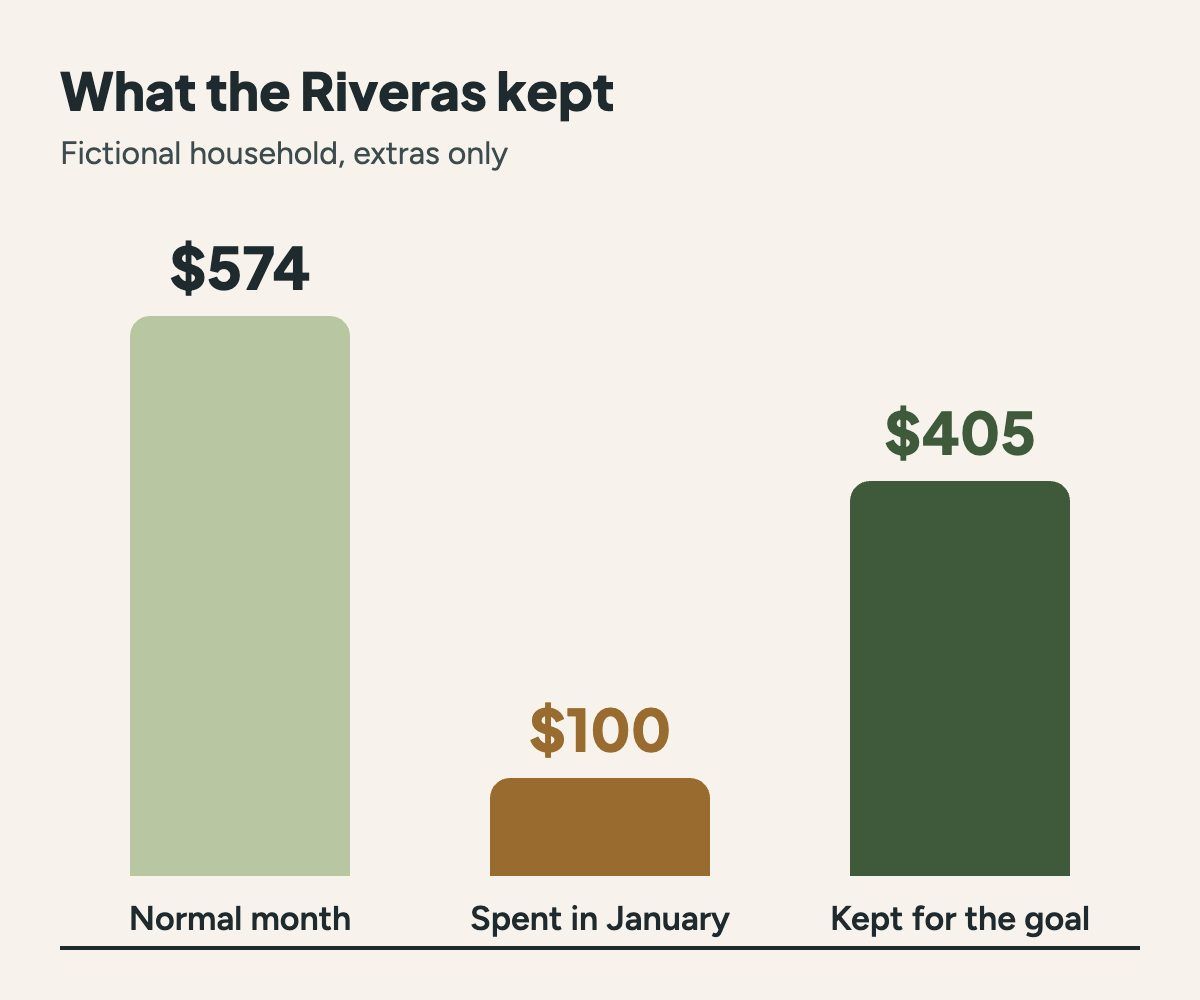
Without the February check, they would have told everyone they saved $474, which sounds great until the earbuds arrive.
How Do You Come Back in February Without Undoing January?
Decide on each wish-list item first, then move the money on the same day, before anything else touches it.
Your February 1 re-entry card
- Do I still want it, now that a few weeks have passed?
- Is it in February’s budget, or am I just ending the pause with a bang?
- Buy it, drop it, or wait one more month.
- Move the retained money to the goal today (February 1, 2027 is a Monday).
Keep one January rule for February, just one, like a three-day wait before online orders or no takeout on weeknights. If the retained money is for a cost you know is coming, put it in a sinking fund so it stays put, and if you don’t have any savings cushion yet, it can be a first emergency fund stage. Looking for something for the rest of the year? There are other savings challenge ideas that work with a regular paycheck.
Read more: Saving and money goal guides
What’s in the No Spend January 2027 Printable?
The No Spend January 2027 printable is three US letter pages, one for your rules, one to track January and one for the February 1 check.
- Page 1, my rules, with your goal and target, your baseline, what you keep paying, what you pause, gray areas, your exceptions cap and your January dates.
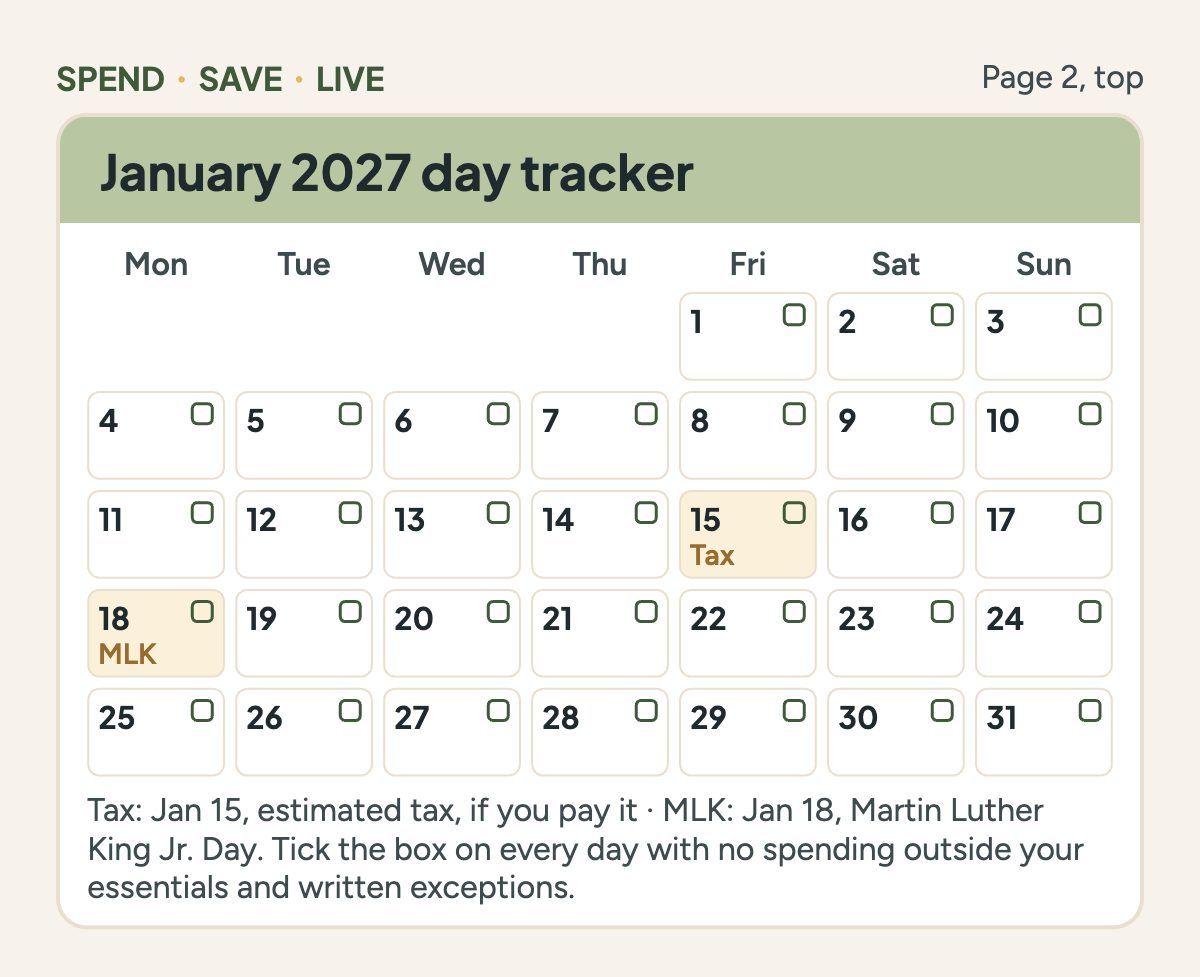
- Page 2, the tracker, with a 31-day grid starting Friday, January 1, a purchase log, a running exceptions total and a wish list.
- Page 3, the February 1 check, with what you didn’t spend, the wish-list sort, what you kept and one rule for February.
Here are three sections up close, so you can see what you’d fill in. It works as a no spend tracker for January 2027, and you can reuse it as a no spend month template for any other month.
Get the Full No Spend January 2027 Printable
The full printable PDF is coming soon. It will be free to SPEND • SAVE • LIVE readers.
When the PDF is out, print it at 100% scale on US letter paper, and fill page 1 before January 1 while you still feel calm about the whole thing.
What a No Spend Month Can’t Fix (and Where to Get Help)
A no-spend month can’t close a gap between your income and your essentials, and if that’s where you are, real help is a better first step than a challenge.
- 211 connects you with local help paying bills and finding food, and every call is confidential.
- The NFCC agency finder connects you with certified nonprofit credit counselors, with no upfront fees and no obligation.
- The CFPB’s Your Money, Your Goals toolkit has more printable tools like the spending tracker and cutting expenses tool mentioned above.
- If you’ve never made a budget at all, build a simple first budget before you try a challenge.
- New to SPEND • SAVE • LIVE? Start Here shows where everything is.
Frequently Asked Questions
Does a day with an exception still count as a no-spend day?
That’s your call, so write it in your rules before January 1. A simple way is to check the box only on days with nothing outside your essentials, and log exceptions in the purchase log so the cap stays honest. Either way, the February 1 check measures the result, not the number of boxes.
What if I start no spend January late?
Start the day you read this. On February 1, compare what you spent against the matching share of your normal-month baseline, for example 27/31 of it if you started on January 5.
Any tips for a no-spend challenge?
Start from a normal month’s baseline so you can measure the result, write your exceptions before day one, keep a wish list instead of buying, and move the money you kept to one goal on the first day of the next month.
Is there a printable tracker for No Spend January?
The SPEND • SAVE • LIVE No Spend January 2027 printable has three pages, which are your rules, a 31-day tracker with a purchase log, and a February 1 money check. This post shows sections of it, and the full PDF is coming soon.
How is a low-buy challenge different from a no-spend challenge?
A no-spend challenge pauses extras completely for a set time, while a low-buy challenge sets limits, like one clothing purchase a month. Low-buy can suit a longer stretch, such as a whole year.
Can you use gift cards during no spend January?
Decide before January 1 and write it in your gray-area rules. Most store gift cards can’t expire within five years of when they were issued or last loaded, but promotional or bonus cards are excluded and can expire sooner, so check those first.
Can you still buy groceries during no spend January?
Yes. Groceries are an essential, so set the grocery budget at your November grocery total and keep buying food. The pause is for extras like takeout and snacks out, not for feeding yourself.
Key Takeaways
- Measure a normal month’s extras first (November, not December), so you know what January actually kept.
- Write your essentials and a capped list of real-life exceptions before January 1.
- A slip gets logged, not a restart. Keep going the next day.
- Money kept is what you didn’t spend minus purchases you only delayed. Move it to one goal on February 1.
Give the Money a Name Before January Gets Its Rules
One last thing, because it’s the whole point. Write your goal’s name on page 1 before you write a single rule, so on February 1 the money already knows where it’s going. Would I do it again? Happily, and in January. If yours goes well too, the next question is whether a low-spend year fits the rest of 2027.
Sources (checked November 2026)
- IRS, estimated tax payments FAQ (fourth-quarter 2026 payment due January 15, 2027)
- CFPB, Your Money, Your Goals spending tracker
- CFPB, Your Money, Your Goals cutting expenses tool
- CFPB, What is a Buy Now, Pay Later (BNPL) loan?
- CFPB, Regulation E, 12 CFR 1005.20 (gift cards)
- 5 U.S.C. 6103, legal public holidays (Martin Luther King Jr. Day)
- Federal Reserve Financial Services, holiday schedules (January 18, 2027)
- 211.org
- NFCC agency finder
- CFPB, Your Money, Your Goals toolkit
Educational content, not financial advice.