

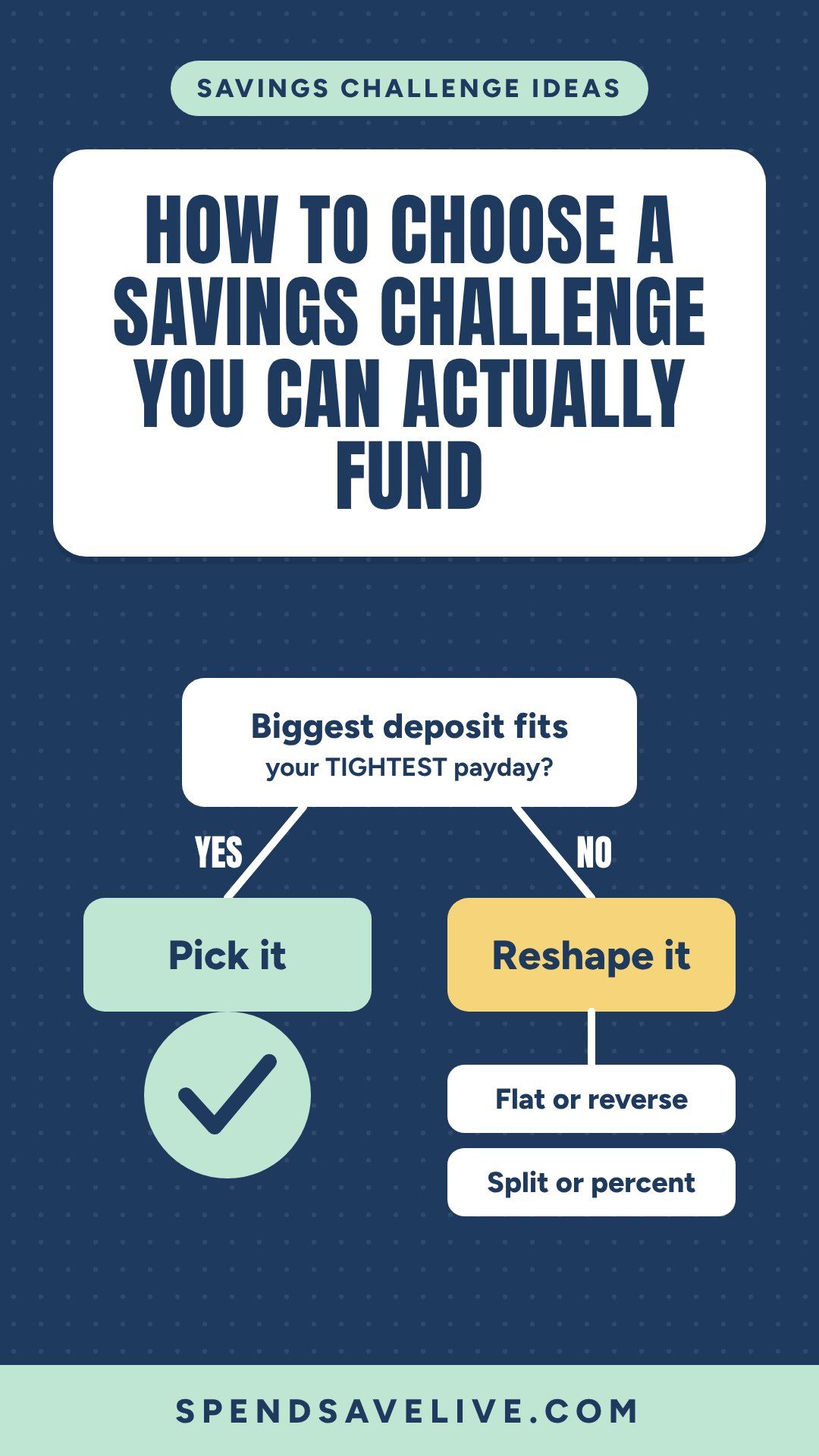
The best savings challenge ideas are the ones your tightest payday can fund. Before you pick one, check three things: the total, the biggest single deposit and when it lands. If that deposit is more than you have left after bills on that payday, reshape the challenge: go flat, reverse it or save a percentage.
Every January the internet fills up with savings challenge ideas, and every one of them looks easy on the first page of the chart, because week one asks for a dollar and a dollar is nothing. Then October shows up, the chart wants $40-something a week right when gifts and heating bills arrive, and a lot of perfectly good savers quietly quit (and feel weirdly guilty about it, which is the worst part).
So this post does the boring bit nobody else does. You’ll see seven popular challenges side by side by total, biggest deposit and when the big deposits land, then run a quick tightest-payday test, follow one fictional saver on uneven pay and look at the Savings Challenge Picker. It sits with the other savings challenges in our Saving & Money Goals guides.
Read this also:
- A 52-Week Savings Challenge That Fits Your 2027 Cash Flow
- A Biweekly Savings Challenge Built Around Your Paydays
- No-Spend January 2027 Rules That Leave Room for Real Life
- A Financial Goals Worksheet That Turns a Wish Into a Plan
Quick confession before we start, I have never done a formal savings challenge in my life. What I do is boring on purpose: on payday itself, automatic transfers go out to separate pots, each one a fixed percentage of my income, because those are no brainer things and I don’t want to think about them every month. That’s also why I’m a little obsessed with the question this whole post asks, which is whether the plan fits the paycheck, not whether the chart looks cute on the fridge.
And there’s a good reason to protect your cushion while you do this. In the Federal Reserve’s latest household survey, 63% of adults said they would cover a surprise $400 expense with cash or its equivalent, the same share as the year before. A challenge that eats your bill money just moves the problem from one month to the next.
Is This for You? A 30-Second Check
- You want to start saving in 2027 with some kind of plan.
- You’ve started a challenge before and dropped it somewhere around spring (or December).
- Your pay or your bills change from one payday to the next.
- You know, or want to find out, what’s left after bills on your tightest payday.
If your bills already don’t fit your paycheck, skip down to the help section near the end first. That comes before any challenge.
What Are the Best Savings Challenge Ideas, and What Do They Really Cost?
Most savings challenges look alike until you see the biggest single deposit, so that’s the column to read first.
Here are seven of the most popular ones, run on a 2027 calendar. The totals are the easy part, the third column is the one that decides whether you finish.
| Challenge | Total in 2027 | Biggest single deposit |
|---|---|---|
| 52-week ($1 more each week) | $1,378 | $52 |
| Reverse 52-week (starts at $52) | $1,378 | $52 |
| 26-paycheck step ($3 more each payday) | $1,053 | $78 |
| Flat weekly | $1,378 | $26.50 |
| 100-envelope | $5,050 | $100 |
| Penny (1 cent more each day) | $667.95 | $3.65 |
| Dollar a day | $365 | $1 |
Notice anything? The 52-week, the reverse version and a flat $26.50 a week all land on the exact same $1,378, they just ask for it at very different times. The 100-envelope challenge looks fun until you see it adds up to $5,050, and the penny challenge is tiny per day but still grows to $3.65 a day by late December. Full guides live in their own posts: the 52-week savings challenge that fits your cash flow, the 100-envelope challenge and the penny savings challenge.
Savings Challenge Ideas With No Fixed Total
Some of the easiest savings challenge ideas don’t come with a chart at all. They save what you didn’t spend, which makes them great for uneven pay:
- No-spend days or weeks, where the money you’d have spent goes straight to savings (here’s how to run a no-spend January that still leaves room for real life).
- Round-ups, where purchases get rounded to the next dollar and the change moves to savings.
- Guess-the-bill, where you budget a bill high and save the difference when it comes in lower.
- A subscription pause, where you pause one subscription for a month and save its price.
- Windfalls, like part of a tax refund. The CFPB says putting away a portion of your tax refund is one of the easiest ways to get started.
- $5 bills, if you still use cash, where every $5 bill you get goes in the jar.
Read more: A 52-Week Savings Challenge That Fits Your 2027 Cash Flow
When Do the Big Deposits Hit? (The December Problem Nobody Mentions)
The timing of the big deposits matters as much as the total, and the classic 52-week challenge saves its most expensive stretch for the most expensive season.
Start the 52-week challenge on January 1, 2027, and $598 of it (43%) is due between October 1 and December 24. January 1, 2027 is a Friday, so week 52 lands on Friday, December 24.
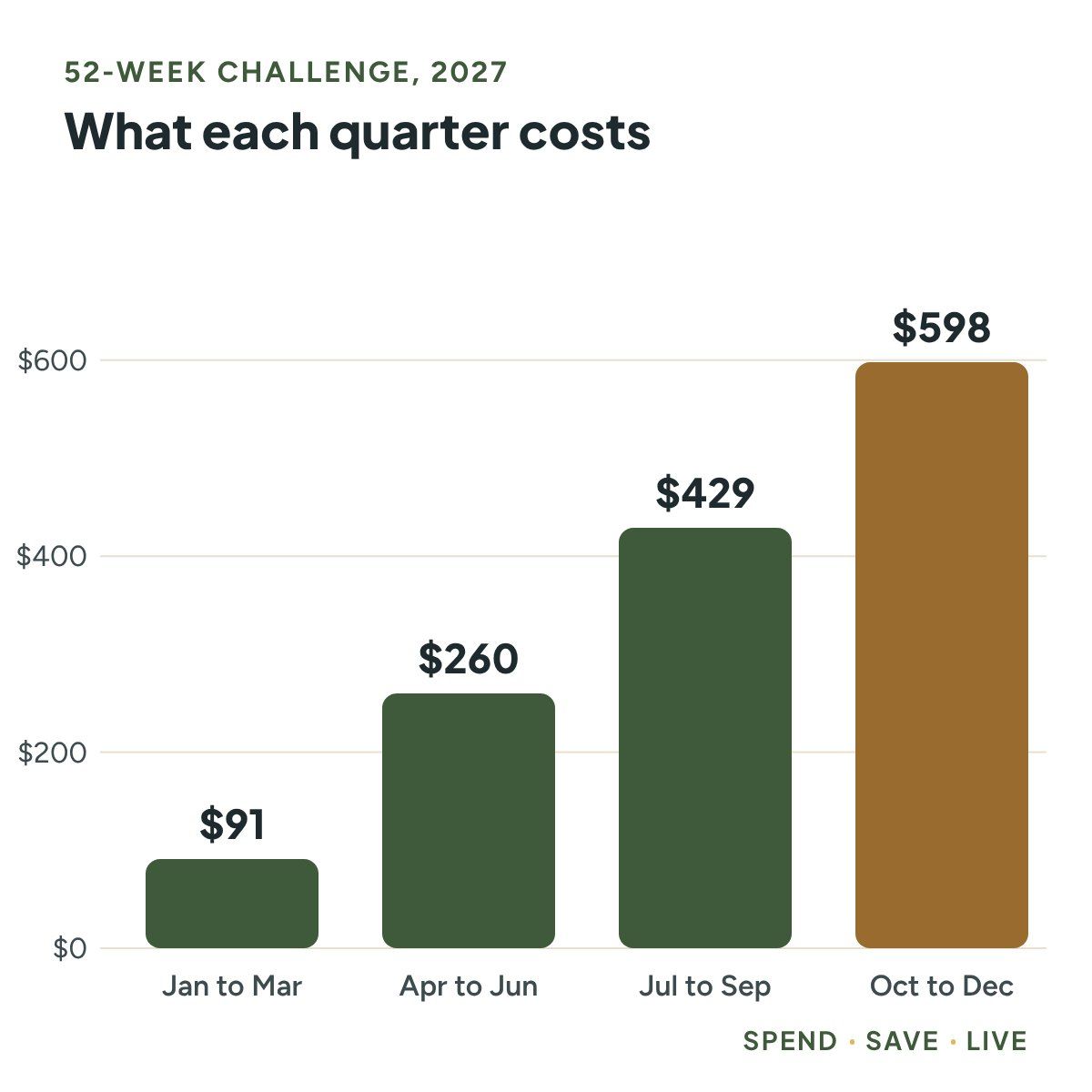
So the first three months cost you $91 in total, which feels amazing, and the last three cost $598, which is right when the gift list, the travel and the heating bill all want a word. Here’s when each challenge asks for its biggest money:
| Challenge | When the big deposits land | How flexible |
|---|---|---|
| 52-week | October to December | Fixed |
| Reverse 52-week | January to March | Fixed |
| 26-paycheck step | Last paydays of the year | Fixed |
| Flat weekly | Never, every week is the same | Fixed |
| 100-envelope | Any day you draw a big number | Random |
| Penny | December | Fixed, but small |
| Percentage of pay | Follows your pay | Flexible |
If you already know December is your expensive month, the reverse version or a flat amount is usually the kinder choice. (Or give December its own pot, and this post on holiday savings shows how.)
How Do I Know If a Savings Challenge Is Realistic for Me? (The Tightest-Payday Test)
Find the leftover on your tightest payday, then make sure the challenge’s biggest deposit fits inside it with a little spare.
This is the answer to the question people actually ask on forums, which is some version of “how realistic is this money challenge?” It takes about ten minutes and one subtraction:
- List what comes in on each payday for a month or two, and note which money is regular and which isn’t (tips, overtime and side income usually aren’t).
- Subtract the bills and essentials due before the next payday. The CFPB’s cash flow budget does this week by week and puts it plainly: “If it’s negative, you’re falling short.”
- Circle the smallest leftover. That’s your tightest payday, and it’s the only number this test cares about.
- Compare it with the challenge’s biggest deposit for one pay period. Paid every other week? Then two weeks of a weekly chart land on one paycheck.
- Pick the challenge if it fits with a few dollars to spare, or reshape it if it doesn’t (more on that in a second).

Why the tightest payday and not the average? Because averages don’t pay rent. A challenge that fits a normal payday and breaks on the one where rent comes out is a challenge you’ll skip, and skipped weeks are exactly how people end up quitting.
What Does a Savings Challenge Look Like on a Real Biweekly Paycheck?
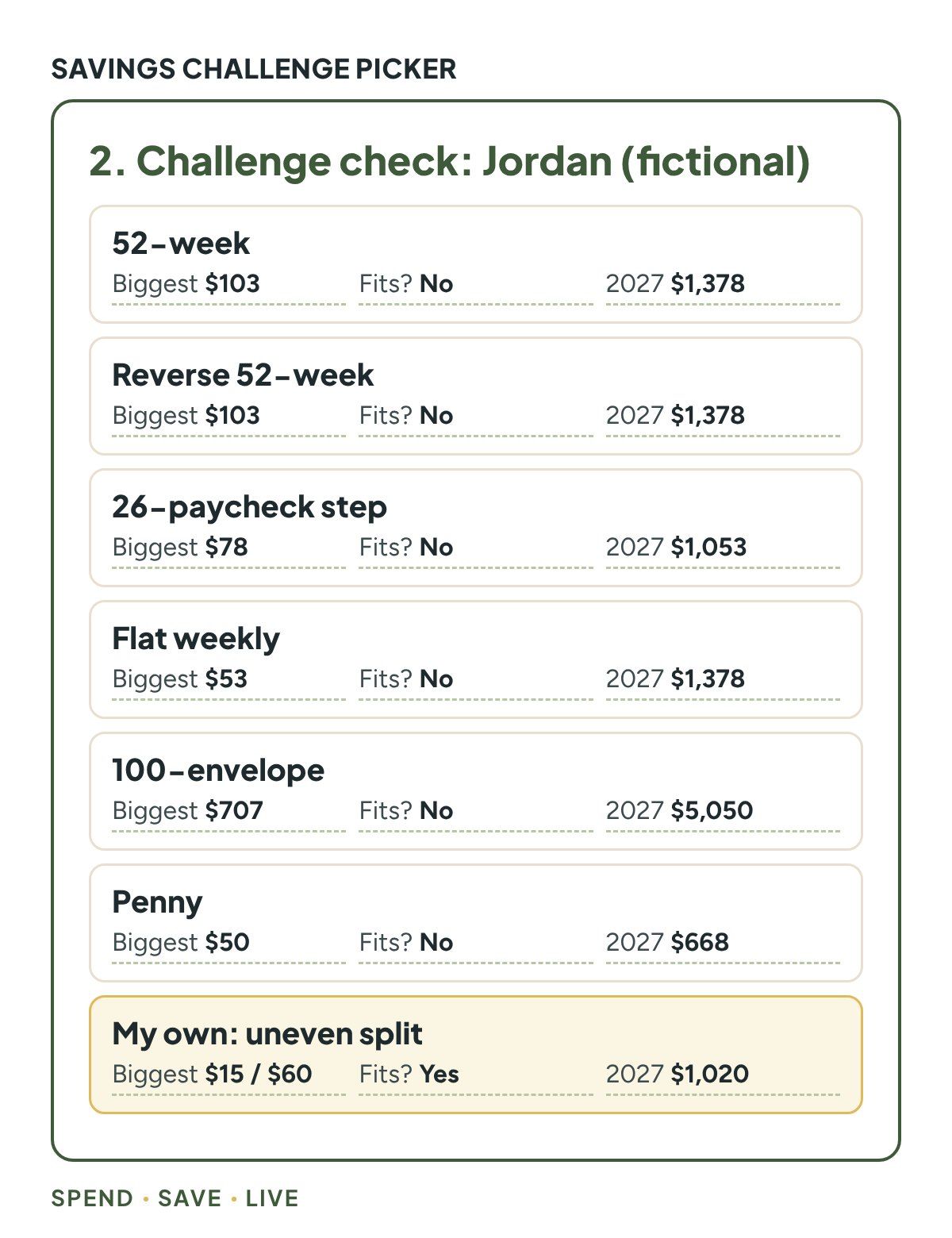
Our fictional saver Jordan can’t fund the 52-week challenge past March, but can save $1,020 in 2027 on an uneven plan and never come up short.
Jordan is made up, and so are the numbers, so your pay and bills will differ. Jordan is single and paid every other Friday from Friday, January 8, 2027, which is 26 paydays. Rent comes out of the first paycheck each month, so after bills and essentials Jordan has $25 left on that payday and $95 on the other one.
| Plan (per payday) | Fails the $25 payday from | 2027 total |
|---|---|---|
| 52-week, two weeks per payday ($3 up to $103) | Fri, April 2 | $1,378 |
| 26-paycheck step ($3 up to $78) | Fri, May 14 | $1,053 |
| Uneven: $15 on rent payday, $60 on the other | Never ($10 and $35 spare) | $1,020 |
The math: 12 rent paydays × $15 plus 14 other paydays × $60 = $1,020. Jordan’s leftover for the whole year is 12 × $25 plus 14 × $95 = $1,630, so the plan uses about 63% of it and leaves a little spare every single payday. (April and October 2027 each have three paydays, which is why it’s 12 and 14, not 13 and 13.)
And the two famous ones? By December the 52-week version wants $103 on Christmas Eve, more than even Jordan’s good payday. A 100-envelope challenge squeezed into 100 days would need about $707 a payday, so that’s a no. A flat $20 every payday fits easily but only reaches $520.
The lesson is a little annoying in a good way. Jordan saves only $33 less than the 26-paycheck step and never once has to choose between rent and the chart. If you’re paid every other week, here’s the full biweekly savings challenge built around real pay dates.
My Challenge Failed the Test. Now What?
Reshape the schedule and keep the habit, because the habit is the part that matters.
- Go flat. The 52-week total is $26.50 a week, every week, so nothing gets scary in October.
- Reverse it, so the big weeks land in January to March while your motivation is still fresh.
- Split it by paycheck, like Jordan, with a small amount on the tight payday and a bigger one on the easy one.
- Save a percentage of each paycheck, so the deposit moves when your pay does.
- Start short. A 30-day savings challenge is a cheap way to test the habit before you commit to a year.
- Write a pause rule now, before you need it. Something like “if a paycheck is short, I save $5 that payday and keep going.” The CFPB’s savings plan tool adds the other half: divide the goal by the weeks you have, and if it doesn’t fit, brainstorm ways to decrease spending or increase income.

And three easy mistakes to skip: picking a challenge by its total instead of its biggest deposit, starting the 52-week in January with no plan for December, and taking challenge money out of bill money (that one costs you more in fees than it saves).
I do the reshaping thing myself, by the way. In an expensive month I sometimes lower or pause one of my transfers, and in lean months I cut the extras first, like shopping and eating out, before I touch the savings habit. Nobody hands out medals for saving the exact same amount through a bad month.
If short weeks are the rule right now and not the exception, a low-income savings challenge with zero-deposit weeks is built for exactly that.
Read more: A Low-Income Savings Challenge With Zero-Deposit Weeks
Where Should the Challenge Money Go So It Actually Stays Saved?
Into a separate savings account at an insured bank or credit union, moved by an automatic transfer on payday.
The CFPB says setting up automatic recurring transfers is often one of the easiest ways to save, and some employers let you split your paycheck between checking and savings. Keep an eye on your balance, though, because the same guide warns that an automatic transfer can trigger an overdraft fee if checking is short that day. Pick the transfer date for the day after the paycheck lands, not the day before.
Keep it somewhere insured, too. FDIC insurance covers $250,000 per depositor, per FDIC-insured bank, for each account ownership category, and stocks, crypto and other investments aren’t covered. If you save cash for a challenge, count it on payday and move it into the account once it adds up, so it doesn’t quietly turn into takeout money. Here’s how to automate savings without leaving your bills short.
What a Savings Challenge Can’t Do, and When to Get Help
No challenge fixes income that doesn’t cover essentials, and if that’s where you are, the bills and the help come first.
- 211 connects you with local help with bills, food and other needs near you.
- A nonprofit credit counselor through the National Foundation for Credit Counseling (877-360-6322) can help you look at debts and payments.
- New to all of this? Start Here walks through the basics one step at a time.
Saving $5 a payday while you sort out the bigger stuff still counts. Small is fine, the point is keeping the habit alive until the bigger numbers fit.
What’s in the Savings Challenge Picker?
One page that runs the tightest-payday test for you and keeps your pick and your pause rule in writing.
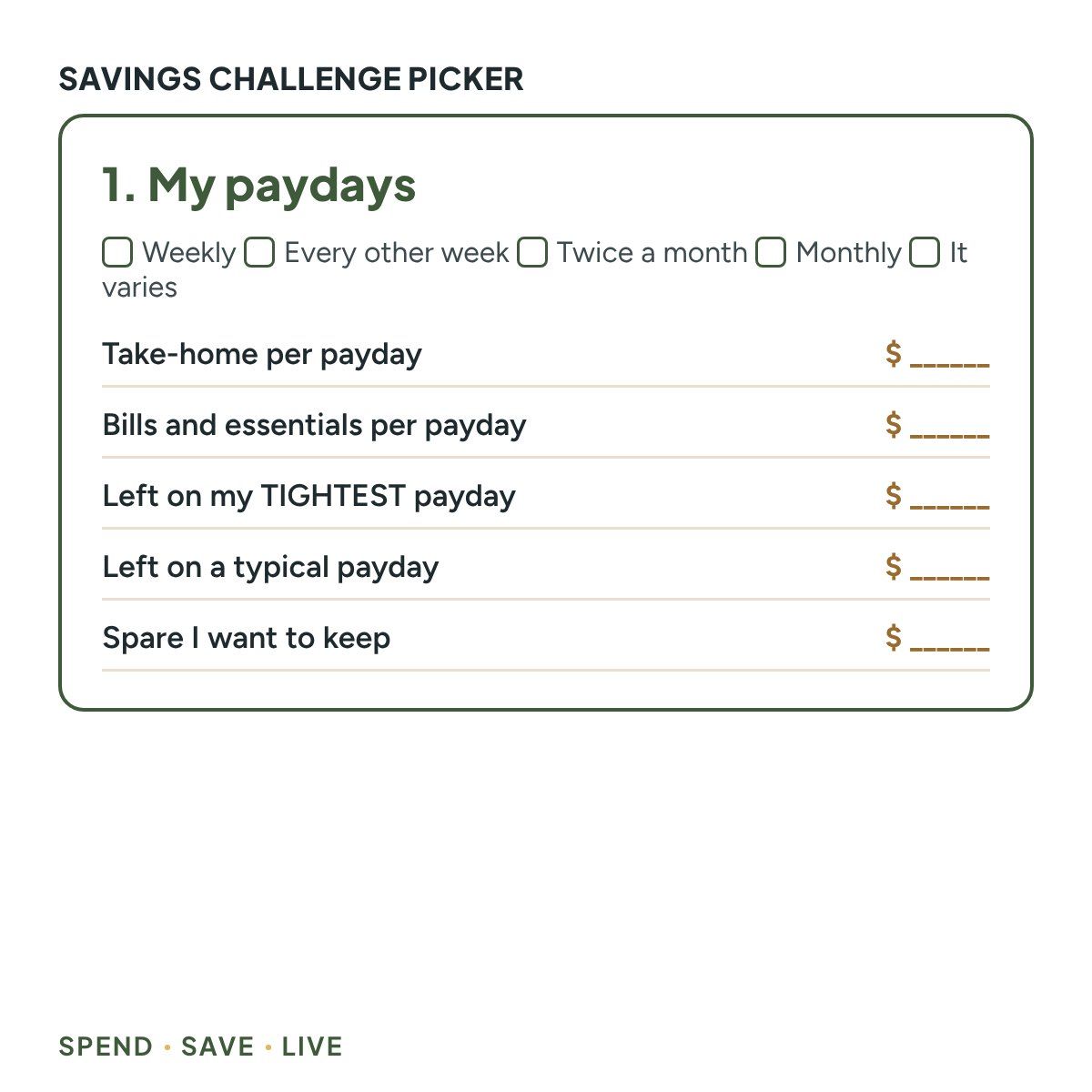


- My paydays: how often you’re paid, take-home and bills per payday, and the leftover on your tightest and typical payday.
- Challenge check: seven challenges, each with its biggest deposit per pay period, a yes or no for your tightest payday and its 2027 total, plus a blank row for your own idea.
- My pick: the challenge or reshaped plan, the amount per payday, a start date, tick boxes for flat, reverse, uneven or percentage, and your pause rule.
Get the full Savings Challenge Picker
The full printable PDF is coming soon. It will be free to SPEND • SAVE • LIVE readers.
Frequently Asked Questions
What are some good ideas for money saving challenges?
The 52-week, reverse 52-week, 26-paycheck step, flat weekly, penny and percentage-of-pay challenges are the classics, plus no-spend days and round-ups if you want something with no fixed total. Pick by the biggest single deposit, not the total. For short tries, there are also mini savings challenges.
What is the best savings challenge?
The one whose biggest deposit fits your tightest payday with a little spare. For steady pay that’s often a flat weekly amount; for uneven pay it’s usually a percentage or a split plan like Jordan’s.
How do you make your own savings challenge?
Set a goal, divide it by the weeks or paydays you have, test the biggest deposit against your tightest payday and write the plan down. If it doesn’t fit, move the date or lower the amount before you start.
How much is a 52-week savings challenge?
$1,378 if you save $1 more each week from $1 to $52. Saved flat, that’s $26.50 a week. Started on January 1, 2027, $598 of it is due from October to December.
How do you automate savings?
Set up a recurring transfer from checking to savings for the day after payday, or ask your employer about splitting your direct deposit. Keep a little buffer in checking so the transfer never causes an overdraft. Here’s how to automate savings without leaving your bills short.
What is the $27.39 rule?
It’s the idea that saving $27.39 a day adds up to about $10,000 in a year ($9,997.35 over 365 days). That’s $191.73 a week, so run the tightest-payday test before you commit. For a shorter, bigger target, see this six-month savings plan.
Key Takeaways
- Compare savings challenges on three things: the total, the biggest single deposit and when it lands.
- Test the biggest deposit against what’s left on your tightest payday, not your average one.
- A 52-week challenge started January 1, 2027 needs $598 between October 1 and December 24.
- If a challenge fails the test, reshape it (flat, reverse, uneven or percentage) instead of quitting.
- Keep the money in a separate insured account, moved automatically the day after payday.
Pick the Boring One You’ll Actually Finish
Grab your last two pay stubs, find your tightest payday, and hold each challenge’s biggest deposit up against it before you print a single chart. The exciting $5,050 can wait, a plan that’s still running next December is the one that actually builds savings. Ready to set yours up? Turn it into a real target with this financial goals worksheet.
Sources (checked November 2026)
- Federal Reserve, Economic Well-Being of U.S. Households in 2025
- CFPB, Cash flow budget tool
- CFPB, Savings plan tool
- CFPB, An essential guide to building an emergency fund
- FDIC, Understanding deposit insurance
- National Foundation for Credit Counseling
- 211.org
- Challenge totals, the 2027 calendar and Jordan’s numbers: SPEND • SAVE • LIVE calculations, November 2026. Jordan is a fictional example.
Educational content, not financial advice.