

A sinking funds tracker is a ledger with one page per fund. Write the opening balance, then log every deposit and withdrawal with its date and the new running balance. Once a month, add up all the fund balances and compare the total with your actual bank account. If they differ, find the missing entry before you move on.
You paid the car insurance from the right fund, you felt very grown up about it, and then a week later nobody in the house can say how much is left for school stuff or holiday gifts, because three funds live in one savings account and the bank only shows one number. That’s the moment you need a sinking funds tracker, and it’s also the moment most trackers stop being useful, because they only show how close you are to a goal and have nowhere to write the money going out.
So this one is a ledger. You’ll see the five columns, how to log a withdrawal without wrecking the balance, a four-month example from a fictional family with real dates, and the monthly check that makes the funds match the bank to the cent. If you haven’t started yet, set up your first sinking funds first, then come back. It all sits with the other sinking funds guides in Saving & Money Goals.

Read this also:
- How to Start Sinking Funds for Costs You Know Are Coming
- Sinking Fund Categories for the Expenses Your Budget Forgot
- A Sinking Fund Calculator That Works Back From the Due Date
- A Savings Goal Tracker That Accounts for Every Dollar
Quick note from me before we start: I live in Finland and I’ve kept my own pots for years (an expense pot, a travel pot, a gift pot and a few more), and the one thing that kept them honest was writing down the money going OUT, not just the money going in. Everything below is built around that.
Is This Sinking Funds Tracker for You? A 30-Second Check
- You keep two or more sinking funds in one savings account.
- You’ve paid at least one bill from a fund in the last year.
- You aren’t quite sure what each fund holds today.
- Your notes and your bank balance don’t match (or you’re scared to look).
Two or more yeses and this post is for you. If you’re behind on rent, utilities or debt payments right now, skip ahead to the help section near the end first, because a tracker can’t fix that part.
What Is a Sinking Funds Tracker, and Why Isn’t a Progress Bar Enough?
A sinking funds tracker records every dollar in and out of each fund, not just how close you are to the goal.
Progress trackers (the cute thermometers and coloring sheets) work great until the day you spend from the fund, and then they just sit there at 100% while the actual money is gone. A ledger keeps going after the bill, because the withdrawal is a line like any other and the balance carries down.
The CFPB’s guide to building an emergency fund puts it simply: “Find a way to regularly check your savings.” A ledger is that check, written down. If you mainly want a pretty chart that fills up toward one goal, a savings goal tracker with a progress chart is the better fit.
What Goes on a Sinking Fund Ledger (and What Can Stay Off)?
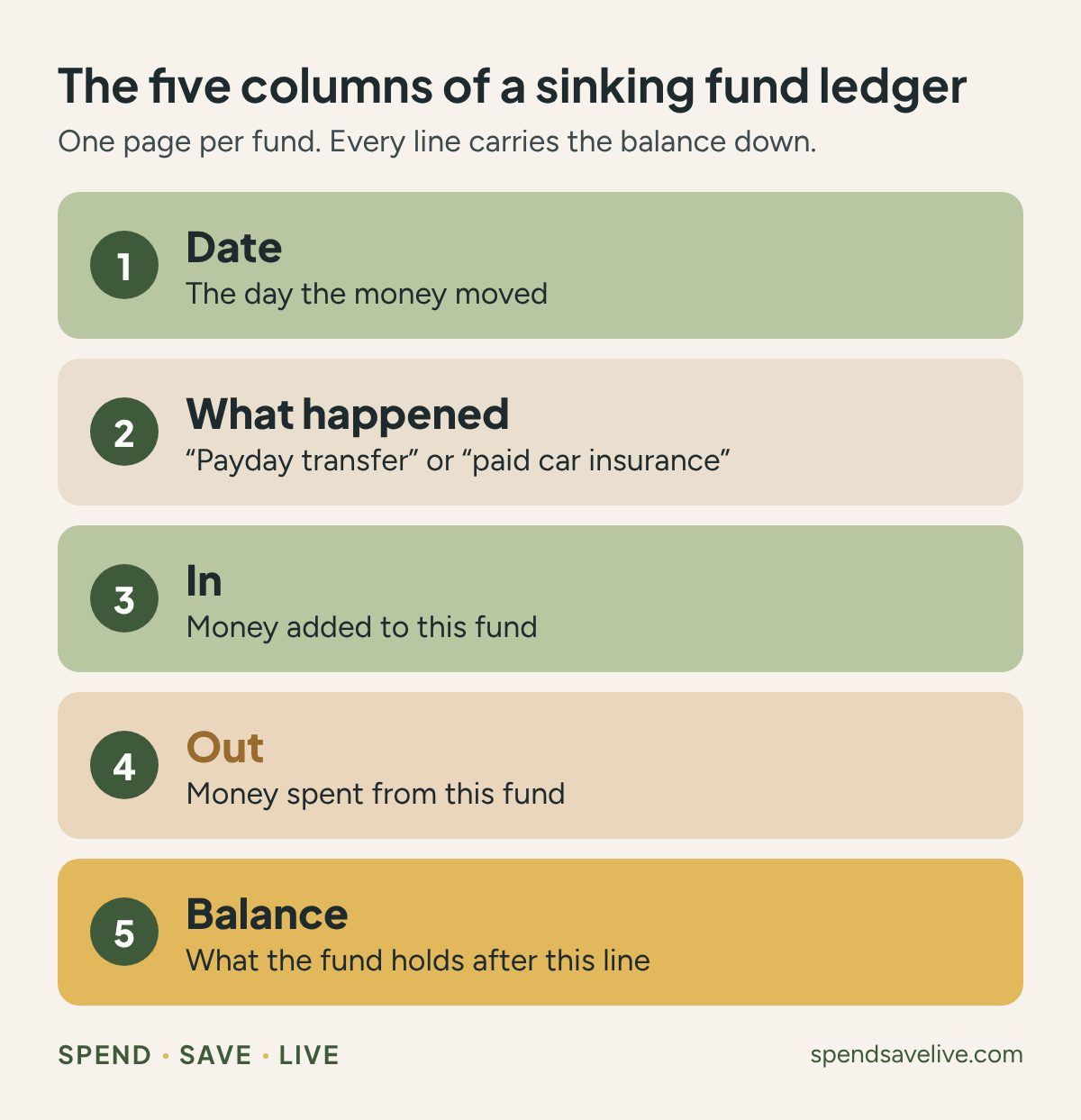
A sinking fund tracker needs five columns per fund: date, what happened, money in, money out and balance.
- Date: the day the money actually moved.
- What happened: “payday transfer”, “paid car insurance”, “field trip fee”.
- In: money added to this fund.
- Out: money spent from this fund.
- Balance: what the fund holds after this line.
At the top of each page write the fund name, the target, the due date, the opening balance and the date you counted it. Everything else can stay off. If you don’t know which funds deserve a page yet, start with which funds to start with, and put each due date on a budget calendar so the bills don’t sneak up on you.
It’s the same habit the CFPB’s spending tracker teaches: write down the amount and what it was for, even when there’s no receipt.
Prefer a sinking funds spreadsheet in Excel or Google Sheets? Use the same five columns, one tab per fund, and one total row. Before my dashboard I used one very simple Google Sheet, one block per month, with each pot as its own savings row and a little paid or done status next to it (super simple, and that’s why it worked).
How Do I Record a Withdrawal Without Wrecking the Balance?
Write it down the day you pay, as money out, and carry the new balance down.
- Pay the bill.
- On that fund’s page, write the date, who you paid and the amount in the Out column.
- Subtract it from the balance above and write the new balance.
- If you paid from checking, move the money back from savings the same day and note the transfer on the same line.
Money you move into a fund from checking is a deposit on that fund’s page. Don’t count it as income in your budget too, because you already counted it once when you got paid.
If the bill is bigger than the fund, log only what came out of the fund and write the rest as “paid from budget”. No negative balances, ever, because a negative fund balance only hides the problem until the next bill.
Whatever is left after the bill stays in the fund. That’s how I do it too: I pay bills from the same pot the money went into, and leftover money in a pot just stays there for next time.
Read more: A Simple Monthly Budget Planner With a Filled-In Example
What Does a Sinking Funds Tracker Look Like After Four Months? (Worked Example)
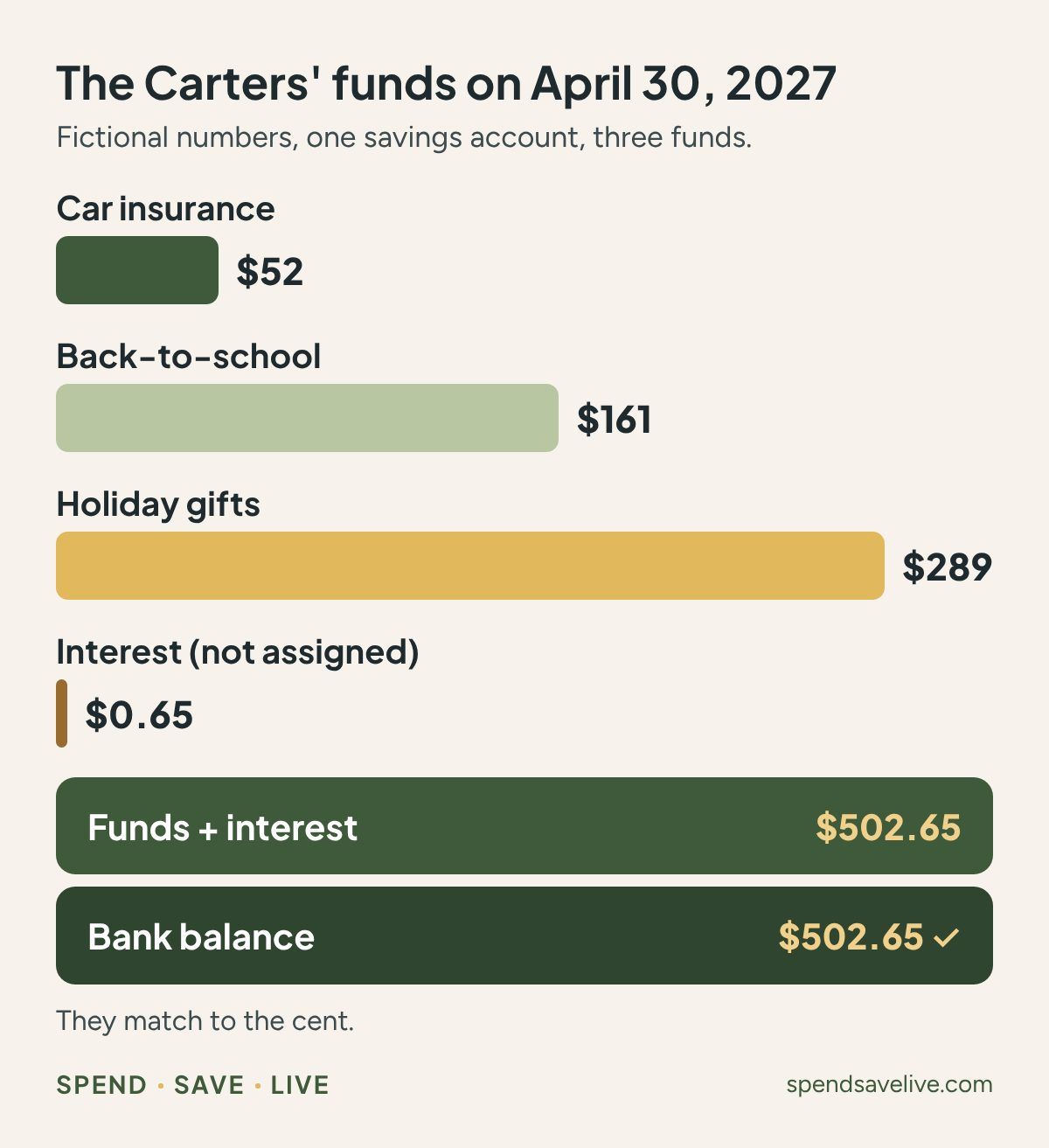
The fictional Carters’ one savings account held $502.65 on April 30, 2027, and their three fund pages add up to exactly that.
Fictional numbers, your costs will differ. The Carters take home $2,400 every other Friday starting Friday, January 8, 2027, and keep three funds in one savings account: car insurance ($81 a payday), back-to-school ($20 a payday) and holiday gifts ($21 a payday, with $100 already saved). The $642 premium isn’t a typical price, and the small interest amounts are made up too.
| Date | Car insurance entry | Balance |
|---|---|---|
| Jan 8 to Apr 16 | 8 deposits of $81 | $648 |
| Wed, Apr 28 | Paid the 6-month premium, out $642 | $6 |
| Fri, Apr 30 | Deposit $46 (next premium due Nov 1) | $52 |
| Fund on Apr 30 | What happened | Balance |
|---|---|---|
| Car insurance | $694 in, $642 out | $52 |
| Back-to-school | $196 in, $35 out (March 12 field trip fee) | $161 |
| Holiday gifts | $100 opening, $189 in | $289 |
The math: opening $100 + deposits $1,079 − withdrawals $677 + interest $0.65 = $502.65, which is exactly the bank balance ($52 + $161 + $289 + $0.65).
How Do I Reconcile Sinking Funds With My Bank Balance?
Here’s how to track sinking funds in one line: once a month, add every fund balance plus the interest line, and the total must equal the account balance on the same date.
Fund pages added up = bank balance. Every month.
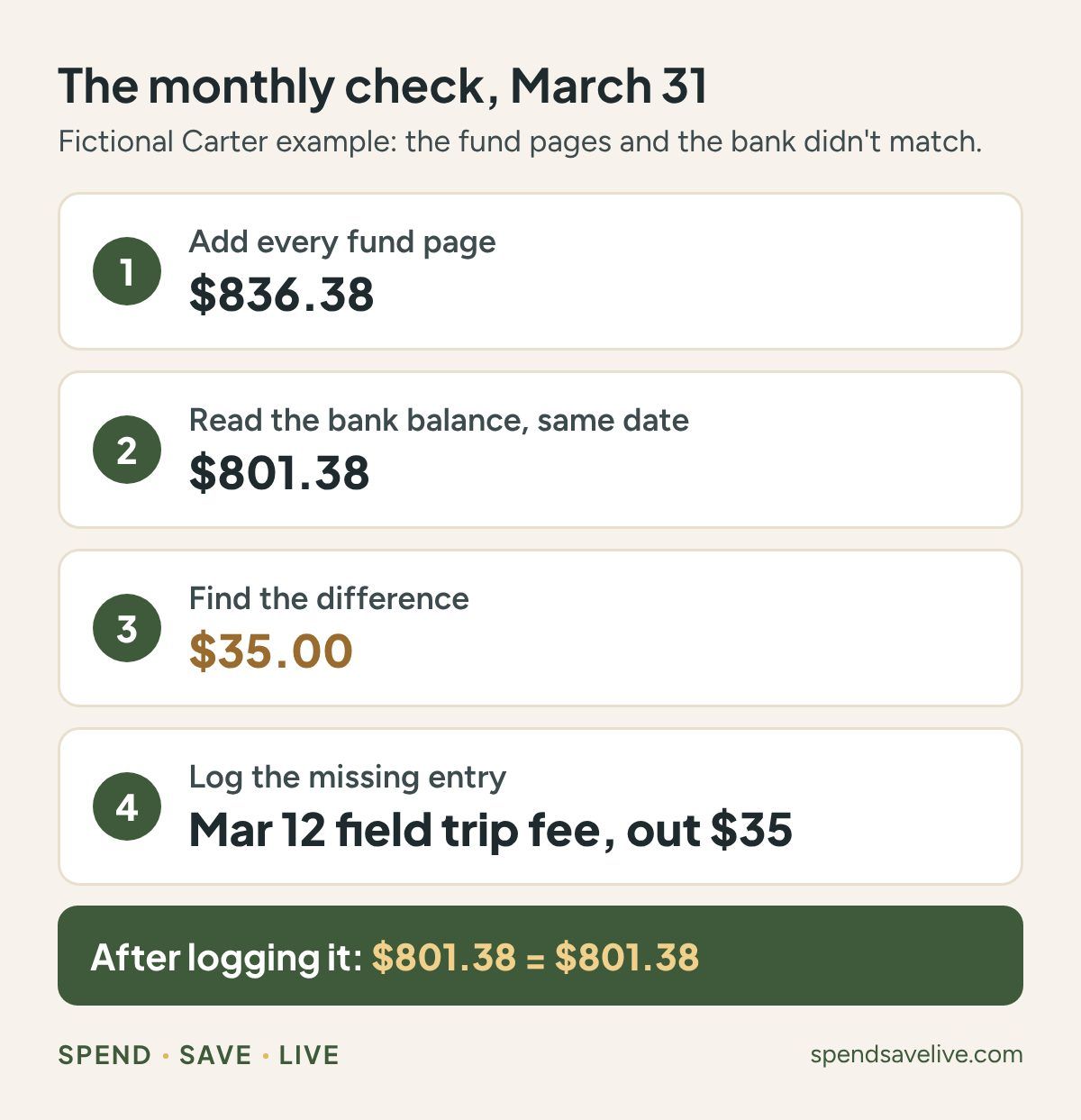
- Add up the latest balance on every fund page.
- Add the interest line (interest you haven’t assigned to a fund yet).
- Read the bank balance for the same date.
- If the two don’t match, find the missing entry and write it in.
The Carters’ March check went like this: the fund pages said $836.38, the bank said $801.38. The $35 gap was the March 12 field trip fee, paid from the account but never written on the back-to-school page. One line later, everything matched again.
When the numbers don’t match, it’s almost always one of three things:
- a withdrawal or deposit you didn’t log,
- a transfer that hasn’t landed yet,
- interest or a fee you haven’t written down.
And if money is gone that you didn’t spend, call your bank right away. The CFPB says that at the latest you must notify your bank within 60 days after it sends the statement showing the transaction, so a monthly check catches it in time. My own transfers go out on payday and I log every transaction, which makes this check a quick job instead of an evening of scrolling through statements.
What’s in the Sinking Funds Ledger Printable?
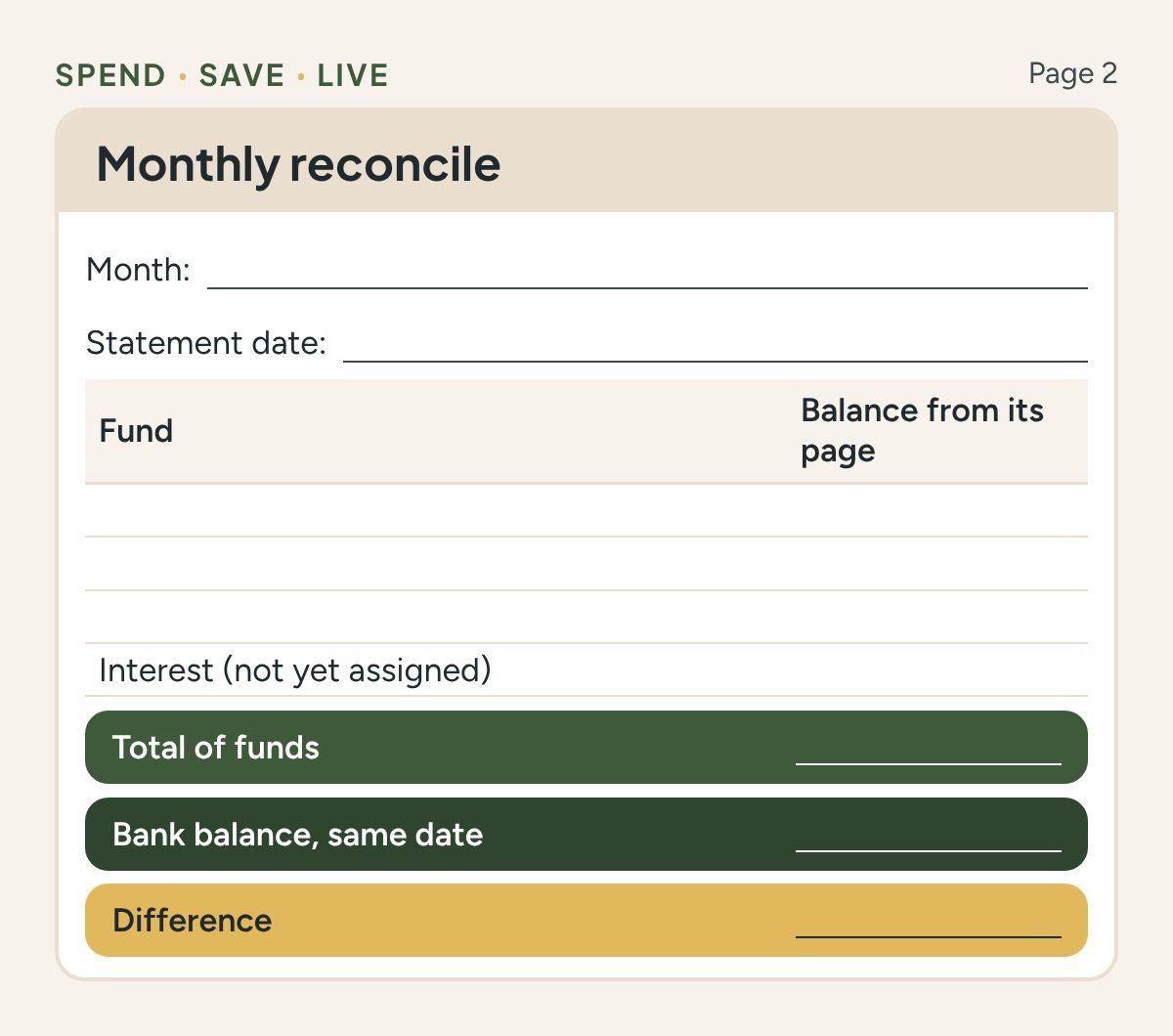
Two pages: a fund ledger (print one per fund) and a monthly reconcile page, the same two you just saw in use.



- Page 1, fund ledger: fund name, target, due date, opening balance, the date you counted it, per-payday amount, and 22 rows of date, what happened, in, out and balance.
- Page 2, monthly reconcile: up to 8 funds, an “interest (not yet assigned)” line, the total, the bank balance on the same date, the difference, and a three-cause checklist for when it isn’t $0.
Get the full Sinking Funds Ledger
The full printable PDF is coming soon. It will be free to SPEND • SAVE • LIVE readers.
What If a Withdrawal Leaves a Fund Short?
Recount the per-payday amount from today’s balance, and don’t raid another fund to cover it.
The Carters’ back-to-school fund dropped from $100 to $65 after the March 12 fee. Their target was $300 by August 2, so:
- $300 target − $65 balance = $235 still needed.
- 10 paydays left, from March 19 to July 23.
- $235 ÷ 10 = $23.50, rounded up to $24 a payday.
- At $24 they reach $305 by August 2. At the old $20 they’d reach only $265, $35 short.
Their total per payday goes from $122 to $126, then down to $91 from April 30 once the car insurance is paid. The CFPB’s savings plan tool uses the same work-backward method, and our sinking fund calculator does the division for you.
Read more: A Biweekly Budget Template for Bills Between Paydays
Should My Sinking Funds Live in One Account or Several?
Either works: one account needs the ledger, several accounts need less tracking but more logins.
The old six-per-month limit on savings transfers was removed from the Federal Reserve’s rule on April 24, 2020, but the Fed’s savings deposits FAQ notes the change doesn’t require banks to drop their own limits. So check your account terms before you plan lots of small withdrawals.
Money in a savings account at an insured bank is covered by FDIC deposit insurance up to $250,000 per depositor, per insured bank, for each ownership category (stocks and crypto aren’t deposits, so they aren’t covered). More on where to keep sinking funds is coming in its own guide.
Keep your emergency fund off this ledger. The CFPB describes it as money “set aside for unplanned expenses”, and sinking funds are for the planned ones, so keep sinking funds apart from emergency savings.
What a Tracker Can’t Fix, and When to Get Help
A ledger shows you the shortfall, but it can’t make your income cover the essentials.
- The CFPB’s prioritizing bills tool helps you decide what gets paid first when there isn’t enough.
- 211 connects you with local help with bills and food.
- The National Foundation for Credit Counseling (877-360-6322) lists nonprofit credit counselors.
- Money missing that you didn’t spend: contact your bank right away and see the CFPB guide on unauthorized transactions.
New here? Start Here walks through the whole SPEND • SAVE • LIVE system in order.
Frequently Asked Questions
How do you keep track of sinking funds?
Give each fund its own ledger page with a running balance, log every deposit and withdrawal with its date, and once a month check that all the balances add up to your actual account.
What is a sinking fund balance?
It’s what one fund holds today: the opening balance plus every deposit, minus every withdrawal. Your running balance column shows it after each line.
Do people really use sinking funds, and how?
Many budgeters keep one fund for each dated cost, like car insurance or back-to-school, add a set amount every payday, and pay that bill only from its fund.
What sinking funds should I have?
Start with the dated costs you paid last year, the ones that felt like surprises. The full list is in our guide to sinking fund categories. See which funds to start with.
Should one sinking fund cover lots of different things?
You can, but every extra fund is another page to reconcile. Combining small costs into one fund, like “car stuff”, keeps the tracker easier to manage.
How do you organize sinking funds?
Use one ledger page per fund, sorted by due date, plus one reconcile page you fill in once a month. If you have too many funds, merge the small ones. More on too many sinking funds is coming soon.
Is there an app for tracking sinking funds?
Any app, spreadsheet or paper ledger works if it records withdrawals and you check the total against the bank each month. We don’t rank apps, so pick the one you’ll actually open.
Key Takeaways
- Track each fund like a tiny bank account: opening balance, dated deposits, dated withdrawals, running balance.
- Log the withdrawal the day the bill is paid, before you do anything else.
- Once a month, the fund balances plus interest must add up to the real account balance.
- A withdrawal that leaves a fund short means a new per-payday amount, not a skipped bill.
The Bank Number and Your Notes Can Finally Agree
The whole trick is boring on purpose: write the money going out the day it goes out, and check the total once a month. Do that and the next time a bill lands you’ll know exactly which fund pays it and what’s left after (no panic, no guessing). If you’re still picking your funds, start your first three here.
Sources (checked November 2026)
- CFPB, An essential guide to building an emergency fund
- CFPB, Your Money, Your Goals: Spending tracker
- CFPB, Your Money, Your Goals: Savings plan tool
- CFPB, Your Money, Your Goals: Prioritizing bills
- Ask CFPB, Unauthorized transactions or money missing from your account
- Federal Reserve, Regulation D interim final rule (April 24, 2020)
- Federal Reserve, Savings deposits FAQ
- FDIC, Understanding deposit insurance
- 211.org
- National Foundation for Credit Counseling
Educational content, not financial advice. The Carter family and all their numbers are fictional.