

Write down what the goal costs, subtract what you’ve already saved, count the paydays left before your deadline and divide. That’s your amount per payday. Then check it against what’s really left after that paycheck’s bills, and if it doesn’t fit, move the date or shrink the target instead of leaning on willpower.
Most money goals start life as a sentence like “save for a car this year”, which sounds lovely and tells you absolutely nothing about what to do when your paycheck lands on Friday.
This financial goals worksheet turns that sentence into a number per payday. It starts from what you’ve already saved (most sheets skip that line), counts your real 2027 paydays, tests the amount against what’s actually left on payday and, when the answer is no, works out a new date on paper. There’s a fictional example where the deadline really moves, and the printable itself is coming soon for SPEND • SAVE • LIVE readers. More guides like this live in Money goals.

Read this also:
- How to Start Sinking Funds for Costs You Know Are Coming
- A 52-Week Savings Challenge That Fits Your 2027 Cash Flow
- Budgeting for Beginners From the Money You Actually Have
- A Life Audit That Helps You Choose One Change for 2027
Quick check before you grab a pencil, because this sheet only does one job:
- Yes, if you have one money goal with a price tag and a paycheck or benefit that lands on a schedule.
- Not yet, if three goals are fighting over the same dollar. First decide which goal gets the next dollar, then come back with the winner.
- Different sheet, if the goal is about health, work or habits. For life goals that aren’t about money there’s a separate worksheet, or try a New Year goal setting worksheet for goals that aren’t about money.
- Help first, if this month’s bills aren’t covered yet. Skip to the help section near the end, no shame in it.
What Does a Financial Goals Worksheet Need That Most Free Ones Skip?
Five lines, in this order: target, already saved, deadline, paydays left and amount per payday, plus a fit test and a plan B for when it doesn’t fit.
I went through the worksheets that show up on Google’s first page for this (they’re nearly all PDFs from credit unions, a university, a state regulator, a nonprofit and the CFPB), and most of the pieces exist somewhere. They just never all exist on the same page.
The strongest of them is the CFPB’s My New Money Goal worksheet, and credit where it’s due: it averages three months of income and spending, tests what’s “available to save” and lists four fixes when the money’s short, one of them being to stretch the time. What it doesn’t have is a line for money you’ve already saved toward this goal, a payday count instead of months, or the math for your new date.
| What it covers | CFPB worksheet | This worksheet |
|---|---|---|
| Affordability test | Yes | Yes, per paycheck |
| Money already saved | No line for it | Yes |
| Time unit | Months | Your paydays |
| New date if short | Says stretch the time | Works it out |
| Filled example | No | Yes, below |
So this sheet keeps the CFPB’s honest test and wraps the payday math around it, which is the part that tells you what to actually move on Friday.
How Do You Turn a Goal Into an Amount per Payday? (No Math Degree Needed)
Subtract what you’ve already saved from the target, then divide by the paydays left before the deadline.
- Write the goal as one line with a number and a date. The CFPB’s SMART goals tool wants it specific, measurable and time-bound, and “$3,000 toward a used car by August 31, 2027” ticks every box.
- Subtract what you’ve already saved for it. Skip this and every payday amount comes out too high, which is exactly how a doable goal starts looking impossible.
- Count your paydays from the next one to the last one on or before the deadline. Paydays, not months (the next section shows why).
- Divide and round up to the next whole dollar. That’s the number you test.
It’s the same division the CFPB uses in its savings plan tool, where $1,000 over 40 weeks comes to $25 a week, just pointed at the days money actually lands in your account.

This is pretty much how I planned my own big goal for 2024. I set the target first and worked backward from it, which came out at about 30% of my salary every month, starting in December 2023, and I hit it in summer 2024 (I’m paid monthly, so my paydays and my months are the same thing, lucky me, but most of you aren’t, which is the whole next section).
How Many Paydays Do You Really Have in 2027? (Fewer Than Your Calendar Thinks)
Anywhere from 12 to 53, depending on how you’re paid, and every other Friday gives you 26 or 27.
January 1, 2027 falls on a Friday, which makes it a slightly odd year for anyone paid on Fridays. Here’s how it shakes out:
| How you’re paid | Paydays in 2027 | Months with an extra payday |
|---|---|---|
| Weekly (Fridays) | 53 | Jan, Apr, Jul, Oct, Dec |
| Every other Friday from Jan 1 | 27 | Jan, Jul, Dec |
| Every other Friday from Jan 8 | 26 | Apr, Oct |
| Twice a month | 24 | None |
| Monthly | 12 | None |
And this is where months quietly lie to you. A deadline eight months away sounds like 16 paychecks on a biweekly schedule, but with a first payday on January 8 and a deadline of August 31 you get 17, because the last one lands on August 20. Move the deadline to August 15 and it drops to 16, so count them on a real calendar instead of guessing.
- Three 2027 federal holidays land on a Friday, January 1, June 18 (Juneteenth, observed) and December 24 (Christmas, observed), per OPM. If one of those is your payday, ask your payroll team whether pay moves, because employers handle it differently.
- Social Security pays on the second, third or fourth Wednesday depending on your birth date, and SSI on the 1st, according to the SSA 2027 schedule. Some people who got Social Security before May 1997 are paid on the 3rd.
- Biweekly is the most common schedule, used by 43.0% of private establishments in February 2023, per the BLS. That counts businesses, not workers, but it’s why this post fusses so much about Fridays.
Those three-paycheck months are handy for goals, and Dana’s example below uses two of them.
Read more: A 52-Week Savings Challenge That Fits Your 2027 Cash Flow
Does the Amount Actually Fit What’s Left on Payday?
It fits if the amount per payday is at or below what’s left after that paycheck’s bills and the savings already going out.
This is the CFPB’s available-to-save test done per paycheck instead of per month, because a goal that fits on average can still bounce on the paycheck that also has to cover rent.
- Take-home on this paycheck (what actually lands, after tax and deductions)
- Minus the bills this paycheck covers
- Minus savings already going out, like an emergency cushion transfer
- Equals what’s left on payday
- Your amount per payday should be at or below that, ideally with a few dollars of buffer
If your hours change week to week, use the average of your last three paychecks, which is the same idea as the CFPB’s three-month average.
Then give it a test drive. The CFPB suggests trying a plan for a month or so before you set up automatic savings, which is a polite way of finding out your grocery number was fiction before it costs you anything.

Read more: Budgeting for Beginners From the Money You Actually Have
What If the Plan Doesn’t Fit? (Change the Date, Not Your Willpower)
Move the date, add money that has a real date on it, or lower the target, and do it on paper now instead of finding out in August.
Trying harder isn’t a plan. If the math says $150 and your paycheck says $105, the paycheck wins every single time, no matter how motivated you felt in January.
- Same goal, later date. Keep the amount you can afford, divide what’s still needed by it, round up, and count forward that many paydays. That payday is your new deadline.
- Add a dated extra. A tax refund (if you expect one), a third paycheck, a bonus that’s actually in your contract. The IRS says it issues more than nine out of ten refunds in less than 21 days and lets you split a refund across accounts, so one slice can go straight to the goal. Never count an amount or a date you can’t see yet.
- Same date, smaller goal. Already saved plus what you can afford times the paydays left. That’s what’s realistic by the deadline, and a smaller win on time can feel a lot better than a big one that keeps slipping.
- Change the inputs, only if it’s real. Cut a cost you can really live without, or add income, but check what extra work really pays per hour before you sign up for anything, and if your pay is behind the market, ask for a raise with evidence.
The CFPB’s handout on revising goals says the same thing, more politely: if you miss a target, keep saving, and either lower the total or give yourself more time.

A Financial Goals Worksheet Example Where the Deadline Moves
Fictional Dana needs $150 per payday but only has about $105, so with two dated extras her deadline moves from August 31 to October 1.
Fictional example. Dana is single, rents, and is paid every other Friday starting January 8, 2027, with $1,560 take-home per paycheck. Her goal is $3,000 toward a used-car down payment by August 31, 2027, and she has already saved $450 for it.
The goal math
| Line | Value | How |
|---|---|---|
| Target | $3,000 | her number |
| Already saved | $450 | in her car pot |
| Still needed | $2,550 | 3,000 − 450 |
| Paydays to Aug 31 | 17 | Jan 8 to Aug 20 |
| Needed per payday | $150 | 2,550 ÷ 17 |
If she’d forgotten the $450, she’d be aiming for $176.47 a payday, $26.47 more than she needs. The month-based version of the same goal says $318.75 a month for eight months.
Does it fit?
| Line | Value | How |
|---|---|---|
| Monthly take-home | $3,380 | 1,560 × 26 ÷ 12 |
| Monthly expenses | $3,050 | her budget |
| Savings already going out | $100 | emergency cushion |
| Available per month | $230 | 3,380 − 3,050 − 100 |
| Available per payday | about $106 | 230 × 12 ÷ 26 |
| Result | Does not fit | short about $45 |
She commits $105 per payday (keeping a dollar of breathing room), about $45 short of the $150 she needs. So she runs all three fixes:
- Plan A, same amount, later date: by August 20 she has $1,785 of the $2,550. At $105 a payday she finishes on her 25th payday, Friday, December 10, 2027.
- Plan B, dated extras: $105 a payday plus a $300 tax refund she expects around March 12 and $200 from each third paycheck (April 30 and October 29). By August 31 she’s at $2,285, and she reaches $2,550 on Friday, October 1, 2027, before the October extra is even needed.
- Plan C, same date, smaller goal: keep August 31 and aim for $2,235 in total ($450 + $105 × 17).
Dana picks Plan B and writes October 1 on her worksheet. The deadline moved one month instead of three, purely because the extra money had dates on it. (The refund is part of the fiction too. Real refunds aren’t guaranteed, so she treats that line as a bonus until it lands.)


What’s in the 2027 Financial Goals Worksheet?
Two pages: the goal and payday math on page 1, the fit test and plan B on page 2.
- Page 1: my goal and why it matters, target, already saved, still needed, deadline, how I’m paid, next and last payday, a 53-box payday counter, paydays left and amount per payday.
- Page 2: take-home, bills this paycheck covers, savings already going out, left on payday, the fit test, amount I can commit, paydays needed, three lines for dated extras, revised deadline, smaller target, my plan and review dates (one month in, then every three months).
Print the financial goals worksheet on US letter at 100% and fill it in pencil, because the dates are allowed to change (that’s kind of the point).
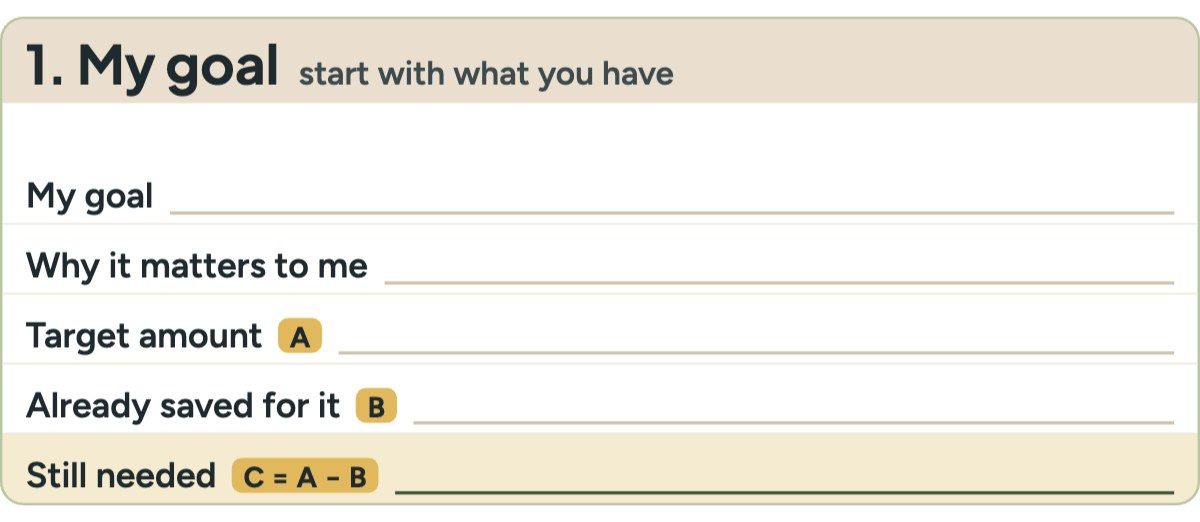

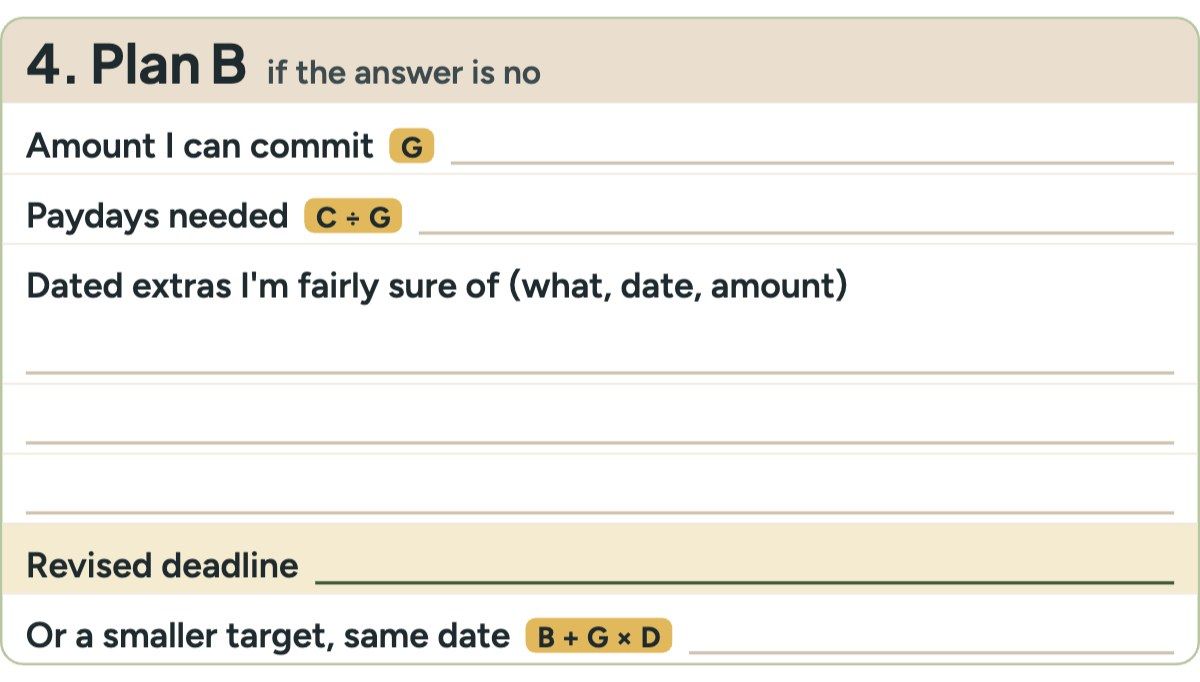
Get the Full 2027 Financial Goals Worksheet
The full printable PDF is coming soon. It will be free to SPEND • SAVE • LIVE readers.
Once your number fits, automate the transfer for your next payday so you don’t have to be a hero every two weeks, and track it with a savings goal tracker so you can see the pot grow. Then decide where to keep the money, ideally somewhere you won’t dip into for groceries. If it sits in a bank, FDIC insurance covers $250,000 per depositor, per insured bank, for each account ownership category.
Rather have a game than a plain transfer? Pick a savings challenge your paycheck can fund and point it at this goal.
Read more: How to Start Sinking Funds for Costs You Know Are Coming
What Can’t This Worksheet Do, and When Should You Get Help?
It plans one goal at a time. It doesn’t rank goals, pick investments or fix a budget that’s already short.
If there’s nothing left on any payday, the goal waits and the budget comes first, and that’s simply the right order. These are good places to start:
- Call 211 or search 211.org for local help with bills, housing and food. It’s confidential and available 24/7.
- Use the NFCC agency finder for a confidential consultation with a certified credit counselor (no upfront fees, no obligation).
- The CFPB’s Your Money, Your Goals toolkit has more worksheets for income, bills and debt.
- New here? The Start Here page shows which guide to read first.
Frequently Asked Questions
What is a good example of a financial goal?
One with a number and a date, like a $1,000 cushion by June or $3,000 toward a car by fall. If you want more ideas, here are more financial goal examples.
How do you make financial goals?
Pick one goal, give it an amount and a date, subtract what you’ve already saved and divide by the paydays left. Test that amount against what’s left on payday, try it for a month, then automate it.
What should my financial goals be?
There’s no single right list. Start with the goal that matters most to you right now and fits on payday, then add the next one once the first transfer is running.
How do I fill in a financial goals worksheet?
Work through the five lines in order: target, already saved, deadline, paydays left and amount per payday. Then do the fit test, and if it fails, fill in plan B. Dana’s example above shows every line filled in.
How much should a sinking fund be?
The cost minus what you’ve set aside, divided by the paydays until it’s due. For costs you know are coming, you can work backward from the due date the same way.
How can setting financial goals help with budgeting?
A goal turns “save more” into a set amount per payday, and your budget then has to make room for it like any other bill.
What if I miss a contribution?
Recount the paydays left and redo the division with what’s still needed, or move the date. One missed payday changes the math a little, not the whole plan.
Key Takeaways
- Subtract what you’ve already saved before you divide.
- Count paydays, not months. Every other Friday in 2027 gives you 26 or 27.
- Test the amount per payday against what’s really left on that payday.
- If it doesn’t fit, move the date, add dated extras or shrink the target, on paper, before you miss it.
- Review one month in, then every three months.
Seventeen Fridays and One Pencil Line That Moves
Back to that car sentence from the top. Write the five lines, run the fit test, and if the date has to move, move it now while it’s still your choice instead of a surprise in August. And if a few yearly bills keep sneaking up on the same paychecks, start a sinking fund for them with the exact same payday math.
Sources (Checked November 2026)
- CFPB, My New Money Goal worksheet
- CFPB, Your Money, Your Goals: SMART goals tool
- CFPB, Your Money, Your Goals: Savings plan tool
- CFPB blog, Set a goal, make a plan, and save automatically (2014, archived)
- CFPB, Your Money, Your Goals: Revising goals
- CFPB, Your Money, Your Goals toolkit
- BLS, Length of pay period (February 2023)
- SSA, Schedule of Social Security payments 2027
- OPM, Federal holidays
- IRS, Direct deposit your refund to one, two or three accounts
- FDIC, Understanding deposit insurance
- 211.org, Your local 211
- NFCC, Agency finder
- 2027 payday counts and Dana’s numbers: SPEND • SAVE • LIVE calculations, November 2026. Dana is a fictional example.
Educational content, not financial advice.