

Log one ordinary week in broad blocks (work, commute, chores, free time and so on) until the seven days add up to 168 hours. Put that log next to the plan you wrote before the week started, find the biggest gap you can actually control, and change only that one thing next week.
Most of us carry around a picture of our week that is a lot kinder than the real thing, and a time audit is simply the moment you check that picture against what actually happened. You don’t need a stopwatch or an app watching your screen for it, just one honest week written down in big chunky blocks.
Below you get a seven-step way to do it in about ten minutes a day, a fictional week (hi Priya) where both the plan and the log add up to 168 hours, a way to read the gaps without beating yourself up, and one rule for picking the single change that is worth making.

Read this also:
- A Life Audit That Helps You Choose One Change for 2027
- A New Year Goal Setting Worksheet That Fits Your Real Week
- A Printable Habit Tracker With Room for Imperfect Weeks
- A Side Hustle Calculator for the Money You Keep per Hour
I plan my own week with time blocks in my calendar, because between studying, leading finance at our team company and running my own business, a week without a plan just evaporates. The plan only works, though, if the hours in it are real ones, and that is exactly what this little audit checks. (It lives in our Time and planning corner of Habits and life planning, if you want more of the same.)
Quick self-check before you start:
- Your week feels full and you honestly can’t say what filled it.
- A plan you made last month didn’t survive past Wednesday.
- You want to add something new (a class, a goal, a side project) and have no idea where it would fit.
- If you’re behind on rent or bills right now, skip straight to the help section first. That matters more than any worksheet.
What Is a Time Audit, and Is It the Same as a Life Audit?
A time audit is a record of where your hours went during one week, kept by you, for you, and read by nobody else. Your boss never sees it, and it doesn’t care how “efficient” you were.
People search for it as a time audit, a personal time audit or plain old time auditing, and the idea is the same every time: you write down what you actually did, then you compare it with what you thought you’d do. It sounds almost too simple, and it is simple, which is the whole point. The US government even runs a big version of it, the American Time Use Survey, which asks people what they did with their day (its latest results, for 2025, came out in June 2026). Yours is the same idea, just for one person and one week.
It is also a different tool from a life audit worksheet. The life audit asks which areas of your life need attention, and the time audit asks whether you actually have the hours to act on what you found. If you did the life audit and thought “great, now when exactly?”, this is the next page.
And because it’s personal, the log stays on your own paper or your own sheet. You’re not measuring anybody else, and nobody is measuring you.
Why Compare What You Planned With What Actually Happened?
Because the surprise lives in the plan. Most of us plan our own week as if nothing will go wrong, and a log shows what the week did instead.
Pretty much everybody does this. In a well-known 1994 study by psychologists Roger Buehler, Dale Griffin and Michael Ross, students guessed their senior thesis would take about 34 days (33.9 on average). It took them 55.5, and only about 30% finished within the time they had predicted (Buehler, Griffin and Ross, 1994).
Those were big projects, not weekly routines, so I’m not saying your Tuesday plan is off by 60%. I’m saying the gap between “what I think will happen” and “what happens” is normal, and the easiest way to shrink it is to look at a real week before you plan the next one.
How Do You Do a Time Audit in One Week, Step by Step?
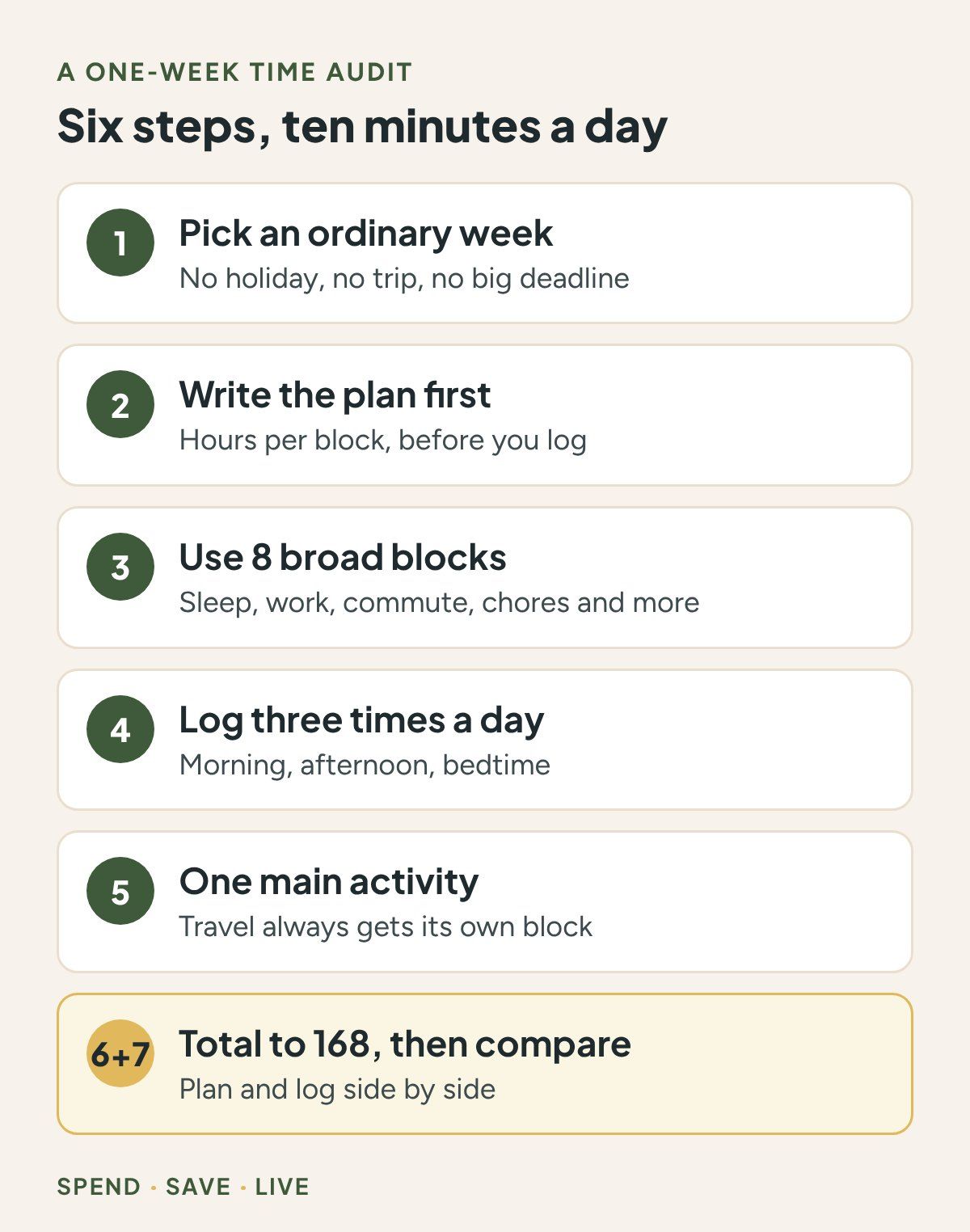
Seven small steps, about ten minutes a day, and the only math is adding up to 168 (that’s 24 hours times 7 days).
- Pick an ordinary week. No holiday, no trip, no giant deadline. You can start on any day.
- Write your plan first. Before you log anything, jot down how many hours you expect for each block this week. This plan is what you compare against later, so don’t skip it.
- Use 8 broad categories. Sleep, Paid work, Commute, Meals and getting ready, Home and chores, Family and friends, Errands and appointments, Free time. Rename them or add one, but keep it under 10.
- Log three times a day. Morning, mid-afternoon and bedtime, in whole or half hours. Memory is pretty good for a few hours and pretty useless after a few days (ask me what I had for lunch on Thursday).
- One main activity per block. If two things overlap, like folding laundry with a show on, write down the main one. Travel always gets its own block, so commutes and errand runs don’t quietly hide inside other things.
- Add it up on day 7. Total each category for the week. The whole thing must come to 168. If you’re an hour short, go find it, because the missing hour is usually something small and sneaky, and that’s a finding too.
- Put the plan and the log side by side. Same rows, two columns. The next section shows exactly how that looks.
Here is one fictional day from the worked example, so you can see how chunky the blocks are allowed to be. Nobody is logging “4 minutes checking email” here.
| Block | Hours | What it was |
|---|---|---|
| Sleep | 6.5 | In bed by 11:30 |
| Meals and getting ready | 1.5 | Breakfast, shower |
| Commute | 0.5 | Bus to work |
| Paid work | 8.5 | Office, stayed late |
| Commute | 0.5 | Bus home |
| Errands and appointments | 1 | Pharmacy and post office |
| Meals and getting ready | 1 | Cooked dinner |
| Home and chores | 1 | Dishes, laundry |
| Free time | 1 | Show on the couch |
| Family and friends | 1 | Call with her sister |
| Free time | 1.5 | Reading in bed |
| Total | 24 | One Tuesday, logged three times |
What Does a Filled-In Time Audit Look Like?
Like this: one fictional week, planned and logged, where both columns add up to 168 hours and the gap jumps right out at you.
Meet Priya. She is made up for this example, and so is every number below. She works full time in an office in the US, rents an apartment, has no kids and cooks most nights. She wrote her plan on Sunday, logged three times a day, rounded to the nearest hour and counted the trip to work as Commute. Sleep is just hours in bed here, not something we judge.
| Block | Planned hours | Logged hours |
|---|---|---|
| Sleep | 56 | 54 |
| Paid work | 40 | 44 |
| Commute | 5 | 7 |
| Meals and getting ready | 21 | 22 |
| Home and chores | 10 | 14 |
| Family and friends | 12 | 10 |
| Errands and appointments | 6 | 10 |
| Free time | 18 | 7 |
| Total | 168 | 168 |
Both columns land on 168 (I checked the math twice, because of course I did). The gaps, logged minus planned, are -2, +4, +2, +1, +4, -2, +4 and -11, and they cancel out to zero, which is exactly what should happen when the week has a fixed size. Free time ended up as 7 of 168 hours, about 4.2% of the week, when she had planned 18 hours, about 10.7%.
| Block | Gap in hours | What the log showed |
|---|---|---|
| Free time | -11 | Planned 18, logged 7. Most weekday evenings ended with chores or errands |
| Errands and appointments | +4 | 8 separate trips, about 1.25 hours each |
| Home and chores | +4 | Laundry and dishes spread over five evenings |
| Paid work | +4 | Four days ended about an hour late |
| Commute | +2 | Two slow days with an extra hour |
| Meals and getting ready | +1 | A slow Sunday morning |
| Sleep | -2 | Logged, not judged |
| Family and friends | -2 | Two evenings cancelled |
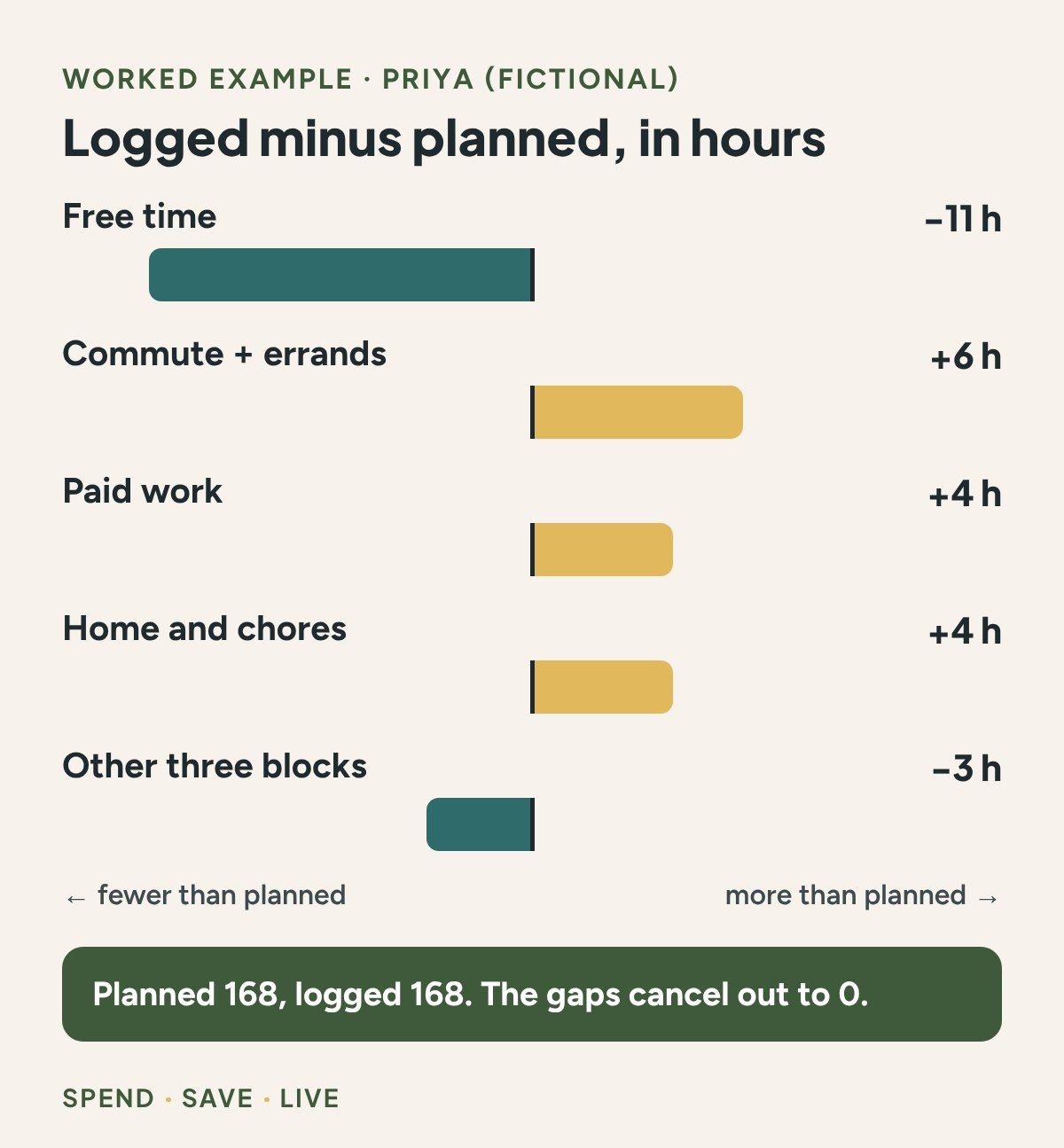
So what does this tell Priya? Not that she’s lazy, and not that she planned too little work. It tells her she planned 11 more free hours than her week actually had room for, because errands, chores and late finishes quietly ate her evenings. And a plan is a lot easier to change than a whole person (thank goodness).
How Do You Read the Gaps Without Judging Yourself?
Treat every gap as information about the plan, never as a grade on you.
For each big gap, ask three quick questions:
- What kind of block is it? Fixed (your job, the commute), flexible (errands, chores) or a choice (free time).
- Did the plan change, or did the week? A sick coworker or a broken washing machine is the week changing. Planning 18 free hours on top of a full-time job might just be the plan being hopeful.
- Would you make the same call again? If you stayed late to help a teammate and you’d happily do it again, that hour can stay exactly where it is.
Fixed blocks usually can’t be argued down in one week. Flexible blocks can, and that’s where most of your room is hiding. A choice block, like free time, shows you what you were willing to give up when the week got tight, which is worth knowing on its own.
Two things I’d leave out on purpose. Don’t compare your totals with national averages or with a friend’s week, because your week has your job, your people and your commute in it, and nobody else’s numbers fit it. And this sheet only counts hours. It doesn’t say what your body or your mind needs, so if your sleep or energy worries you, that’s a talk with a doctor, not a worksheet.
If you already try to plan your days and the plans keep falling apart, the log is usually why, and what to change when time blocking keeps failing picks up from there.
Which One Thing Should You Change After Your Time Audit?
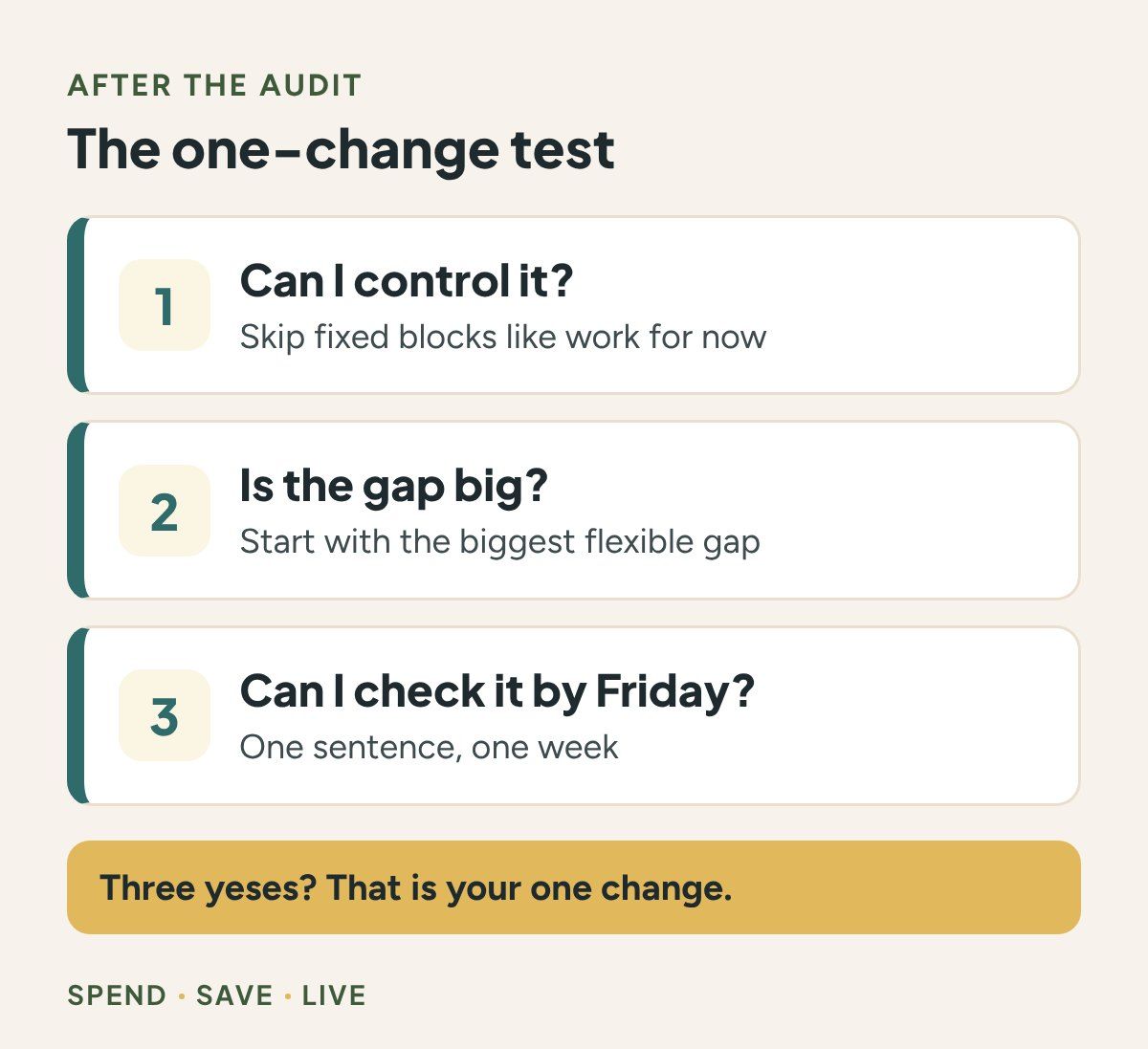
Pick the block you can control with the biggest gap, and change one thing about it for one week. Just one.
- Find the biggest gap in the whole week.
- If you can’t control it this week (your job, your commute), move to the next biggest flexible block.
- Write the change as one sentence you can check by Friday.
- Leave everything else alone, even the gaps that annoy you.
The change itself can take one of four shapes, and any of them is fine: batch it (errands in fewer trips), move it (laundry to one evening), protect a block (one evening nobody books over) or shrink the plan (plan 10 free hours instead of a hopeful 18).
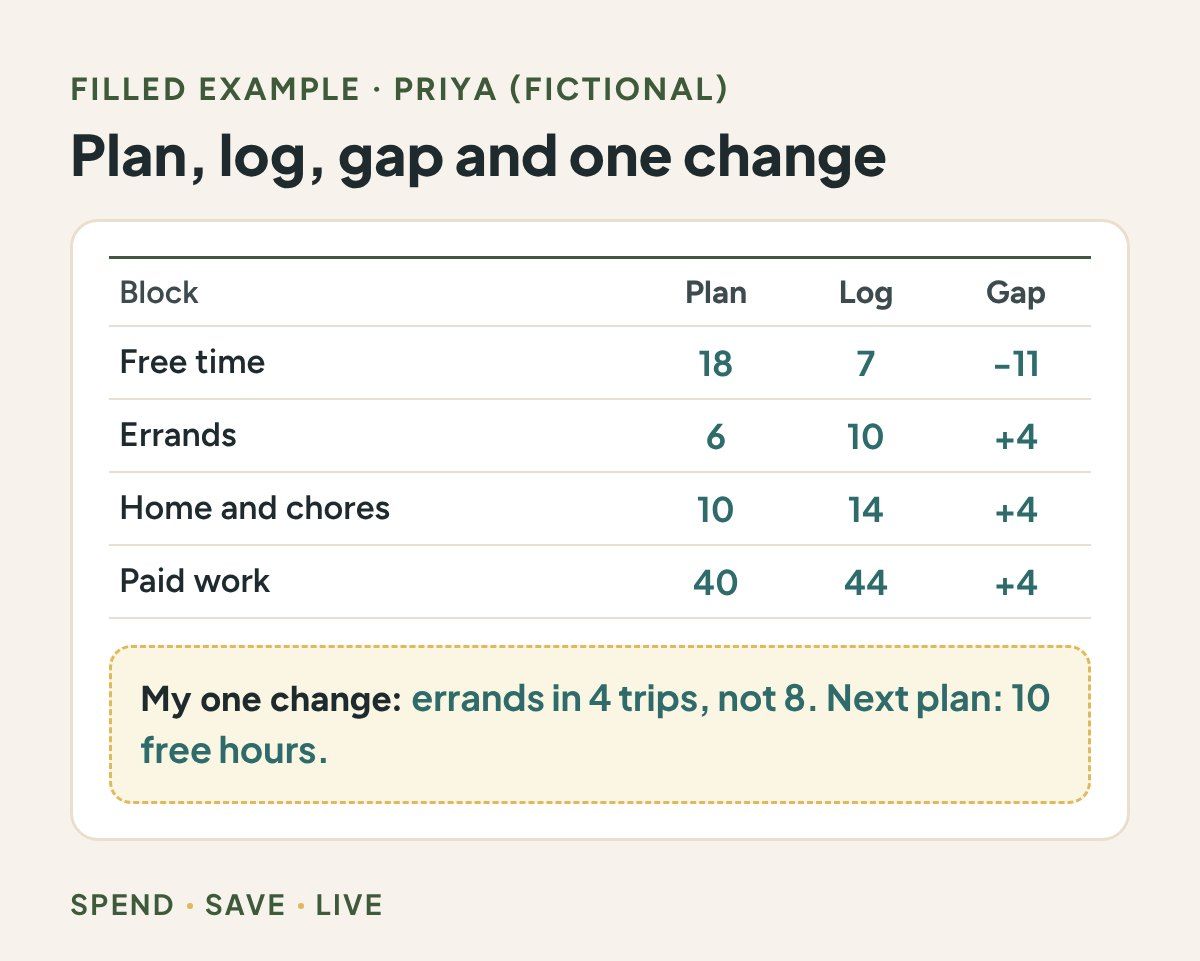
Priya’s biggest gap is free time, but free time is the result, not the cause, so she looks at what ate it. Work and commute are fixed for now, and errands are flexible. Eight trips took 10 hours, so she plans 4 longer trips of about 1.75 hours each, which is 7 hours. That frees 3 hours, and her new plan has 10 free hours instead of 18. Every block now adds up to 168 again (54 + 44 + 7 + 22 + 14 + 10 + 7 + 10).
Notice it doesn’t magically give her 18 hours back. It moves her plan to a number her week can actually hold. Less exciting, I know, but she’ll actually get those 10 hours.
Once you know your real free hours, goals get a lot easier to size. The new year goal setting worksheet and the guide on how to fit annual goals around the commitments you already have both work better with this number in hand. And if the free hours are meant for extra income, check what extra work really pays per hour before you sign up for anything.
How Do You Turn That One Change Into Next Week’s Plan?
Write next week’s plan from your logged hours, not from your old plan, then change your one block and put it on the calendar.
For Priya, that means every number in next week’s plan is her logged number, except errands (now 7) and free time (now 10). It looks less exciting than her first plan. It also has a real chance of surviving Wednesday.
This is the point where a time audit hands over to time blocking, and you don’t need to reinvent anything. Start with how to start time blocking with room for interruptions, use a weekly time-blocking template that shows your real capacity, or keep it lighter with a weekly planning template. If your life runs on your phone, there’s also a guide to time blocks in Google Calendar, and a daily planning template for the days that need more detail.
My own version is time blocks in my calendar, and the days still go sideways sometimes. When they do:
It happens, I don’t sweat. I adapt and I adjust.
For the change itself, a tick a day on a habit tracker printable is plenty. Then look back every week with a weekly review checklist, and repeat the full audit once the change has had a few weeks to settle. One time-audit worksheet from TMetric suggests a follow-up audit in 4 to 6 weeks, which is a sensible rhythm if you need a number.
What’s Inside the Seven-Day Time Audit Worksheet?
A three-page printable that does the adding with you: a day log, a 168-hour tally with plan against log, and a page for your one change with Priya’s filled-in week as a model.


Get the full Seven-Day Time Audit
The full printable PDF is coming soon. It will be free to SPEND • SAVE • LIVE readers.
When Is a Time Audit Not Enough, and Where Can You Get Help?
A time audit can show you that your fixed commitments are bigger than your week. It can’t make more hours, and that isn’t your fault.
If your log shows that work, caregiving and travel already fill everything, the answer is outside the sheet. That usually means a conversation with a manager or a family member, or some outside support:
- 211 connects you with local help for bills, food, housing and more, and its site says every call is completely confidential.
- If your question is about pay for the hours you worked, the US Department of Labor’s Wage and Hour Division lists its contact options there.
- Not sure where to start with your money at all? The Start Here page points you to the first steps.
And one more time for the people in the back: this sheet counts hours. If sleep, stress or energy worry you, a doctor or a licensed professional is the right person to talk to.
Key Takeaways
- A week has 168 hours, so a log that doesn’t add up to 168 has a gap in it, and the gap is part of the finding.
- Broad blocks are enough. One main activity per block, and travel always gets its own block.
- Compare the log with your own plan, never with an average or somebody else’s week.
- Change one block you control, then write next week’s plan from the logged numbers.
- Repeat the full audit after a few weeks, and use a weekly review in between.
Frequently Asked Questions
What is a time audit?
A time audit is a one-week log of where your hours go, written in broad blocks like work, commute, chores and free time, and then compared with the plan you made before the week started. It’s a personal tool, so nobody else reads it.
How long should a time audit last?
One ordinary week of seven days, so the weekend counts and the total can reach 168 hours. If your schedule changes a lot from week to week (shifts or travel), log a second week before you change anything.
How do I do a personal time audit?
Write your plan first, log broad blocks three times a day for seven days, add each category up until the week reaches 168, compare the log with the plan, and change one block you can control.
What categories should I use for a time audit?
Start with eight: Sleep, Paid work, Commute, Meals and getting ready, Home and chores, Family and friends, Errands and appointments, and Free time. Rename them to fit your life and keep the list under 10.
Do I need an app, or is a time audit sheet on paper enough?
Paper or a simple spreadsheet is enough. Broad blocks logged three times a day give you everything you need, and you skip apps that track your screen or record more than you want to share.
How often should I repeat a time audit?
After your one change has had a few weeks to settle. One TMetric worksheet suggests a follow-up audit in 4 to 6 weeks, and a weekly review checklist covers the weeks in between.
Your Week Was Never Too Small, the Plan Was Just Too Hopeful
Remember that kinder picture of your week from the start? After one honest log it gets less kind and a lot more useful, and the fix is usually one block, not a whole new you. Log the week, change one thing, and if you still want the bigger-picture version afterwards, the life audit is waiting.
Sources (checked November 2026)
- Buehler, Griffin and Ross (1994), Exploring the planning fallacy, Journal of Personality and Social Psychology 67(3)
- US Bureau of Labor Statistics, American Time Use Survey
- TMetric, Time Audit Worksheet with Activity Categories (PDF)
- 211.org
- US Department of Labor, Wage and Hour Division contact page
Educational content, not financial or medical advice.