

Focus on four parts of your year: money, time, habits and life admin. Ask yourself three short year-end reflection questions in each, notice the lesson that keeps coming up, then turn that one lesson into a single keep, change or stop decision with a start date and a January review date.
Most year-end reflections end the same way, with three pages of honest (and maybe slightly teary) notes about the year and not one thing that’s different by February. These year-end reflection questions are built to avoid that, because there are only 12 of them and the last page makes you pick one decision and put a date on it.
This is for grown-ups looking back on their own year, not a classroom exercise and not a work review. You’ll get the questions, a filled-in sample from a fictional family, a look at the printable sheet, and where to get real help if the year was a hard one. It sits with our other resets and reviews in the Habits & Lifeplanning guides.

Read this also:
- A Life Audit That Helps You Choose One Change for 2027
- No-Spend January 2027 Rules That Leave Room for Real Life
- How to Start Sinking Funds for Costs You Know Are Coming
- Budgeting for Beginners From the Money You Actually Have
I write a year-end review every single year, about how the year went, what went well, what could be better and what didn’t go well at all. The writing itself takes me about two hours in a journal (I want to try my dashboard next time, we’ll see how that goes), and what you’re reading is the shorter version I’d hand a friend.
Quick check before you start.
- Start now if you have a quiet 30 to 45 minutes (our rough estimate for the 12 core questions), can pull up your last few bank statements, and want one change rather than a whole new life.
- Wait if money is a crisis this week, like a shutoff notice or rent you can’t cover. Jump to where to get help first, the questions will still be here.
- Want to rate every area of your life instead? That’s a different tool, and the life audit worksheet does it in about 30 minutes.
Before You Answer Anything, What Should You Have Open?
Give yourself ten minutes with four things that remember your year better than you do: your calendar, your photos, your last three months of statements and a list of your yearly renewals.
- Your calendar: scroll back through the busy months and notice what kept showing up, and what kept getting moved.
- Your photos: the camera roll is probably the most honest diary you kept this year (fine, it’s mostly food and screenshots, mine too).
- Your statements: three months of bank and card statements, so the money questions get real numbers instead of a vague feeling.
- A renewals list: anything that comes around once a year, like car registration, insurance, memberships and app subscriptions, all in one place.
Does stopping to reflect actually do anything? In one work-training study at Wipro, a business-process outsourcing company in India, call center trainees who spent the last 15 minutes of each day writing about what they’d learned scored 22.8% higher on the final training test than the group who didn’t (Harvard Business School Working Knowledge).
That’s a job-training test, so it doesn’t prove a December journal session will fix your personal life. But across ten experiments with 4,340 participants, the same researchers found that thinking back over a task can teach you more than simply doing more of it (Learning by Thinking, SSRN), which is the whole idea here.
You’ll see advice to reread last year’s review before starting the new one. Do it if it helps you. I don’t (what’s in the past is past, as far as I’m concerned), and the statements and calendar already do a lot of that remembering for you.
Which End of Year Reflection Questions Should You Start With?
Start with these 12 questions, three in each of four areas, and answer each one in a sentence or two instead of an essay.
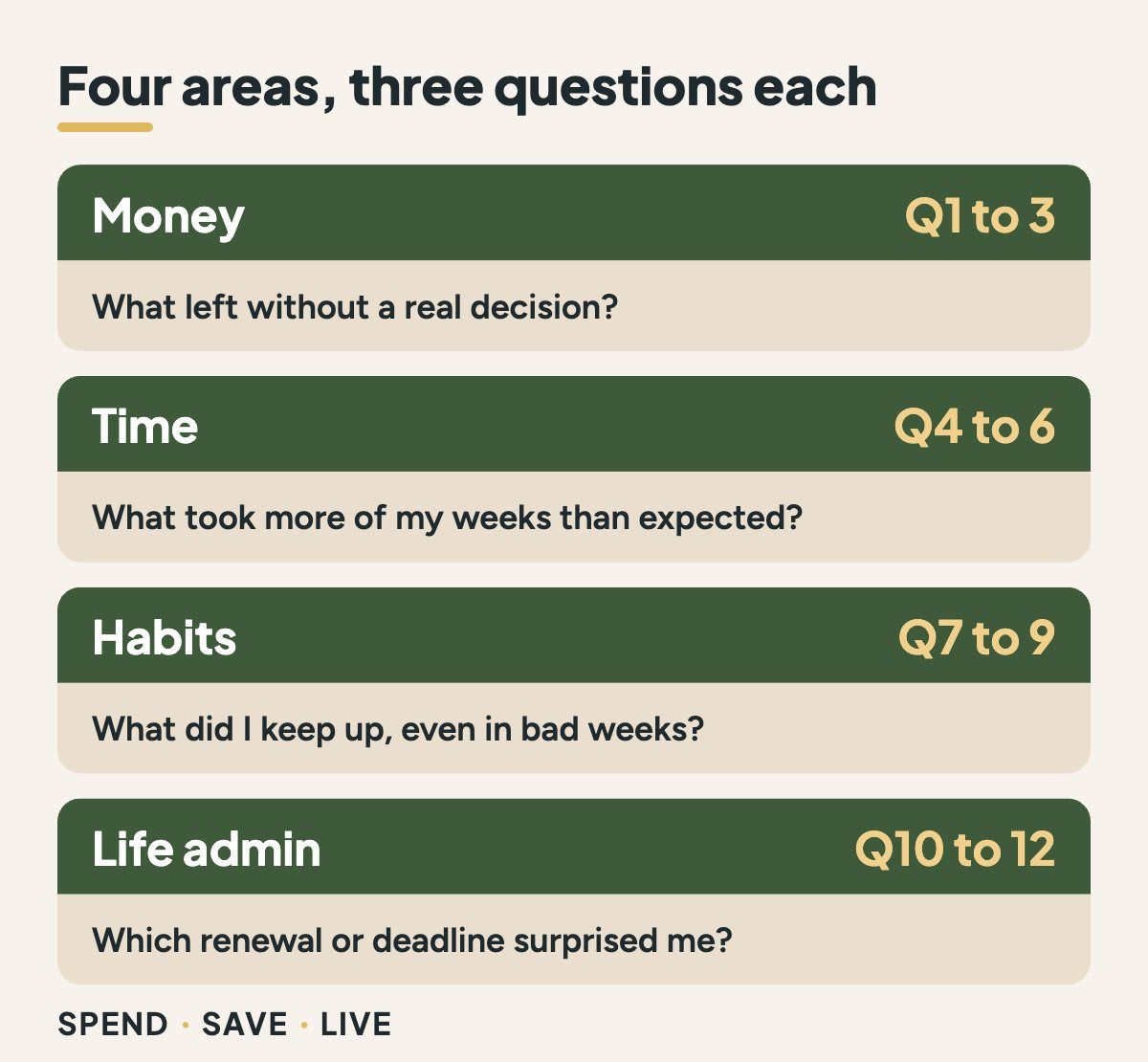
Money
- Which three spending choices am I still glad about?
- Where did money leave without a real decision?
- Which money surprise hit hardest, and could I have seen it coming?
Question 2 is the uncomfortable one. Auto-renewals, delivery fees and that subscription you forgot you even had all count, and finding them is the whole reason you’re looking (no guilt required).
Time
- What took more of my weeks than I expected?
- Which commitment would I turn down if someone asked me today?
- When did my time feel like mine?
If most of your answers end up here, a week of writing down where your hours actually go will tell you more than any question on this list.
Habits
- Which habit did I keep up, even in bad weeks?
- What did I start twice and drop twice?
- Which small routine made my weeks easier?
Be kind to yourself on the second one. Starting something twice means you wanted it twice, and that’s useful information about what to set up differently. When I miss a day of something I track, I don’t punish myself, I just make sure I don’t miss the next one.
Life Admin
- Which deadline or renewal caught me off guard?
- Which piece of paperwork do I keep avoiding?
- What did I fix once and never have to think about again?
Life admin almost never makes it onto reflection lists, which is strange, because it’s where a lot of a year’s stress hides (hello, renewal notice that lands the same week as rent). Give it the same three honest minutes as the money questions.
Read more: A Life Audit That Helps You Choose One Change for 2027
Got More Time (and Coffee)? Which Deeper Questions Can You Add?
If the core 12 felt quick, add a few of these, and three of them come with free official tools that give you something solid to answer with.
- Did a tax refund or a tax bill surprise me this year? The IRS says to check your withholding every January, and its Tax Withholding Estimator walks you through it. (That’s a tool, not tax advice, and your situation is your own.)
- When did I last look at my credit reports? You can check your report from each of the three nationwide credit bureaus once a week for free at AnnualCreditReport.com, according to the FTC.
- How stressed am I about money, honestly? The CFPB’s financial well-being questionnaire is ten questions, and the CFPB says it never collects or stores your answers.
- What did this year teach me about what I actually value?
- What would I tell myself on January 1, 2026, if I could?
The tax question is personal for me. I live in Finland, and in years when I forgot to adjust my tax card and earned a bit more than I’d estimated, I paid tax the next year instead of getting a refund. One year that was €2,000 (about $2,200). My reviews absolutely helped me plan for that, and for the yearly bills that used to catch me off guard.
How Do You Turn Your Answers Into One Keep, Change or Stop Decision?
Circle the answer that shows up in two or more areas, sort it into keep, change or stop, and then pick only one thing to act on.
- Circle the repeat. Read all 12 answers and circle anything that turns up twice, like late fees under money and a missed renewal under life admin. That repeat is your lesson.
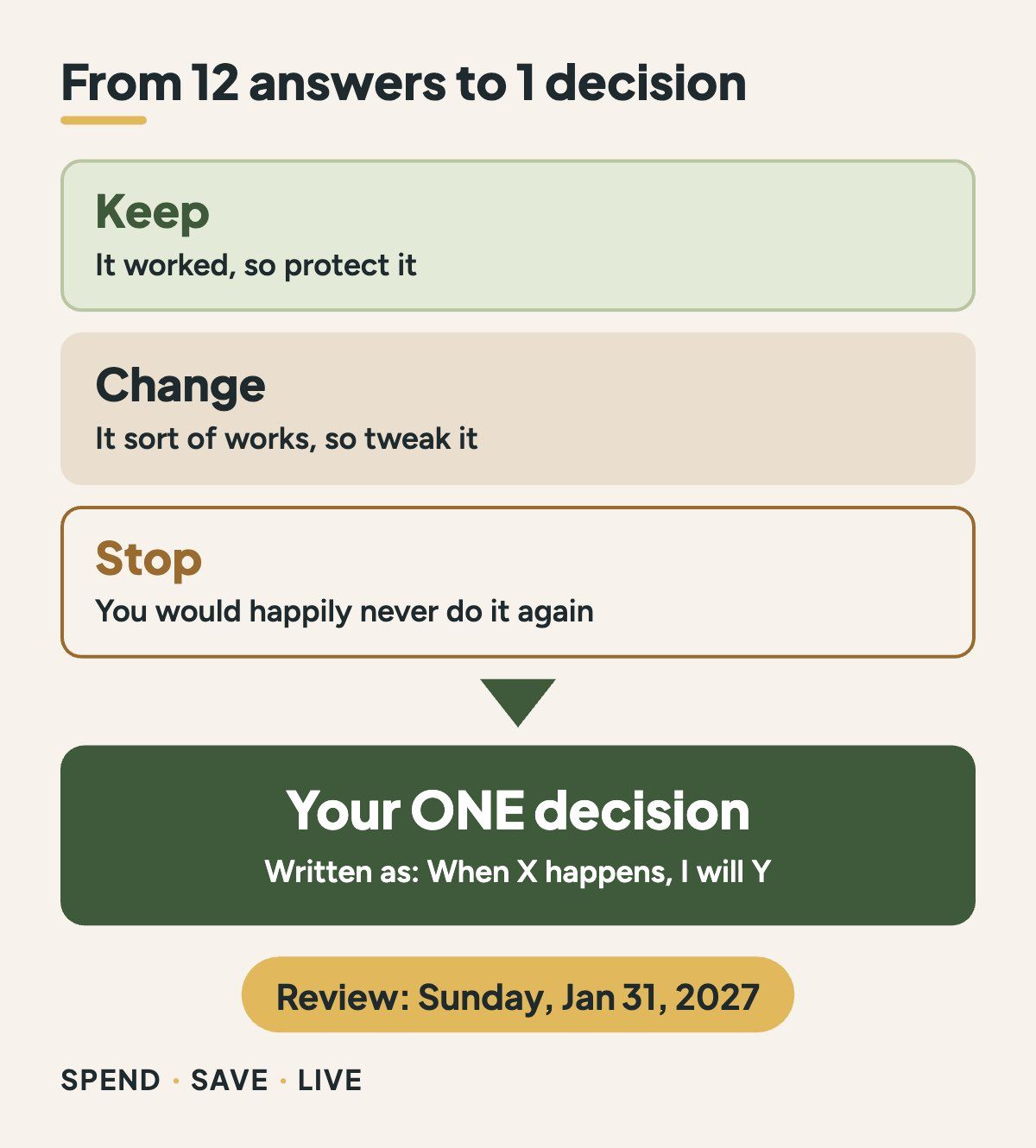
- Sort it. Keep is something that worked and deserves protecting. Change is something that sort of works but needs a tweak. Stop is something you’d happily never do again.
- Pick one. Fill all three lists if you like, but only one item gets a plan this January.
- Write it as an if-then line. “When X happens, I will Y.” Researchers call these implementation intentions, and a review of 94 studies found a medium-to-large effect on how often people reached their goals (National Cancer Institute summary).
- Give it two dates. The day you take the first step, and the review date. On the sheet that’s Sunday, January 31, 2027.
Ask Evan: what did my own keep, change and stop look like?
Keep: staying at university, even though my first semester was SO hard (I’m now the financial lead in my team’s company, so yes, I’m glad I didn’t quit). Change: working too much and spreading myself thin. Stop: pleasing other people.
None of them took more than a line to write, and that’s the length you’re aiming for too.
Once you’ve got your one decision, you can build a small 2027 plan around it, with a first step for January and a check-in every few weeks after that.
What Does a Finished Year-End Reflection Look Like? (A Sample With Real Math)
Here’s one fictional family’s reflection from start to finish: five answers, three sorted lists and one decision with a price tag on it.
Fictional example. The Okafor household is made up, and the amounts are rounded and modest.
Tayo and Sam Okafor have one child and both get paid every two weeks. They sit down on Sunday, December 27, 2026, with coffee and their last three months of statements, and it takes them about 40 minutes. The two streaming subscriptions hadn’t been watched since summer, the late fees came from bills landing before payday, and the money check is a 15-minute habit.
| Area | Their answer | Number |
|---|---|---|
| Money Q2 | Two unwatched subscriptions | $23.98 a month ($287.76 a year) |
| Money Q3 | Three late fees | $99 in late fees |
| Time Q4 | Errands ate Saturdays | None |
| Habits Q7 | Sunday money check | Kept 30 of 52 weeks |
| Life admin Q10 | Surprise car registration | No amount given |
Where the numbers come from: the subscriptions were $12.99 and $10.99, so $23.98 a month and $287.76 over a year. The late fees were $35, $35 and $29. And 30 out of 52 weeks is about 58%, which is more weeks than not.
They circle two repeats. Bills that arrive before payday show up under money (late fees) and life admin (the registration surprise), and the Sunday money check shows up as the one habit that mostly held.
- Keep: the Sunday money check.
- Change: ask their providers whether two bill due dates can move closer to payday. Some may say no, but asking costs nothing.
- Stop: the two unused subscriptions.
- The ONE decision: cancel both subscriptions on January 2, 2027, and move $24 a month into a car-costs sinking fund from February.
- If-then line: “When we do the Sunday money check after payday, then we move the $24.”
- Review date: Sunday, January 31, 2027. Did both cancellations go through, and is the first $24 scheduled?
From February through December that’s 11 months times $24, or $264 set aside before the next registration notice turns up (a full 12 months would be $288). Not life-changing money, and it doesn’t need to be. One lesson became one action with a date, which is more than most three-page recaps manage.

If late fees are your repeat too, put every payday and every bill due date on one calendar for a month, and the clash usually jumps right out at you.
Read more: How to Start Sinking Funds for Costs You Know Are Coming
Prefer Paper? Here’s the End of Year Reflection Worksheet, Page by Page
The 2026 Reflection and 2027 Action Sheet is two US letter pages: page 1 holds the 12 questions with writing lines, and page 2 turns your answers into one decision, with the review date already printed.


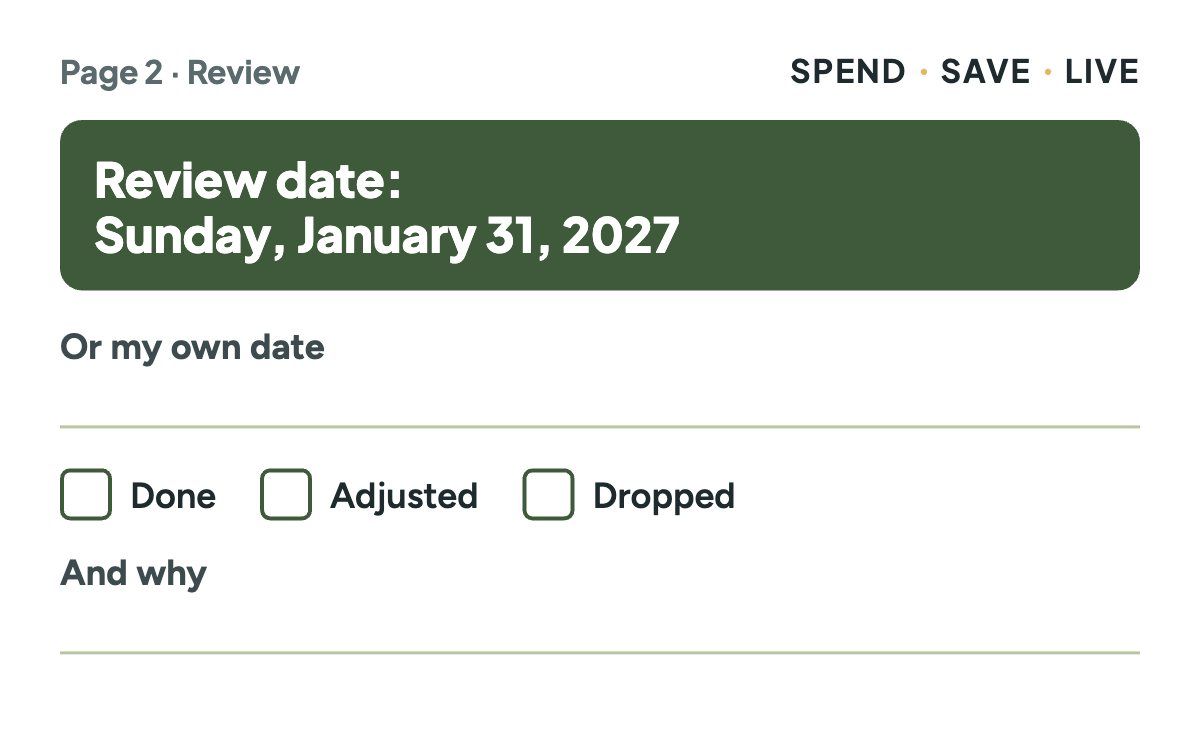
What’s on each page:
- Page 1, Look back at 2026: a before-you-start box (calendar, photos, statements, renewals), four boxes with three questions each and room to write, and one line for the lesson that keeps showing up.
- Page 2, One decision for 2027: keep, change and stop lists, a “My ONE decision” box, the if-then line, first step and date, a “what might get in the way” line, and the review date with done, adjusted or dropped boxes.
Get the Full 2026 Reflection and 2027 Action Sheet
The full printable PDF is coming soon. It will be free to SPEND • SAVE • LIVE readers.
It works on a screen too. I write mine in a journal, but if you’d rather type, copy the same headings into a note or a spreadsheet and you’ve got the same sheet without the printer drama.
Can You Add Your Work Year Without Turning It Into a Performance Review?
Yes, add three short work questions to the same sheet and keep them about your own lessons, not your manager’s rating scale.
- What work am I proudest of this year, and did anyone see it?
- What drained me more than it paid me?
- What evidence would I bring to a pay conversation?
I asked for a raise once and got it, and what I brought was a market pay comparison, meaning what other people in the same role were earning. The third question is where you start collecting that kind of proof, a few lines at a time, so it’s ready before you need it.
When Reflection Isn’t Enough, Who Can Actually Help?
A worksheet can’t pay a bill or settle a debt, but these services can point you to real help.
- Bills, rent, food or utilities: dial 211 or visit 211.org to reach local help. 211 says every call is completely confidential.
- Debt and budgeting: the National Foundation for Credit Counseling connects you with nonprofit credit counselors at 877-360-6322.
- Trouble with a bank, lender or debt collector: the CFPB consumer tools answer common money questions, and you can submit a complaint there.
- If looking back brings up grief or a lot of hard stuff, talk to someone you trust or a licensed professional. In a crisis in the US, call or text 988.
- New here? Start Here shows where to begin on SPEND • SAVE • LIVE.
Frequently Asked Questions
What should I focus on in an end-of-year reflection?
Focus on four areas of your own year (money, time, habits and life admin) and look for the lesson that repeats across them. Then finish with one keep, change or stop decision, so the reflection ends in something you’ll actually do.
Which questions can help me reflect on my year?
Start with 12 core questions, three each for money, time, habits and life admin, and add the deeper ones only if you still have time and energy. A few honest answers tell you more than a hundred skimmed ones.
Can I use a worksheet for my end-of-year reflection?
Yes. A two-page sheet with the questions on page 1 and the decision on page 2 keeps the whole thing short and makes sure it ends in an action. The SPEND • SAVE • LIVE version is coming soon, and this guide shows what’s on both pages.
How can I reflect on my work year as well as my personal year?
Add three work questions to the same sheet: what you’re proudest of, what drained you, and what evidence you’d bring to a pay conversation. Keep them about your own lessons rather than turning them into a formal review form.
What’s a good method for annual goal setting after a reflection?
Take your one decision and give it a first step, a date and a review date. Write it as an if-then line, such as “When payday lands, I move $24,” because if-then plans have a lot of research behind them.
When is the best time to do a year-end reflection?
Any quiet hour in late December or the first week of January works. The date matters less than booking the follow-up, like a review on Sunday, January 31, 2027.
How long should a year-end reflection take?
Plan on roughly 30 to 45 minutes for the 12 core questions (that’s our estimate, not a rule). Stop when you have one decision, not when the page is full.
Key Takeaways
- Four areas, three questions each: money, time, habits and life admin.
- Open your calendar, photos, statements and renewals list first, so your answers come from facts.
- Circle the lesson that shows up in two or more areas.
- Turn it into one keep, change or stop decision, written as an if-then line with a first-step date.
- Book the review now: Sunday, January 31, 2027.
Sunday, January 31, 2027, Is Already Waiting for You
Put that review date in your calendar before you close this tab, because it’s the part everyone skips and it’s the part that turns a nice evening of thinking into an actual change. And if your one decision ends up being about money, the beginner budget guide picks up right where this one stops.
Sources (checked November 2026)
- Harvard Business School Working Knowledge, Reflecting on Work Improves Job Performance
- Di Stefano, Gino, Pisano and Staats, Learning by Thinking: How Reflection Can Spur Progress Along the Learning Curve (SSRN)
- National Cancer Institute, Implementation Intentions
- IRS, Tax Withholding Estimator
- FTC, Free Credit Reports
- CFPB, Financial Well-Being Questionnaire
- CFPB, Consumer Tools
- 211.org
- National Foundation for Credit Counseling
- SAMHSA, 988 Suicide & Crisis Lifeline
Educational content, not financial advice. Euro amounts converted at the ECB reference rate of 1.0989 (November 17, 2026), approximate.