

Most budgets break on the costs nobody listed. A budget categories list sorts your spending into four groups: monthly bills, variable essentials, flexible spending and future expenses. Start with your last three months of statements, give every charge a home, then search the past year for once-a-year bills and set money aside for them each month.
The budget looked perfect on paper, right up until the car registration showed up in the mail and blew a $96 hole in a month that had exactly zero dollars set aside for car registration (because who remembers car registration, honestly). That’s the whole problem a budget categories list is supposed to solve, and it’s also why most category lists you find online don’t quite solve it, since a list of labels can’t tell you which ones YOU keep forgetting.
So below you get the full 40-line list sorted into four groups, the forgotten budget items that slip through most often, a six-step statement check that finds your missing lines, one fictional example with real math, and three simple rules for when to split, combine or retire a category. It sits with the other budget basics in our Spending & Budgeting guides.

Read this also:
- Budgeting for Beginners From the Money You Actually Have
- A Simple Monthly Budget Planner With a Filled-In Example
- A Biweekly Budget Template for Bills Between Paydays
- How to Start Sinking Funds for Costs You Know Are Coming
Housing, transportation and food made up 63.4% of average US household spending in 2025 (33.9%, 16.5% and 13.0%), according to the BLS Consumer Expenditures release. The other 36.6% is where the small lines hide.
Is This for You? A 30-Second Check
- A “surprise” bill in the last year was one you could have seen coming.
- Your Miscellaneous line is often one of your biggest.
- There are charges on your statement you can’t place.
- Your budget has no line for once-a-year costs.
Two or more yeses? This post is for you. Never built a budget at all? Start with budgeting for beginners, then come back for the list. Behind on rent or utilities right now? Skip to the help section near the end first.
What Is a Budget Categories List, and Why Do Costs Keep Escaping It?
A budget categories list is the set of lines your money goes to, grouped so that each line helps you make a decision.
Those lines do two different jobs, and mixing them up is how costs escape. Some lines are labels that tell you where money already went, like groceries or eating out. Other lines hold money for a bill that hasn’t arrived yet, like the vet checkup in March, and a label alone does nothing for those (the money has to actually be set aside).
Costs slip out of a budget for three boring reasons: they’re small, they’re rare, or they get dumped into Miscellaneous where nobody looks at them again. Every rule below is about catching one of those three.
What Are the Main Budget Categories? (Four Groups, Not Forty Labels)
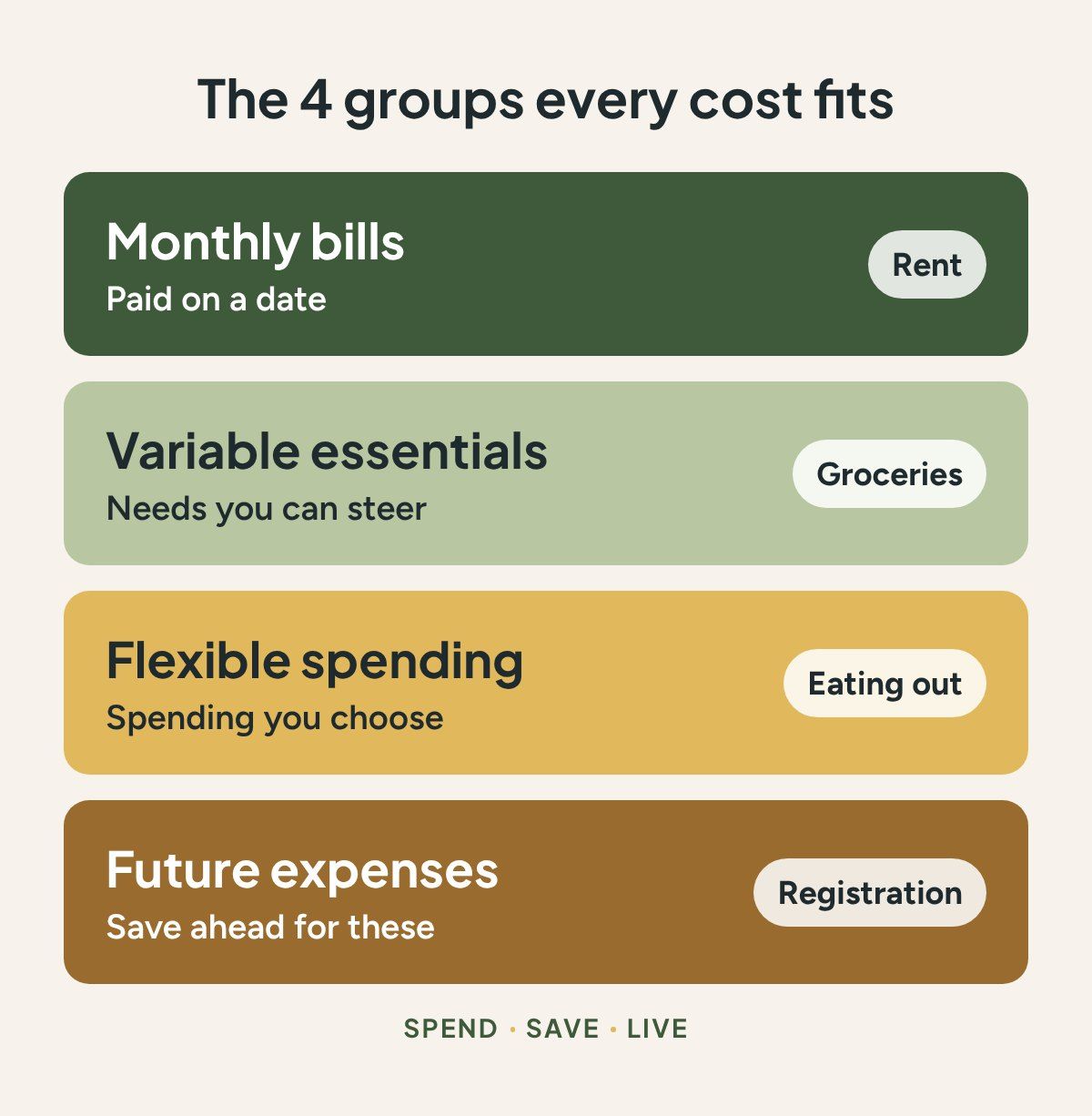
Four groups cover every cost you have: monthly bills, variable essentials, flexible spending and future expenses.
- Monthly bills are the ones you pay on a date, in a set amount, like rent, phone and insurance.
- Variable essentials are needs you can steer a little, like groceries, gas and household supplies.
- Flexible spending is the stuff you choose, like eating out, hobbies and fun money.
- Future expenses are costs you save for ahead, like car registration, gifts and the yearly app renewal.
Savings and any extra debt payment sit as fixed lines under monthly bills, on purpose, so they get paid like a bill instead of getting whatever is left on the 29th. That’s also how you build your emergency fund without having to be brave about it every month.
What Belongs on a Budget Categories List? (The Full 40 to Copy)
These 40 common budget categories, sorted into the four groups, are a starting point you tick or cross out, not a rulebook.
Monthly bills (11)
- Rent or mortgage
- Renters or home insurance
- Utilities
- Phone
- Internet
- Car payment
- Car insurance paid monthly
- Health insurance premium
- Minimum debt payments
- Childcare
- Savings transfer
Variable essentials (9)
- Groceries
- Gas
- Transit fares
- Household supplies
- Prescriptions and copays
- Personal care
- Pet food and care
- Kids’ everyday costs
- Laundry
Flexible spending (9)
- Eating out
- Coffee and snacks
- Entertainment
- Streaming and subscriptions
- Clothing
- Hobbies
- Giving or donations
- Gifts outside birthdays
- Fun money
Future expenses (11)
- Car registration
- Insurance paid every 6 or 12 months
- Annual subscriptions and app renewals
- Vet checkups
- Birthday and holiday gifts
- Back-to-school costs
- Car maintenance and repairs
- Medical deductible
- Property or vehicle taxes
- Home repairs
- Tax top-up if not enough is withheld
Yes, fun money stays on the list, and no, that’s not me being soft. A budget with zero room to enjoy anything is the budget people quit by February, so a small, honest fun line is what keeps the other 39 alive.
Share bills with a partner or a roommate? Give each shared cost its own line and decide the split separately; here’s how to split bills fairly when your incomes differ. For comparison, the CFPB’s own spending tracker uses 12 broad categories, from housing and utilities to pets and “other”, so a shorter list is completely fine if it still catches everything.
You’ll notice there are no percentages here. That’s a separate question with its own post on budget percentages that fit your real costs.
Which Forgotten Budget Items Slip Through Most Often?
The ones that come once a year, a few times a year, or in amounts that feel too small to bother listing.
That’s basically the whole future expenses group above: car registration, insurance you pay every 6 or 12 months, annual app renewals, vet checkups, birthday and holiday gifts, back-to-school costs, car repairs, the medical deductible, property or vehicle taxes, home repairs and a tax top-up. The CFPB’s annual planner asks the same question in a nicer way, whether there are bills you pay “annually, twice a year, or quarterly”, and has you write down each one’s typical cost and anticipated date (you can see it in the CFPB annual planner).
For me it’s always tax. I live in Finland, and in the years I forgot to adjust my tax card and earned a bit more than I estimated, I didn’t get a refund, I paid extra the next year instead. One year that was €2,000 (about $2,200), which is a very loud way to learn that tax deserves its own line.
If you’re in the US and get a regular paycheck, the version of that lesson is to check your withholding once a year with the IRS Tax Withholding Estimator, so a top-up bill doesn’t show up as a surprise in April.
Once you’ve found these costs, give each one a monthly amount and keep that money somewhere you won’t spend it. Here’s how to start a sinking fund for each one, the sinking fund categories most people end up with, and a way to track renewals before they hit.
Read more: How to Start Sinking Funds for Costs You Know Are Coming
How Do I Find My Missing Categories From My Statements?
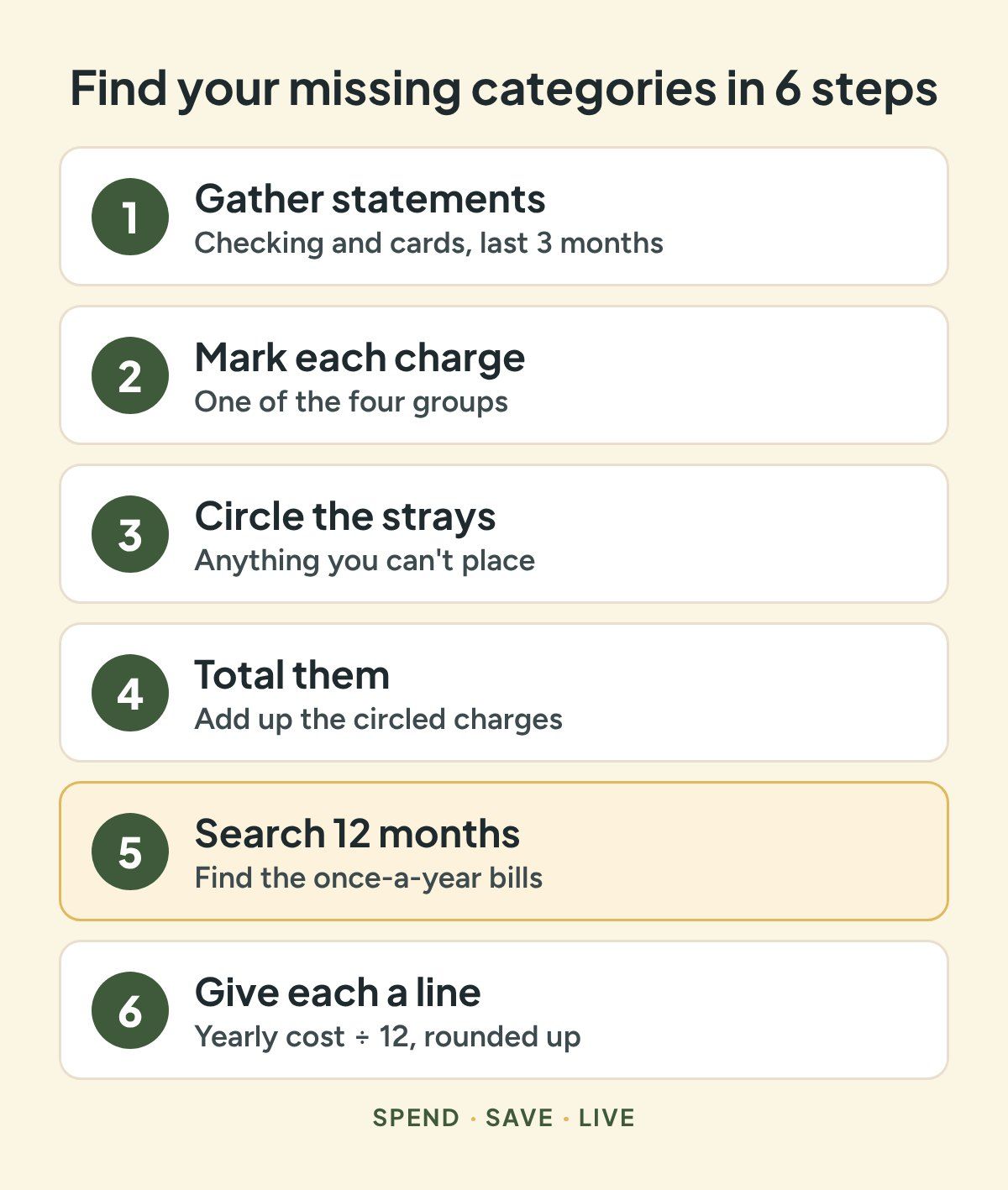
Read three months of statements line by line, then search the past year for once-a-year charges.
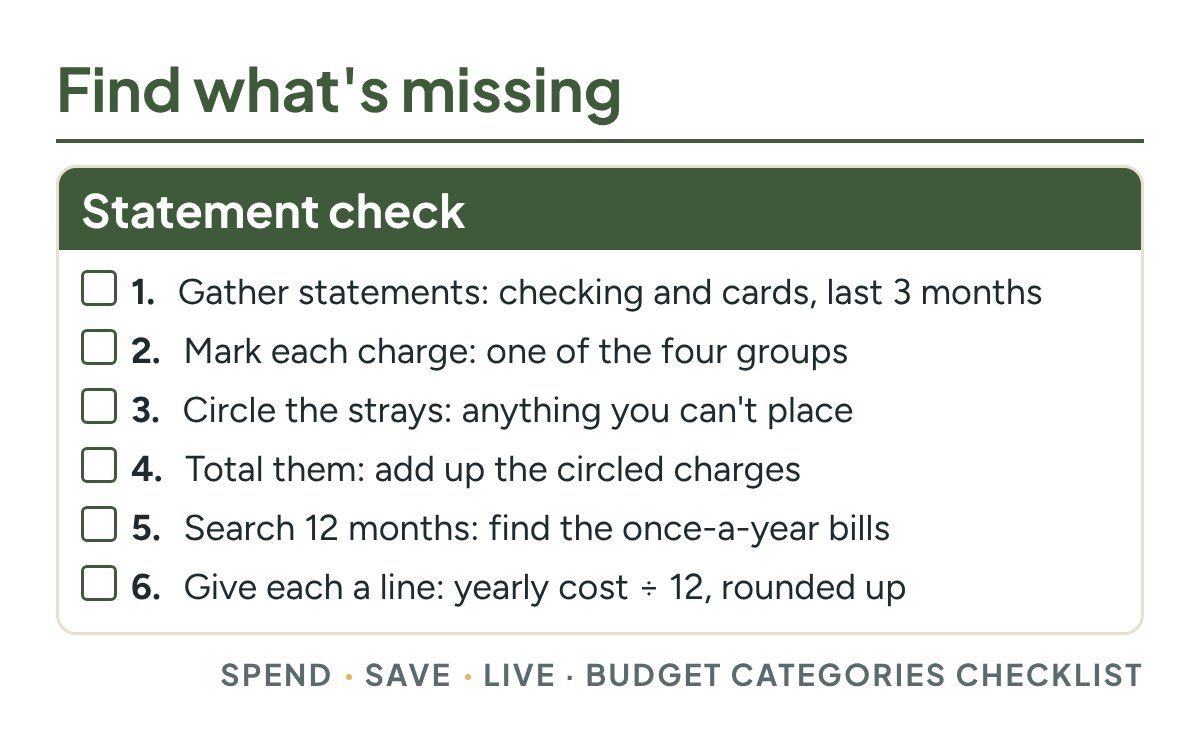
- Gather your checking and credit card statements for the last three months.
- Mark every charge with one of the four groups.
- Circle anything you can’t place.
- Total the circled charges.
- Search the last 12 months for once-a-year charges, like renewals, registration and annual insurance.
- Give every cost you found a line and a monthly amount: the yearly cost divided by 12, rounded up.
Three months feels like a lot? The CFPB says that if tracking a whole month seems too difficult, you can try it for just one or two weeks first, so start small if that’s what gets you started. After that, a spending tracker that explains where your money went keeps the habit going.
What Does a Statement Review Look Like With Real Numbers?
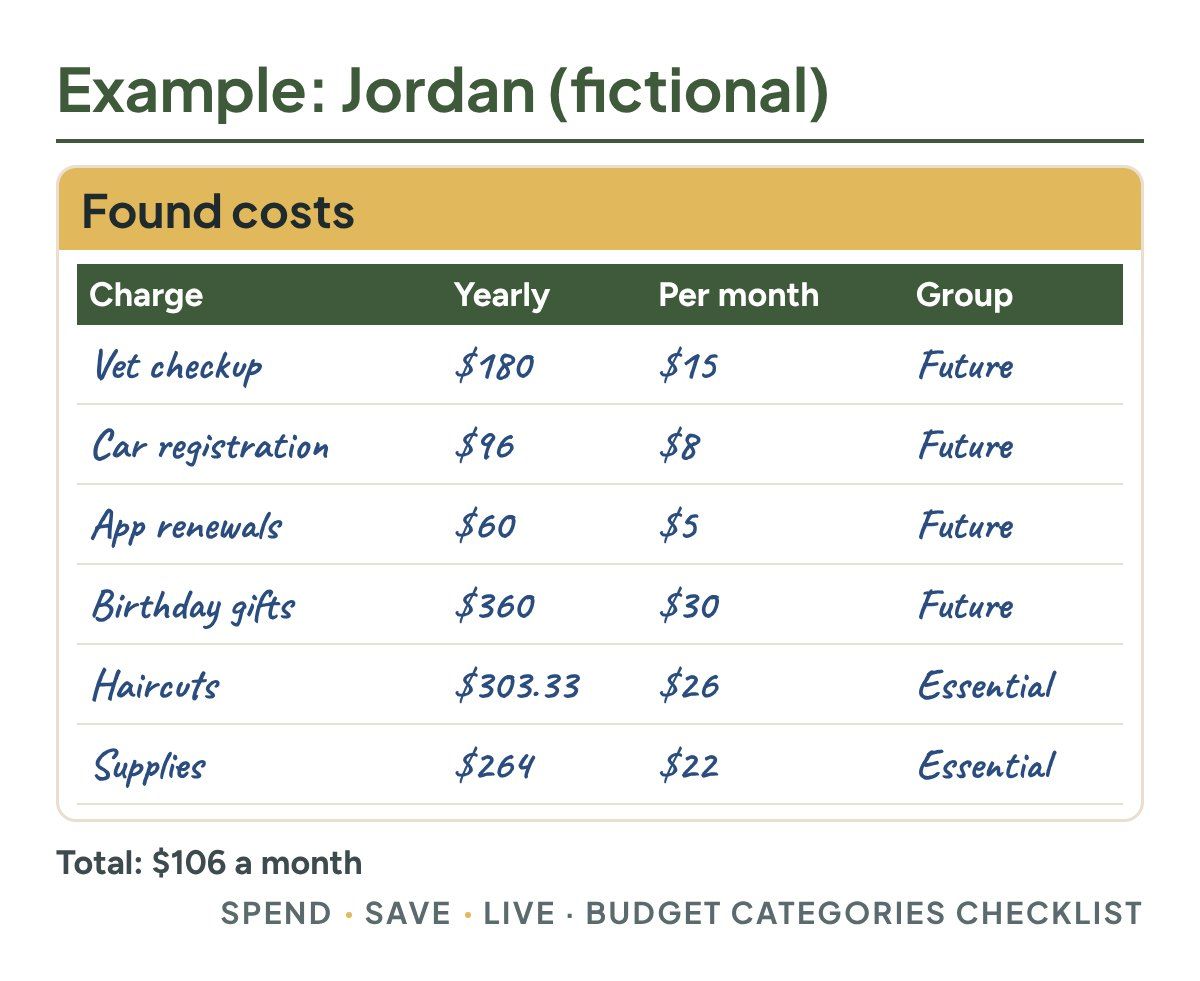
Our fictional Jordan found $562 of unplaced charges and turned them into six lines worth $106 a month.
Jordan is made up, and so are the numbers, so your costs will differ (please don’t treat $96 as a typical registration fee). Jordan rents alone with a cat, takes home $3,600 a month, read the August to October 2026 statements line by line and then searched the past 12 months.
| Charge found | Yearly cost | New line per month |
|---|---|---|
| Vet checkup (future) | $180 | $15 |
| Car registration (future) | $96 | $8 |
| App and cloud renewals (future) | $60 | $5 |
| Birthday gifts (future) | $360 | $30 |
| Haircuts every 6 weeks (essential) | $303.33 | $26 |
| Household supplies (essential) | $264 | $22 |
| Total | $106 |
The math is the yearly cost divided by 12, rounded up. Haircuts at $35 every six weeks are $35 × 52 ÷ 6 = $303.33 a year, so $26 a month. The six charges Jordan actually saw added up to $562 (the vet, registration and renewals from the 12-month search, plus $90 of gifts, $70 of haircuts and $66 of supplies in three months).
Future lines come to $58 a month and essentials to $48, so $106 in total, which is 2.9% of Jordan’s $3,600. And $336 of it (180 + 96 + 60) only showed up in the 12-month search, which is exactly the money a three-month look would have missed.
When Should You Split, Combine or Retire a Budget Category?
Split a line when it hides two decisions, combine two lines when they’re really one decision, and retire a line that sat at $0 with no bill coming.
- Split when one line hides two decisions. Jordan split Food into Groceries and Eating out, because “should I buy food” and “should I order takeout again” are very different questions.
- Combine when two lines are one decision. Streaming and Music became Subscriptions, since both are small, fixed and reviewed together.
- Retire a line that stayed at $0 for three months with no bill coming. Jordan cancelled the gym membership, so the Gym line went too.
One extra check while you’re there: if Miscellaneous is one of your biggest lines, open it up and look. Something in there deserves its own category, and finding it is usually the whole point of the exercise.

How Many Budget Categories Should You Have? (No, There’s No Magic Number)
There’s no official number, so keep enough lines that each one helps a decision and few enough that you’ll actually keep them up.
You’ll see people ask for the 7, 10 or 12 categories of a budget. Those are editorial lists that different sites made up, not rules, and a budget with 9 honest lines beats one with 60 lines you stopped updating in March.
My own first real budget had five lines, and that’s it: rent, daily spending, an emergency fund, fixed business expenses, and the rest went to savings. Later my old Google Sheets budget grouped everything into income, fixed bills, savings and, on its own side, business costs, one block per month, and it was super simple, which is exactly why I kept using it.
Paid weekly? The same groups work in a weekly budget template in Google Sheets.
Read more: Budgeting for Beginners From the Money You Actually Have
What’s in the Budget Categories Checklist?
Two pages that turn this list into your own, with the statement check built in.

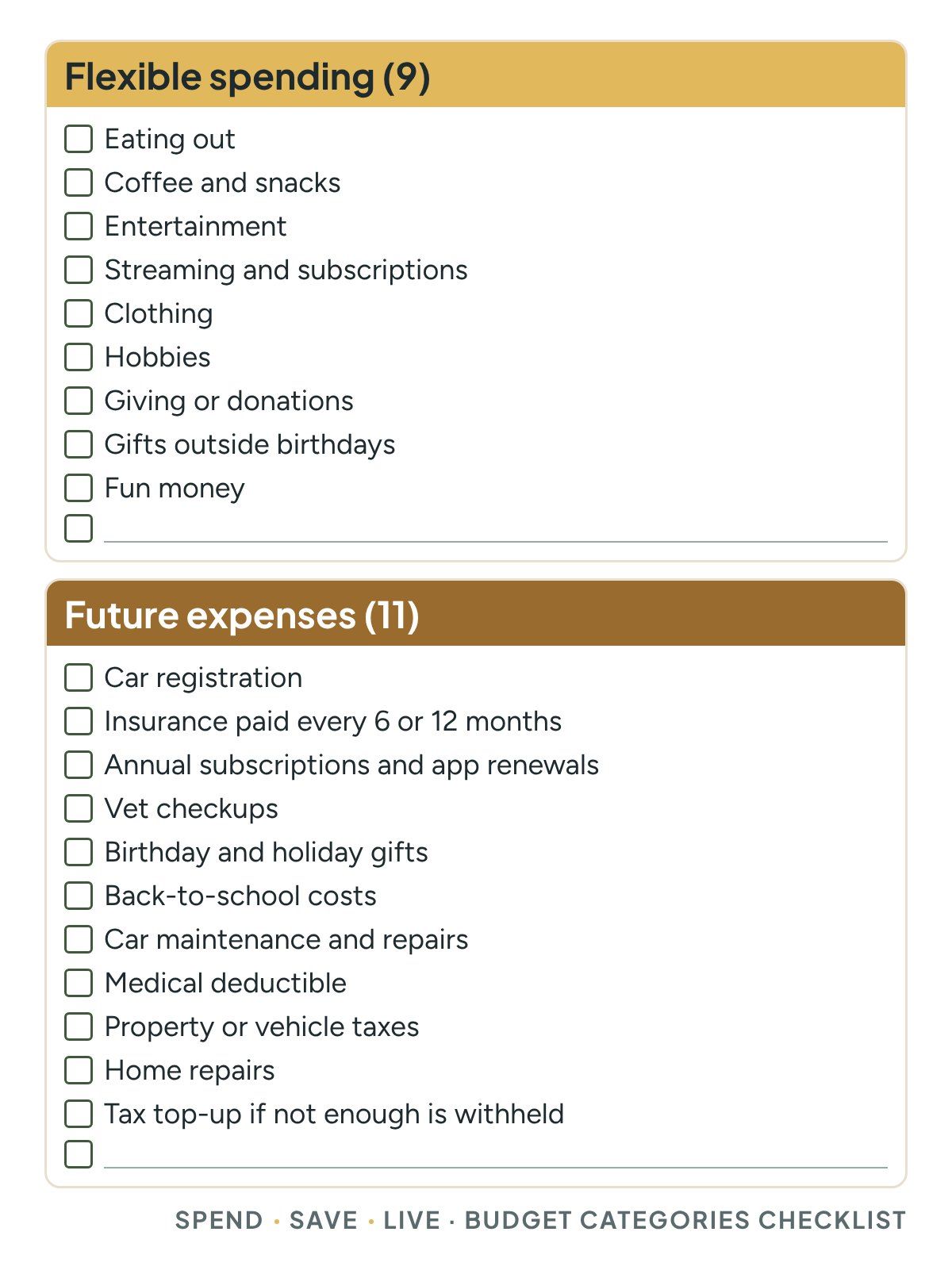
- Page 1 has all 40 lines as tick boxes in the four groups, plus three blank lines per group for the costs only you have.
- Page 2 has the six-step statement check, a found costs table (charge, yearly cost, per month, group) and the split, combine and retire rules, with a little “Miscellaneous was $____ this month. Review it?” line at the bottom.
When your list is done, put these categories into a monthly budget planner so every line gets an amount.
Get the full Budget Categories Checklist
The full printable PDF is coming soon. It will be free to SPEND • SAVE • LIVE readers.
What a Category List Can’t Do, and When to Get Help
Better categories can’t fix income that doesn’t cover the essentials, and if that’s where you are, the bills that protect your home and income come first.
- The CFPB’s prioritizing bills worksheet helps you decide what to pay first, and its advice is plain: don’t ignore bills you can’t pay, call the company and explain instead.
- A nonprofit credit counselor through the National Foundation for Credit Counseling (877-360-6322) can help you build a plan for debts and monthly bills.
- 211 connects you with local help paying bills, finding food and other resources near you.
New here? Start Here walks you through the basics.
Frequently Asked Questions
What are some good budget categories to include?
Start with the four groups (monthly bills, variable essentials, flexible spending and future expenses), then keep the lines your own statements show. The 40-line list above is a starting point to tick or cross out.
What are the 3 main budget categories?
Many lists use fixed, flexible and savings or non-monthly costs. This list splits out a fourth group, future expenses, so once-a-year bills get money set aside before they arrive.
What are the typical percentages for each category in a budget?
There’s no official target. Rules of thumb like 50/30/20 are starting points, not rules. On average, US households spent 33.9% on housing, 16.5% on transportation and 13.0% on food in 2025, which describes spending, not a goal. For more, see budget percentages that fit your real costs.
What are some categories I can use for envelope budgeting?
The flexible spending and variable essentials lines work best, because those are the ones you steer week to week. Here are the cash envelope categories worth tracking.
Where can I find a printable budget list?
The Budget Categories Checklist in this post has all 40 lines plus the statement check. The full printable PDF is coming soon, and you can see all printables in the meantime.
How many budget categories should I have?
There’s no official number, and lists of 7, 10 or 12 are editorial. Keep the lines that lead to a decision and combine or retire the rest.
Where do small, odd costs like haircuts or toilet paper go?
Put them where the decision happens: haircuts under personal care and toilet paper under household supplies, both in variable essentials.
Key Takeaways
- Sort every cost into four groups: monthly bills, variable essentials, flexible spending and future expenses.
- Your statements, not your memory, tell you which categories you’re missing.
- A category earns its place when it helps you make a spending decision or prepare for a future bill.
- Money for a future bill is reserved money, not just a label, so give it a monthly amount.
- Split, combine or retire lines until every one of them is pulling its weight.
Your Miscellaneous Line Is About to Get a Lot Smaller
Grab last month’s statement and a pen, give every charge one of the four groups, and circle whatever doesn’t fit, because those circles are your missing categories. Then give each one a monthly amount, drop it into a monthly budget planner and enjoy the next car registration letter showing up to a line that’s already paid for.
Sources (checked November 2026)
- BLS, Consumer Expenditures 2025 (released October 29, 2026)
- CFPB, Spending tracker
- CFPB, Annual planner
- CFPB, Prioritizing bills
- IRS, Tax Withholding Estimator
- National Foundation for Credit Counseling
- 211.org
- Jordan’s numbers and the 40-line count: SPEND • SAVE • LIVE calculations, November 2026. Jordan is a fictional example. Euro to dollar at the ECB reference rate of November 19, 2026 (1.0992).
Educational content, not financial advice.