

Give each biweekly paycheck its own window, from that payday to the day before the next one. Every bill due inside that window gets paid from that check, even when it’s next month’s rent. Subtract the bills and your day-to-day spending, carry whatever is left into the next window, and hold money back before a window that comes up short.
One Friday the paycheck feels huge, and two Fridays later the exact same amount lands and barely covers rent, which is pretty much the whole biweekly pay experience in one sentence (and no, you didn’t suddenly get worse at money in those 14 days). Bills come once a month on fixed dates, paychecks come every other week, and the two never line up the same way twice.
So this biweekly budget template for Google Sheets has one job, and it’s matching every bill to the paycheck that actually has to pay it. Below you’ll find the real 2027 Friday pay dates, the five-step window method, and a fictional worker’s numbers from January to May, including the check that comes up $388 short and the leftover that saves it.
Read this also:
- Budgeting for Beginners From the Money You Actually Have
- How to Start Sinking Funds for Costs You Know Are Coming
- A Simple Monthly Budget Planner With a Filled-In Example
- A 52-Week Savings Challenge That Fits Your 2027 Cash Flow
Quick confession first: I’ve been paid monthly my whole working life, as a chef and now, so I don’t have a biweekly horror story for you. What I do have is the habit this template grew out of. I started budgeting in Google Sheets (these days I use a dashboard I built with Claude), and my rule has never changed: bills get paid on payday, and then it’s over. Biweekly pay just means you first have to figure out which payday each bill belongs to.
Is this template for you?
- You get paid every 14 days, most likely on a Friday.
- Rent and most bills are due on the same dates every month.
- One check of the two always feels short, and you can never remember which.
- You want a sheet or a printable, not another app.
Paid every week? This guide on budgeting weekly pay fits you better, or try a template built for weekly paychecks. Paid twice a month on set dates, like the 1st and 15th? The same window method works, you’ll just have 24 windows instead of 26.
Is Biweekly the Same as Twice a Month? Your Calendar Says No
No. Every other week gives you 26 paychecks in most years and 27 in some, while twice a month (semimonthly) always gives you 24, which is why the two feel so different even when the yearly pay is the same.
The IRS payroll tables in Publication 15-T count a biweekly schedule as 26 pay periods and a semimonthly one as 24. Biweekly is also the most common schedule out there. In February 2023, the Bureau of Labor Statistics found that 43.0% of private employers paid every two weeks, 27.0% weekly, 19.8% twice a month and 10.3% monthly. That’s a share of employers, by the way, not of workers.

The catch with biweekly pay is that the paydays drift. A twice-a-month check lands on the same dates every month, so you can pin rent to it and forget it. A biweekly check moves a few days earlier every month, so the check that paid rent in January isn’t the one that pays it in March.
How Many Paychecks Will You Get in 2027, 26 or 27?
You’ll get 26, unless your every-other-Friday schedule includes Friday, January 1, 2027, in which case you’ll get 27.
That happens because 2027 starts on a Friday and has 53 Fridays in it (I ran both schedules through a calendar script to be sure). Find your first 2027 payday on a pay stub or in your payroll app, then check the table.
| First Friday payday | Paychecks in 2027 | Months with three |
|---|---|---|
| Jan 1 (Schedule A) | 27 | Jan, Jul, Dec |
| Jan 8 (Schedule B) | 26 | Apr, Oct |
| Any other weekday | 26 | Two (count yours) |
One heads-up for Schedule A. January 1 is a Federal Reserve holiday (see the Fed holiday schedule), so a deposit due that day may move, and your employer decides how. Check your pay stub or ask payroll instead of guessing. The same goes for how a salary is split in a 27-check year, which is set by your employer, not by a rule. Months with three paychecks get their own section further down.
How to Budget Biweekly Pay on a Monthly Calendar in 5 Steps
Give each check a window from its payday to the day before the next payday, and put every bill that’s due inside that window under that check.
This is basically budgeting by paycheck instead of by month, and it takes about 20 minutes to set up the first time.
- Write down your next six paydays and your take-home pay. Take-home pay is what actually lands in your account after taxes and deductions.
- List every bill with its due day and amount. Rent, car, phone, insurance, internet, card minimums, subscriptions. The CFPB’s bill calendar tool says to mark online payments two or three days early and mailed ones at least seven days early, so use that date instead of the due date if you pay by mail.
- Drop each bill into its window. A bill due on the 1st belongs to whichever check lands before the 1st, even if that check arrived in the previous month. A bill due on a payday belongs to the window that starts that day.
- Subtract day-to-day spending and a small buffer. Groceries, gas, personal stuff and a little transfer to savings, per check.
- Carry what’s left into the next window. Most templates skip this step. The CFPB’s cash flow budget tool works the same way, carrying each period’s ending balance into the next one. If you’d rather see it on paper first, a printable 2027 budget calendar puts paydays and due dates side by side.

Why Does the Check Right Before the 1st Always Come Up Short?
Because it usually has to pay rent that’s due after the next payday, so on its own that one check is carrying the biggest bill of the month plus whatever else is due in its window.
The short window: if your window holds the 1st, it holds rent. Look at that window first every month, and if pay minus bills minus spending is negative, the money has to come from the check before it.
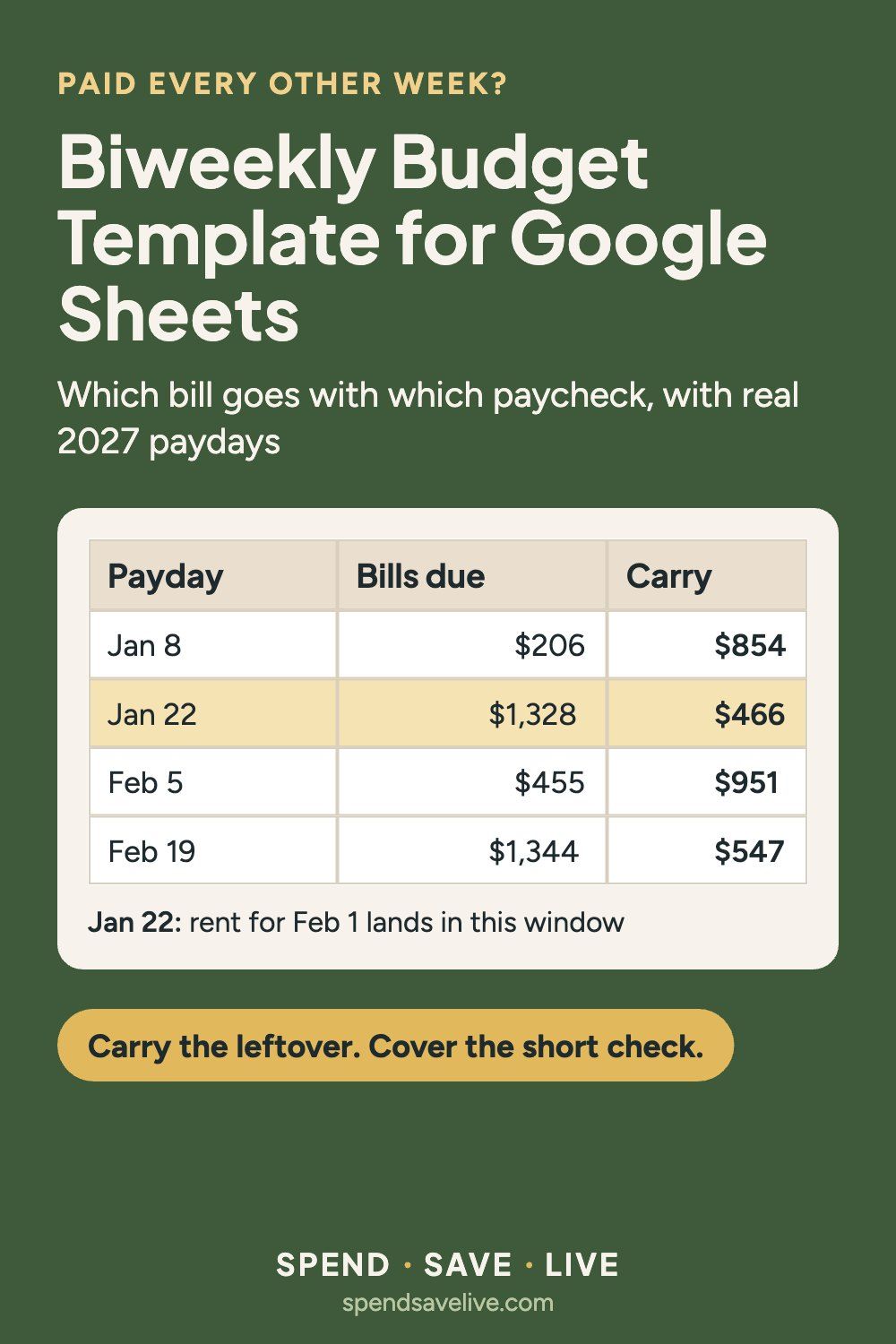
In the example below, the January 22 check has rent for February 1, car insurance and internet in its window, so it comes up short on its own. The CFPB’s improving cash flow tool lists a few ways to fix a short window, and here’s how they work for biweekly pay:
- Hold money back from the check before. The easiest fix, and the one the template flags for you. You leave part of the earlier check in your account instead of spending it.
- Ask to move a due date. Some companies will move a due date so it falls after a payday, if you ask, and the CFPB suggests starting with the ones where you have a good payment record.
- Split a big bill in two. Some landlords and lenders allow two smaller payments at different times of the month. Ask before you assume, and get it in writing.
None of these makes the money bigger, they just move it to where it’s needed, which is half of budgeting anyway.
What Does a Biweekly Budget Look Like From January to May 2027?
Here’s a fictional example. Riley nets $1,300 every other Friday on Schedule B, and the January 22 check comes up $388 short on its own, which the leftover from January 8 covers.
Riley is made up, but every number is real math. Riley’s first 2027 check lands Friday, January 8, with $120 left over from December. Bills come to $1,799 a month:
| Bill | Due | Amount |
|---|---|---|
| Rent | 1st | $1,150 |
| Car payment | 5th | $265 |
| Electric (average) | 12th | $95 |
| Card minimum | 15th | $40 |
| Phone | 18th | $55 |
| Streaming | 20th | $16 |
| Car insurance | 22nd | $118 |
| Internet | 26th | $60 |
Per check, Riley also spends $360: $200 on groceries and household, $70 on gas, $40 on personal and kids’ stuff, and $50 that moves to a buffer savings account. Here’s which bills land in which window:
| Window | Bills due | Bills total |
|---|---|---|
| Jan 8 to Jan 21 | Electric, card, phone, streaming | $206 |
| Jan 22 to Feb 4 | Insurance, internet, rent (Feb 1) | $1,328 |
| Feb 5 to Feb 18 | Car, electric, card, phone | $455 |
| Apr 2 to Apr 15 | Car, electric, card | $400 |
| Apr 16 to Apr 29 | Phone, streaming, insurance, internet | $249 |
| Apr 30 to May 13 | Rent (May 1), car, electric | $1,510 |
And here’s what carries forward after the $1,300 check, the bills and the $360 of spending:
| Window | Opening plus pay | Carry forward |
|---|---|---|
| Jan 8 | $1,420 | $854 |
| Jan 22 | $2,154 | $466 |
| Feb 5 | $1,766 | $951 |
| Apr 2 | $1,928 | $1,168 |
| Apr 16 | $2,468 | $1,859 |
| Apr 30 | $3,159 | $1,289 |
Show the three windows from February 19 to April 1
| Window | Bills total | Carry forward |
|---|---|---|
| Feb 19 to Mar 4 | $1,344 | $547 |
| Mar 5 to Mar 18 | $455 | $1,032 |
| Mar 19 to Apr 1 | $1,344 | $628 |
The January 22 check alone is $1,300 minus $1,328 in bills minus $360 in spending, so it’s $388 short. The $854 carried over from January 8 covers it, which is why Riley holds $400 back from the January 8 check instead of treating it as spending money. The same thing happens before every rent day (February 19, March 19 and April 30 are all short on their own), and the carryover covers each one.

Over the whole year, Riley’s 26 checks add up to $33,800, about $2,817 a month on average, compared with $2,600 in a regular two-check month. After $21,588 in bills and $9,360 in per-check spending, about $2,972 is left at the end of the year. That isn’t free money, though, because car repairs, gifts and school costs haven’t happened yet, so give the leftover a job before it wanders off.
Read more: Budgeting for Beginners From the Money You Actually Have
What’s in the Bi Weekly Budget Template for Google Sheets?
Seven tabs that do the window math for you, plus a two-page printable for anyone who’d rather fill it in with a pen. Both are on their way to readers (see the box below), so here’s exactly what’s inside, and how to build the key formula yourself today.
The template is called the SPEND • SAVE • LIVE Biweekly Paycheck Planner 2027, and every tab has one job:
- Start here: five steps and a reminder that the example is fictional.
- Pay dates: type your first 2027 payday and take-home pay, and it fills in up to 27 paydays, flags months with three and marks January 1.
- Bills: name, due day, amount and whether it’s on autopay. A due day of 29, 30 or 31 moves to the last day of shorter months. Not sure what to list? A budget categories list helps catch the forgotten ones.
- Bill dates: a helper tab that turns each bill into a real date for every month (you can hide it).
- Paycheck plan: one row per window with opening balance, pay, bills due, spending, carry forward and a “Short: hold from previous check” flag.
- Spending lines: your per-check amounts for groceries, gas, personal and buffer savings.
- Example: Riley’s filled-in plan, locked, so you can compare.
Here’s the main formula if you want to build it now. On the Paycheck plan tab, bills due for a window are one SUMIFS that adds every bill dated from the payday to the window’s last day, something like =SUMIFS(BillDates!C:C, BillDates!B:B, ">="&A2, BillDates!B:B, "<="&B2), where A2 is the payday and B2 is the day before the next one. I tested it with Riley’s numbers and every carry matched the tables above, down to the $2,972.

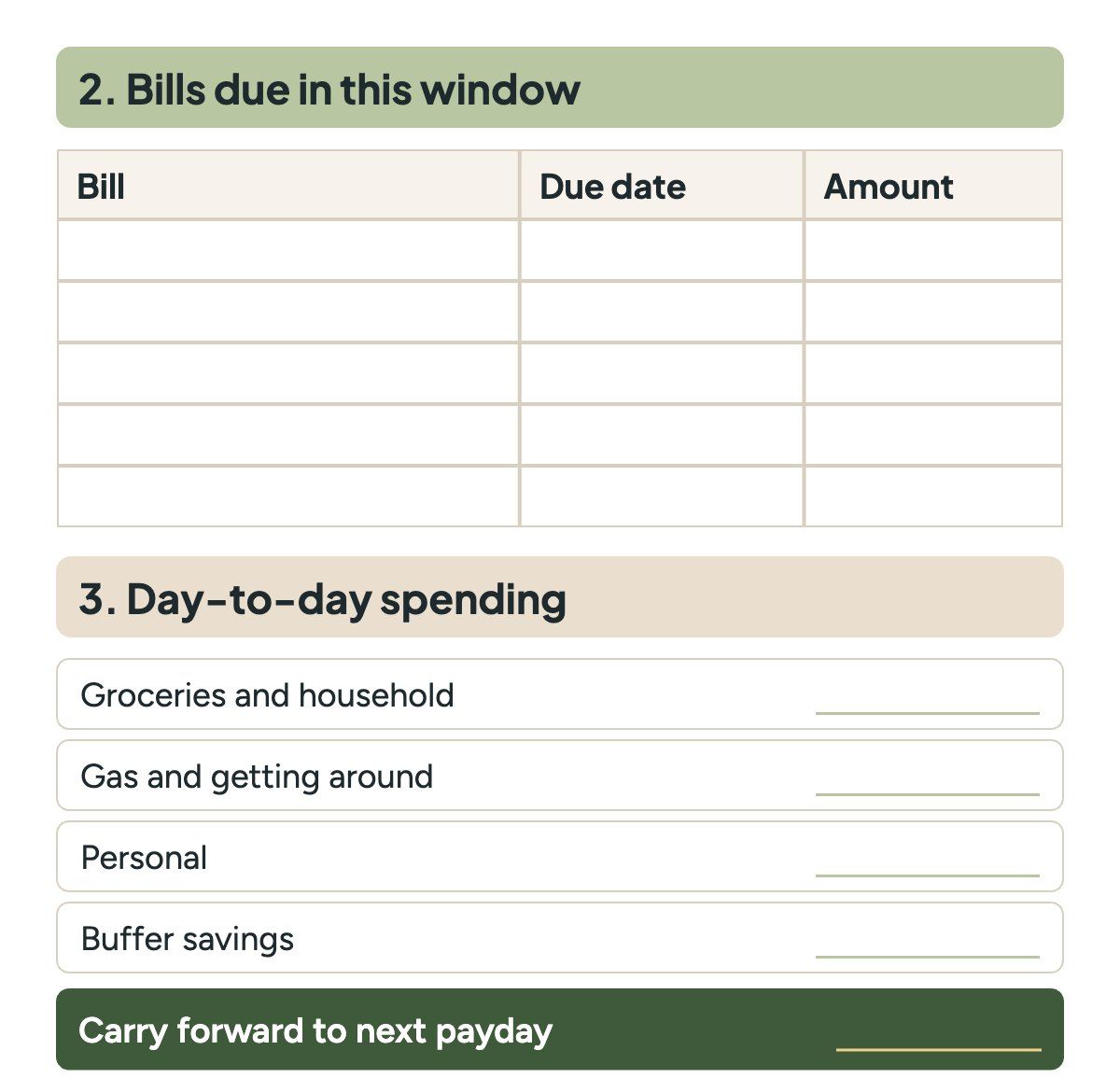
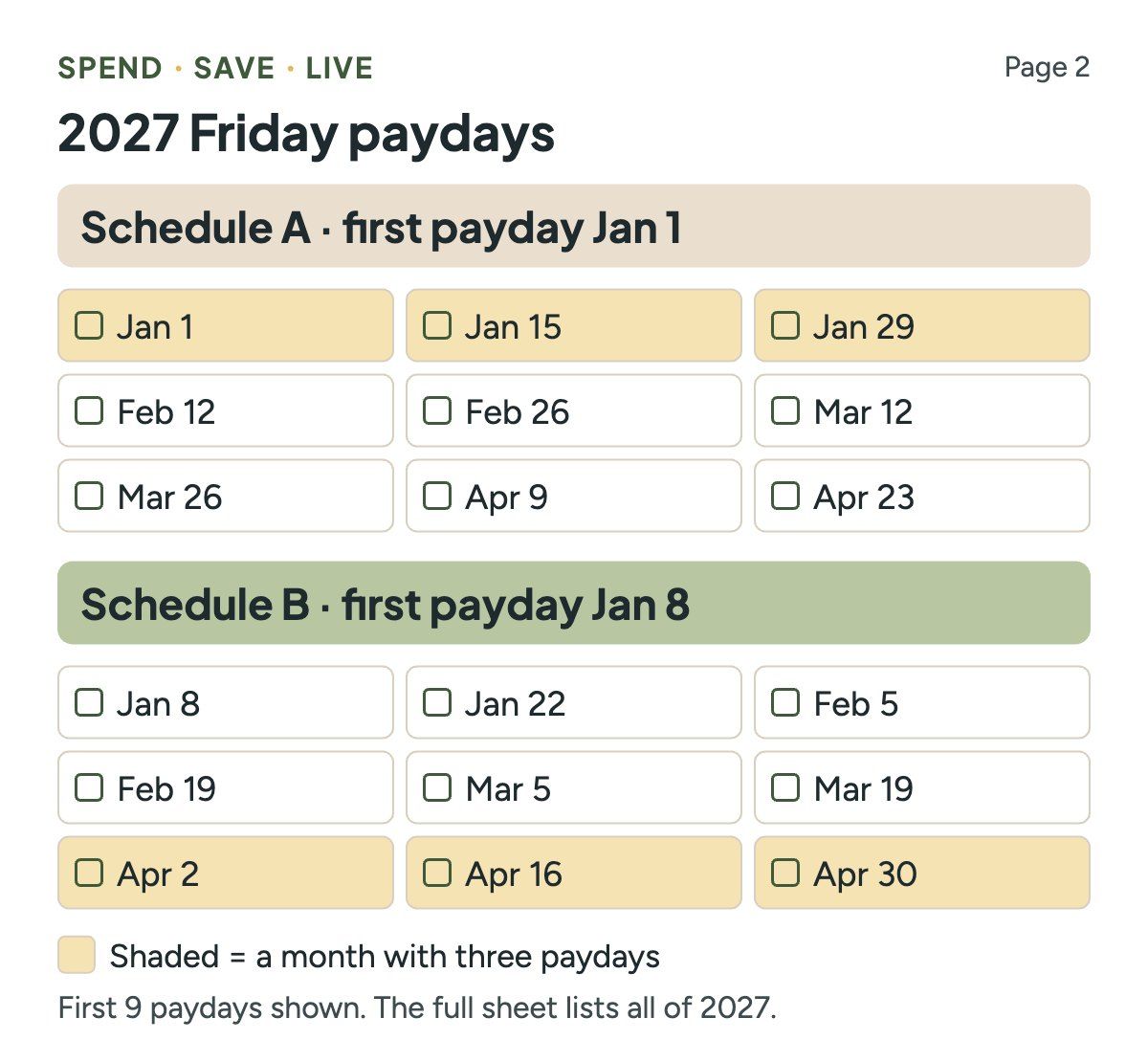
- Page 1: one paycheck window, with the payday, window end, opening balance, pay, bills due, spending and carry forward. Print one per check.
- Page 2: every 2027 Friday payday on both schedules, with three-paycheck months shaded.
Get the full Biweekly Paycheck Planner
The full printable PDF is coming soon. It will be free to SPEND • SAVE • LIVE readers.
Is a Three-Paycheck Month Really Free Money? Mostly Not
Only part of it, because the third check usually opens a window that pays next month’s rent, so only what’s left after that window’s bills is truly extra.
Look at Riley’s April. The April 30 check feels like a bonus, but its window runs to May 13 and holds May rent, the car payment and electric, $1,510 in all, so on its own it’s $570 short. The extra money in a three-check month is real, it just shows up in the carry forward, not in that third deposit.
This is also where yearly bills sneak in. Mine is always tax: in years when I forgot to update my tax card here in Finland and earned a bit more than planned, I paid tax the following year instead of getting money back, and one year it was €2,000 (about $2,200). In the US the same lesson usually means checking your withholding, and a three-check month is a good moment to set money aside for whatever your yearly surprise is.
If you want a plan for those months, here’s how to plan your three-paycheck months, or put the extra toward a biweekly savings challenge built around the same paydays.
Read more: How to Start Sinking Funds for Costs You Know Are Coming
When Every Window Comes Up Short, Call in Backup
A template can’t create money, so if most of your windows are short even with the carryover, the gap is income versus costs, not timing, and that’s a good moment to get outside help.
- Pay the bills that protect your home and income first. The CFPB’s prioritizing bills tool puts things you need for work, insurance and housing and utilities ahead of other debts, and says to contact a company before you miss a payment, not after.
- Dial 211. 211 connects you with local help for rent, utilities and other bills.
- Talk to a nonprofit credit counselor. The National Foundation for Credit Counseling has certified counselors at 877-360-6322.
- Cut to the essentials for a month. Here’s a bare-bones budget for a tight month, and if this is your normal rather than a rough patch, breaking the paycheck-to-paycheck cycle starts from there.
- New here? The Start Here page shows what to read next, and the paydays and bills guides live in one place.
Frequently Asked Questions
How do you budget with Google Sheets?
Make a copy of a template, enter your pay dates and bills once, and let a SUMIFS formula add up the bills between each pair of paydays. After that you only update the amounts that change.
How do you budget biweekly paychecks?
Give each check the bills due from its payday until the day before the next one, subtract your day-to-day spending, and carry what’s left into the next window. When a window comes up short, hold money back from the check before it.
How many biweekly paychecks are in 2027?
26, or 27 if your Friday schedule includes January 1, 2027. January 1 is a Federal Reserve holiday, so that deposit may move. Check your pay stub or ask payroll.
How do you budget if your income changes every check?
Plan with your lowest likely check, not your average, and give any extra a job when it arrives. This guide on how to budget irregular income goes through it step by step.
Can you give an example of a cash flow budget?
Riley’s tables above are one. Each window starts with what carried over, adds pay, subtracts the bills and spending due in that window, and carries the rest forward. Here’s a full cash flow budget example built around bill dates.
Should I pay all my bills on payday?
You can, as long as every bill due before the next payday is covered by the check you have. Paying on payday means you can’t accidentally spend bill money, but leave enough for groceries and gas until the next deposit.
Key Takeaways
- A biweekly check pays every bill due from its payday to the day before the next deposit, even into next month.
- Every-other-Friday pay gives 26 checks in 2027, or 27 if your schedule includes January 1.
- The window that holds the 1st holds rent, so it’s usually short on its own. Hold money back from the check before it.
- Carry each window’s leftover forward instead of starting from zero every payday.
- A third paycheck usually pays next month’s rent first. Only what’s left after its window is extra.
Fourteen Days at a Time Is Plenty
Remember the rich check and the broke check? They were never rich and broke, one of them was paying next month’s rent before the month even started. Once every bill has a window and every leftover rolls forward, you only ever have to think 14 days ahead, which is a lot calmer than guessing your way through a whole month. If budgeting is still new to you, start with budgeting for beginners from the money you actually have, then come back and put your paydays in.
Sources (checked November 2026)
- BLS, Length of pay periods in the CES survey
- IRS, Publication 15-T (pay periods per year)
- Federal Reserve Financial Services, Holiday schedules
- CFPB, Cash flow budget
- CFPB, Bill calendar
- CFPB, Improving cash flow
- CFPB, Prioritizing bills
- Google Docs Editors Help, SUMIFS
- 211.org
- National Foundation for Credit Counseling
Riley is a fictional example. All calendar math and example totals were checked with a calculator script and a test spreadsheet. The euro amount is converted at the ECB rate of 17 November 2026 and is approximate.
Educational content, not financial advice.