

A budget calendar printable puts your paydays, bill due dates and a running balance on dated pages. Write your starting balance, add each payday and bill on its date, then subtract day by day and circle the lowest number. That day is the one to fix, either by moving a due date or by holding a little money back.
Sixteen percent of US adults didn’t pay all of their bills in the prior month, according to the Federal Reserve’s latest household survey, and a missed bill doesn’t always mean the paycheck was too small. Sometimes the month adds up perfectly on paper and there’s still one Thursday where the car payment leaves the day before payday arrives (hello, overdraft notice).
This post is about that Thursday. You’ll put every payday and bill on its real 2027 date, keep a running balance, spot your lowest day weeks ahead and fix it with one phone call or one small hold-back, and the budget calendar printable below gives you a dated page for every month. It sits with the other paydays and bills guides in Spending & Budgeting.
Read this also:
- A Biweekly Budget Template for Bills Between Paydays
- A Simple Monthly Budget Planner With a Filled-In Example
- Budgeting for Beginners From the Money You Actually Have
- A 52-Week Savings Challenge That Fits Your 2027 Cash Flow
Quick gut check before you print anything. A budget calendar earns its spot on the fridge if two or more of these sound like you:
- Your bills fit your monthly pay, but you still run low right before payday.
- Two or more big bills land in the same week.
- Your paydays move around the month because you’re paid weekly or every other week.
- You’ve paid a late fee or an overdraft fee in a month that should have been fine.
If your bills are bigger than your pay even in a good month, a calendar can’t fix that part, so skip to where to get help first.
What Is a Budget Calendar (and Why Isn’t Your Monthly Budget Enough)?
A budget calendar is a month page with your paydays, your bill due dates and your balance after each one, so it checks timing where a regular budget checks totals.
A monthly budget answers one question, which is whether more comes in than goes out. The FTC’s Make a Budget worksheet is a good example of that kind of sheet, with seven groups of costs (housing, food, transportation, health, personal and family, finance, other) and not a single date on it, so it can tell you January works and still miss that rent and the car payment both leave before your first paycheck does.
That’s why I’d keep both. Your monthly budget planner decides how much each bill gets, and the calendar decides when that money has to be sitting in checking.
Before my dashboard, my whole budget lived on one simple Google Sheet, one block per month, with every bill on its own row and a paid or done status next to it. Super simple, and that status column is basically a calendar tick in spreadsheet form.
Apps can project your balance too, if that’s more your thing. This is the pen-and-paper version, because you can see the whole month at once and nothing pings you at 6 a.m.
How to Create a Budget Calendar in Five Steps (Pen Required, Spreadsheet Optional)
Write your starting balance, your paydays, your bills and a weekly spending amount on their dates, then carry the balance forward one day at a time.
- Write what’s actually in checking on day 1, not what you hope is there.
- Write every payday with its take-home amount, the number that lands after taxes and deductions.
- Write each bill on its due date and mark the ones on autopay. The CFPB bill calendar tool says to mark online payments two or three days before the due date and mailed ones at least seven days before, so put those bills on the earlier day.
- Groceries, gas and the rest go in as one amount on one day each week. It doesn’t have to be exact, it just has to be there.
- Add paydays, subtract bills, carry the number forward day by day, then circle the lowest one. Draw a cushion line too, an amount you’d rather not dip under (say $100).
Only step 5 has math, and it’s subtraction. If you think in weeks more than days, a week-by-week cash flow budget does the same job in four columns.

What Does a Budget Calendar Look Like for a Real Month?
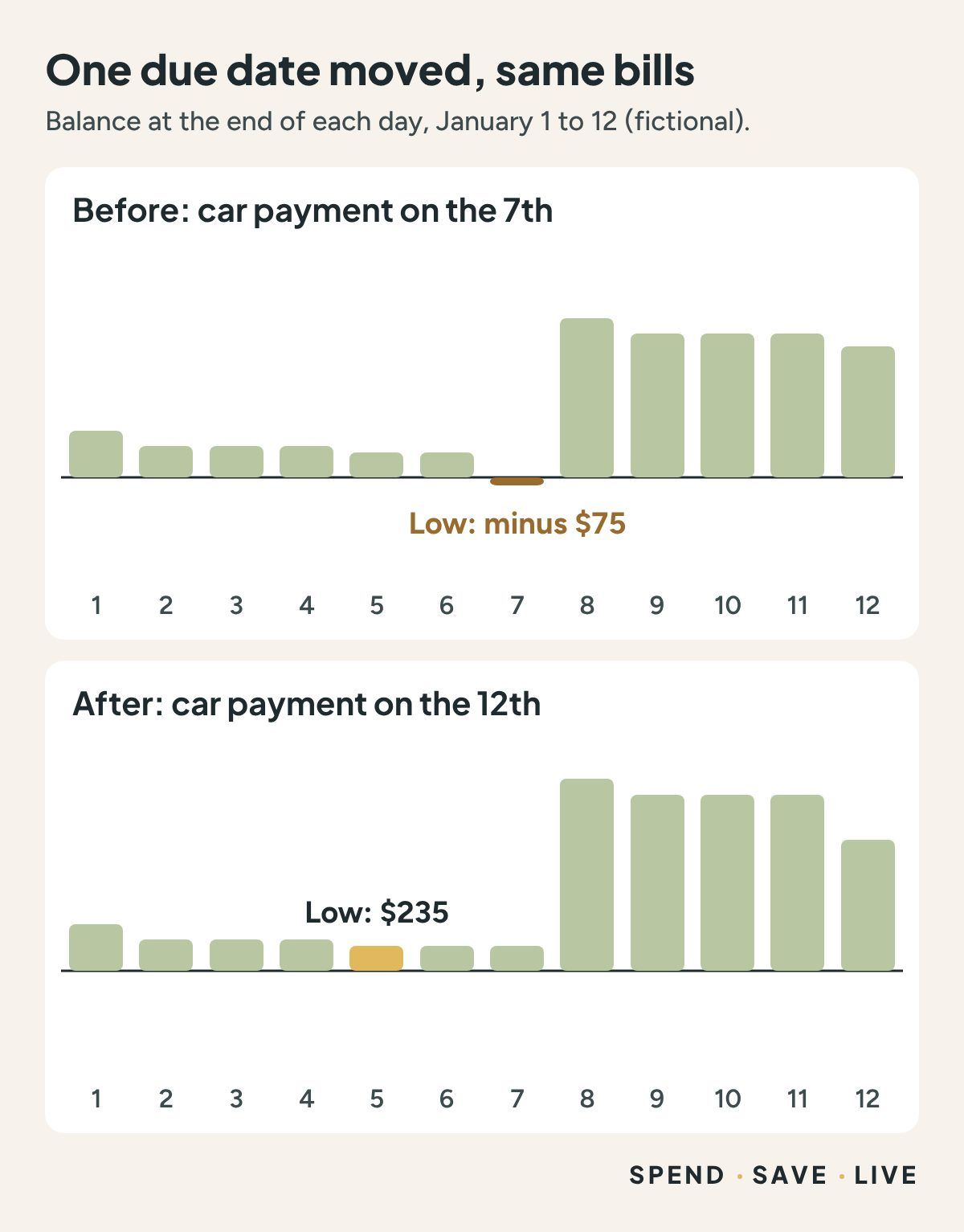
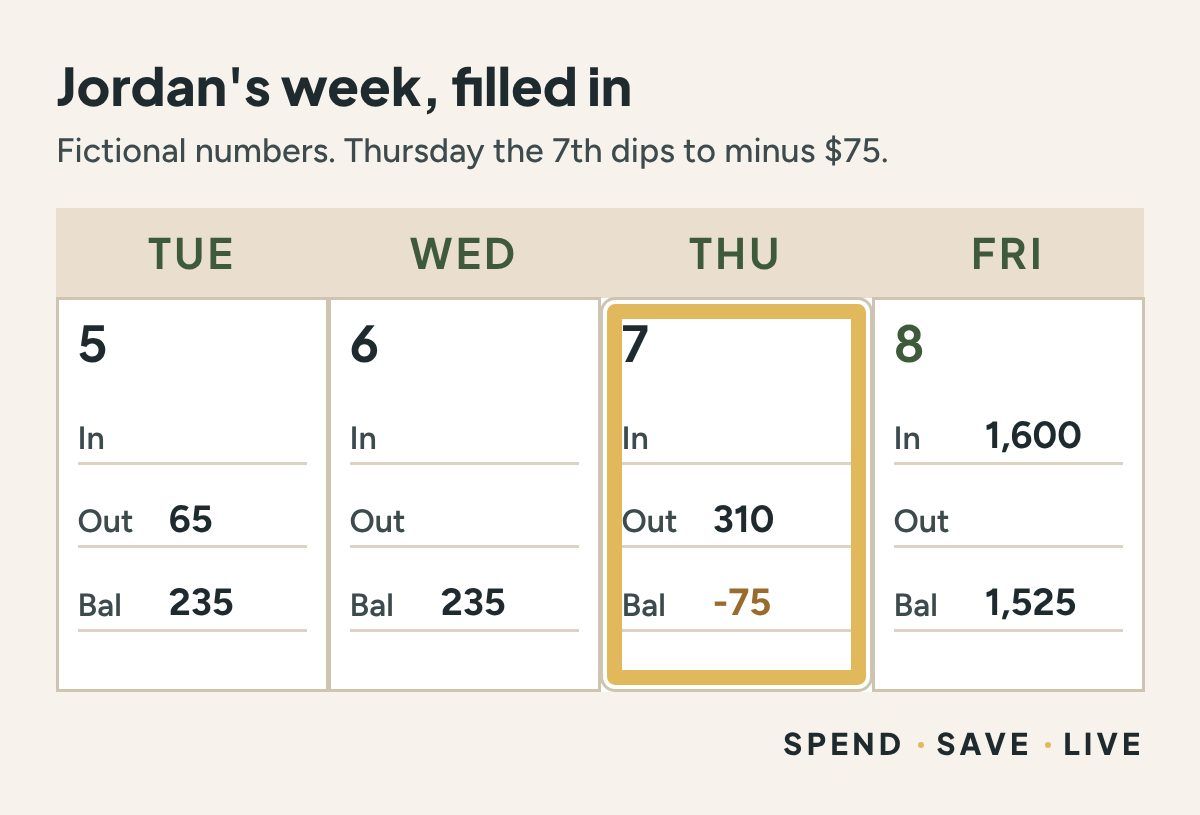
Jordan’s fictional January 2027 ends $234 ahead and still dips to minus $75 on Thursday, January 7.
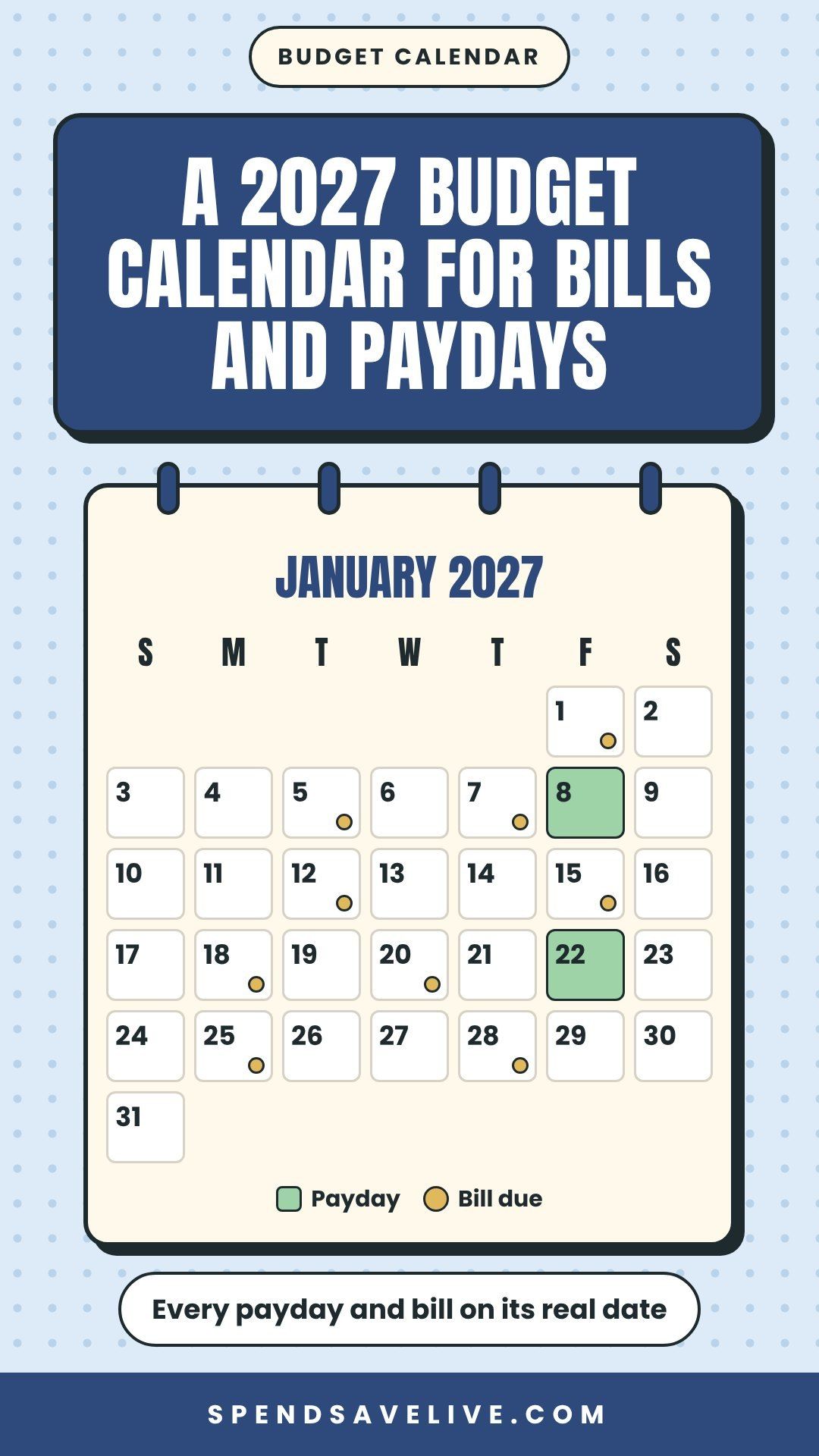
Fictional numbers, your bills will differ. Jordan is one adult paid $1,600 take-home every other Friday (January 8 and 22 in 2027), starts the month with $1,700 in checking, has every bill on autopay and spends about $150 on everyday stuff each Saturday.
| Date | What happens | Balance |
|---|---|---|
| Fri, Jan 1 | Start $1,700, rent $1,250 | $450 |
| Sat, Jan 2 | Everyday spending $150 | $300 |
| Tue, Jan 5 | Phone $65 | $235 |
| Thu, Jan 7 | Car payment $310 | minus $75 |
| Fri, Jan 8 | Paycheck $1,600 | $1,525 |
| Fri, Jan 22 | Paycheck $1,600 | $2,430 |
| Sat, Jan 30 | Last everyday spending | $1,934 |
See every line of Jordan’s January
| Date | What happens | Balance after |
|---|---|---|
| Jan 1 | Start $1,700, rent minus $1,250 | $450 |
| Jan 2 | Everyday spending minus $150 | $300 |
| Jan 5 | Phone minus $65 | $235 |
| Jan 7 | Car payment minus $310 | minus $75 |
| Jan 8 | Paycheck plus $1,600 | $1,525 |
| Jan 9 | Everyday spending minus $150 | $1,375 |
| Jan 12 | Electric minus $120 | $1,255 |
| Jan 15 | Car insurance minus $140 | $1,115 |
| Jan 16 | Everyday spending minus $150 | $965 |
| Jan 18 | Internet minus $60 | $905 |
| Jan 20 | Credit card minimum minus $75 | $830 |
| Jan 22 | Paycheck plus $1,600 | $2,430 |
| Jan 23 | Everyday spending minus $150 | $2,280 |
| Jan 25 | Streaming minus $16 | $2,264 |
| Jan 28 | Student loan minus $180 | $2,084 |
| Jan 30 | Everyday spending minus $150 | $1,934 |
Add it all up and the month looks great. Income is $3,200, bills are $2,216 and everyday spending is $750, so $2,966 goes out and Jordan finishes about 7% of take-home ahead.
Up $234 for the month. Minus $75 on the 7th.
Same money, same bills, and one day where checking goes negative because the car payment leaves the day before payday. A totals-only budget never shows you that day, and the calendar shows it in one circled box.

How Do You Spot the Week You’ll Run Short?
Look for your lowest balance, then for any bill that’s due a week or more before the paycheck that covers it.
The CFPB’s worksheet for changing a bill due date splits the month into four blocks: the 1st to 7th, the 8th to 14th, the 15th to 21st and the 22nd to the end. Drop each bill and each paycheck into its block, and any bill sitting a week or more ahead of the money that pays it is a bill worth asking about.
If you’re paid every other week, watch out, because the short week moves. Jordan’s February paydays are Friday the 5th and Friday the 19th, so the same car payment on the 7th is totally fine that month, which means you check every month and not just January (sorry).
Give yourself a cushion line as well. Jordan’s is $100, and any day under it gets a circle even when it isn’t below zero, because one surprise charge on that day would push it there.
I do a weekly money check that takes about 30 minutes, and that’s the moment to glance at the next two weeks of the calendar. Finding the short week ten days early is a lot nicer than finding it in a bank notification.
Read more: A 2027 Annual Budget Planner for Expensive Months
Can You Ask to Change a Bill Due Date? (Yes, Politely, and It Might Work)
You can ask, plenty of companies allow it, and none of them has to say yes.
The CFPB worksheet lays out the steps, and they’re less scary than a phone call sounds:
- Check the company’s website or call to see its rules for changing a due date.
- Pick a new date that lands after one of your paydays.
- Contact them by phone, email, online form or letter, with your account number ready.
- Confirm when the change starts, what the next bill will be and whether there’s a fee. If the new date is later in the month, the first bill after the change may be bigger.
I am requesting a change in my bill payment due date for my [company] bill.
Sample request line from the CFPB worksheet
For Jordan, moving the car payment from the 7th to the 12th fixes the whole month. The lowest balance becomes $235 on Tuesday the 5th, and the end balance doesn’t change at all.
If the lender says no, the CFPB’s fallback is setting money aside from one part of the month for bills in another. Jordan would keep $175 back from the last December paycheck ($75 short plus the $100 cushion), and the lowest day becomes exactly $100.
One weekend rule, for credit cards only. Per Ask CFPB, a mailed card payment due on a day the issuer doesn’t take mail counts as on time if it arrives by 5 p.m. the next business day, while online and phone payments still have to go in on the due date. For every other bill, check with the company.
My own fix, from the chef years when pay was low and the month felt very long, was paying the bills first on payday and living on whatever was left. I’m still paid monthly and I still pay every bill on payday, and then it’s done. If you’re paid every other week, you can assign each bill to a paycheck the same way.
What’s in the 2027 Budget Calendar Printable?
It’s 14 pages that put every 2027 payday, bill and balance on a dated page, starting with a bill list and a payday year view.

- Page 1, bill list: bill, due day, amount, how you pay, pay-by date, whether the date can move, new due day and a paid tick box.
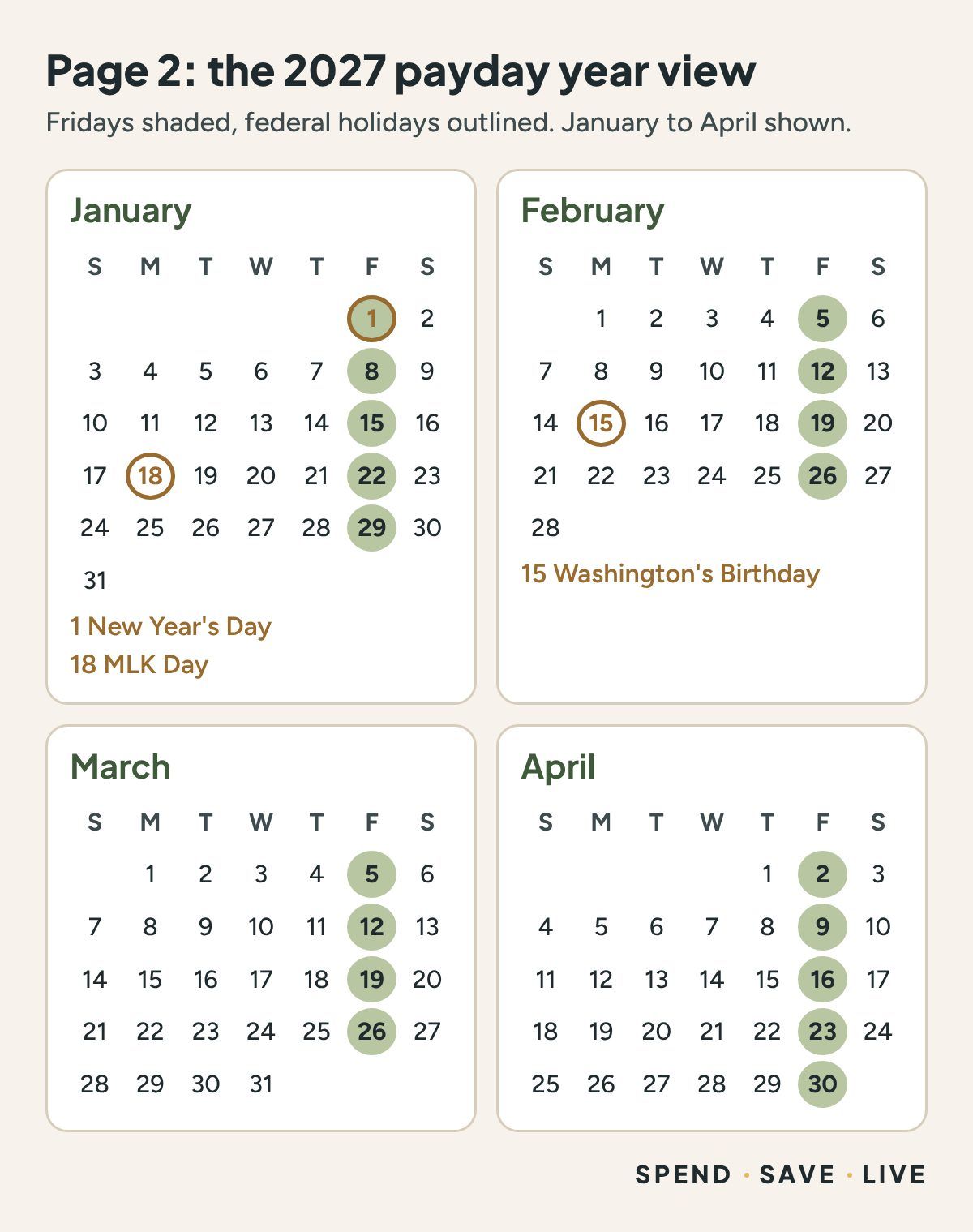
- Page 2, payday year view: all 12 months on one page, every Friday shaded, the 2027 federal holidays outlined and boxes for weekly, every other Friday, twice a month or monthly pay.
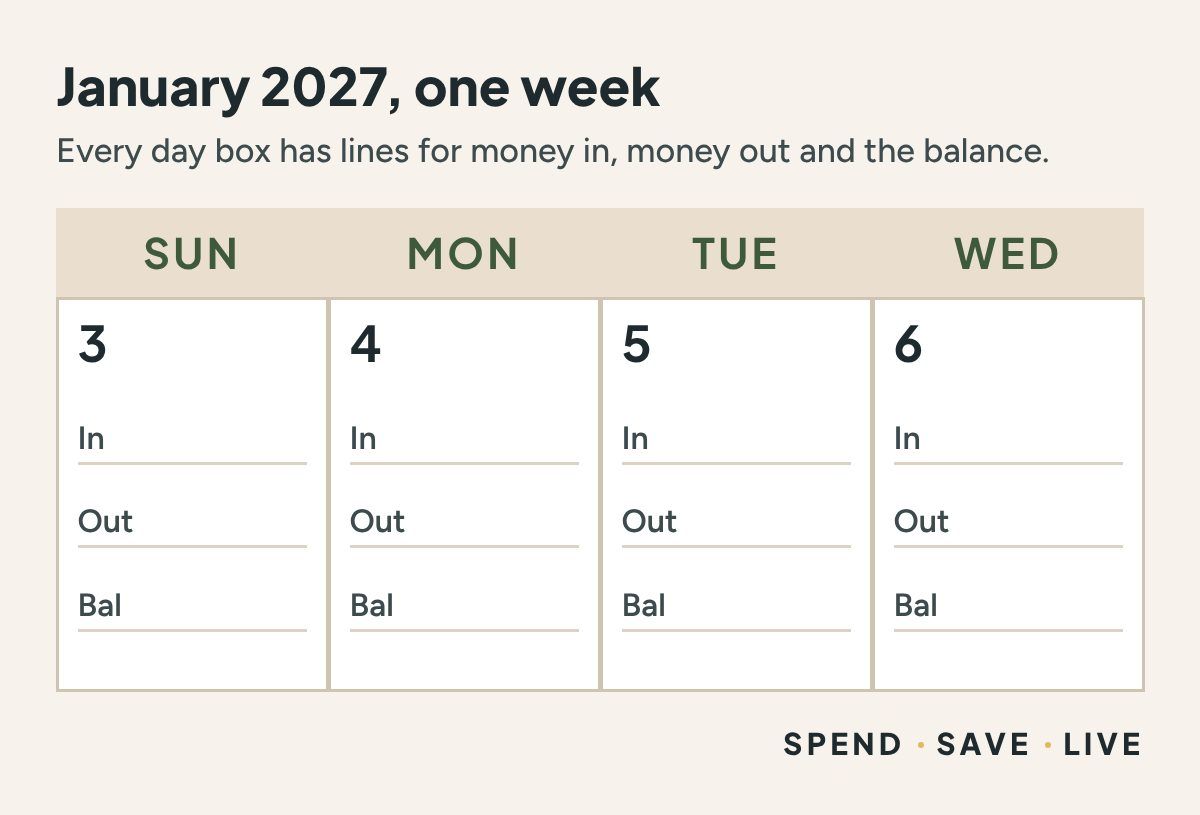
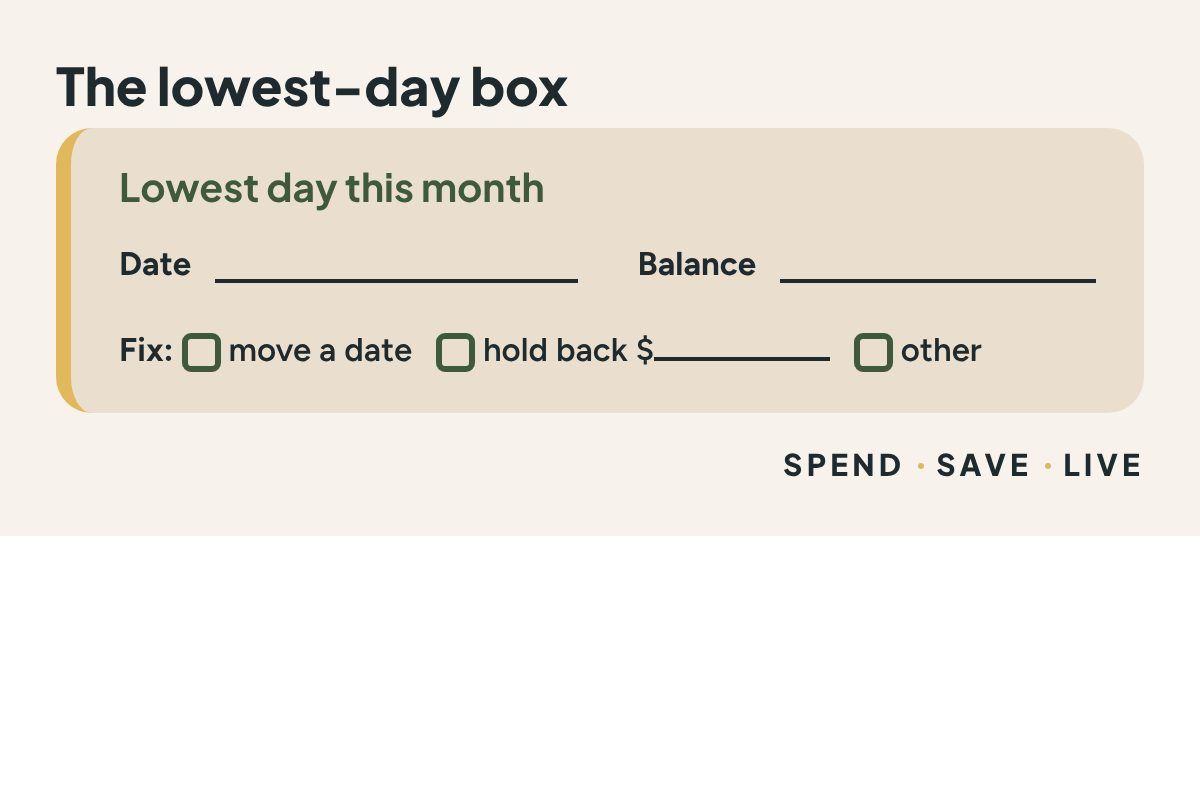
- Pages 3 to 14, January to December 2027: a Sunday-start grid with the real dates, In, Out and Balance lines in every day box, a starting balance and cushion strip on top and a lowest-day box at the bottom.
January, May and October need six week rows in 2027, so those pages have a little less room per day. Print at 100% on US letter paper.
Get the full 2027 Budget Calendar
The full printable PDF is coming soon. It will be free to SPEND • SAVE • LIVE readers.
How Do Weekly, Biweekly and Monthly Paydays Change Your 2027 Calendar?
The more often you’re paid, the more your short week wanders around, so weekly and biweekly earners should check every single month.
- Weekly on Fridays: 2027 has 53 Fridays, and January, April, July, October and December each get five. Here’s how to budget weekly pay for monthly bills.
- Every other Friday from January 8: that’s 26 paydays, with three in April and three in October. See your three-paycheck months in 2027, or point the extra one at a savings challenge that fits your 2027 cash flow.
- Holiday Fridays: OPM lists Friday, January 1, Friday, June 18 and Friday, December 24 as 2027 federal holidays, plus Friday, December 31 for New Year’s Day 2028 (January 1, 2028 is a Saturday). December 24 is one of Jordan’s paydays, so if a payday lands on a holiday, ask your employer when the money arrives.
- Monthly: one payday, so the long stretch is the days right before it, and bills due in the first week after payday are the easiest to cover.
And if you want the whole year in view, not just the month, you can plan for the expensive months on one page.
Read more: How to Find and Use Your Three-Paycheck Months in 2027
What a Budget Calendar Can’t Do, and When to Get Help
A calendar moves money around inside the month, but it can’t make the month any bigger.
If your bills are bigger than your pay even after you’ve fixed the dates, these are better next stops than another spreadsheet:
- The CFPB’s Prioritizing bills tool, which helps you decide what gets paid first. Its advice is blunt: don’t ignore bills you can’t pay, call the company you owe instead.
- Dial 211 to reach local help with bills, utilities and food.
- The National Foundation for Credit Counseling for nonprofit credit counseling, at 877-360-6322.
New here? Start Here walks you through the rest of the site.
Frequently Asked Questions
How do you create a budget calendar?
Write your starting balance on day 1, then every payday with its take-home amount, each bill on its due date and a weekly spending amount. Carry the balance forward day by day and circle the lowest number, because that’s the day to fix.
How do you determine a budget?
Start from the take-home pay you actually receive and the bills you actually have, then decide what each dollar is for. Once the totals work, check the timing on a calendar. Budgeting for beginners walks through a first month step by step.
What are the 7 categories of a budget?
There’s no official seven, but the FTC’s Make a Budget worksheet groups costs into seven: housing, food, transportation, health, personal and family, finance and other. Our budget categories list goes further and catches the costs people forget.
What bills do most adults pay monthly?
No single list fits everyone. Common ones are rent or a mortgage, utilities, phone and internet, insurance, transportation and debt payments, which roughly match the FTC worksheet’s groups.
If you are paid weekly, how do you budget monthly?
Give each bill a payday on the calendar so you know which check covers it. In 2027 the five-Friday months are January, April, July, October and December. Here’s more on how to budget weekly pay for monthly bills.
What if a bill is due on a weekend?
For credit cards, a mailed payment due on a day the issuer doesn’t accept mail counts as on time if it arrives by 5 p.m. the next business day, but online and phone payments are due that day. For other bills, check with the company.
Key Takeaways
- A month can balance overall and still run short before payday, so dates matter as much as totals.
- Write a running balance next to every payday and bill, then circle the lowest day.
- Ask the company for a new due date first. They don’t have to agree, and the first bill after a change may be bigger.
- If the date can’t move, hold money back from the paycheck before the short week.
- Biweekly and weekly paydays move the short week, so check every month of 2027.
Circle One Day, Make One Call, Then Leave January Alone
That Thursday from the top of this post only catches you out if nobody wrote it down. Fill in January, find the circled day, make the one call or set aside the one amount, and you’re done until next month’s page. If you haven’t set your monthly numbers yet, start with the monthly budget planner and come back with the totals.
Sources (checked November 2026)
Educational content, not financial advice. All example numbers are fictional.