

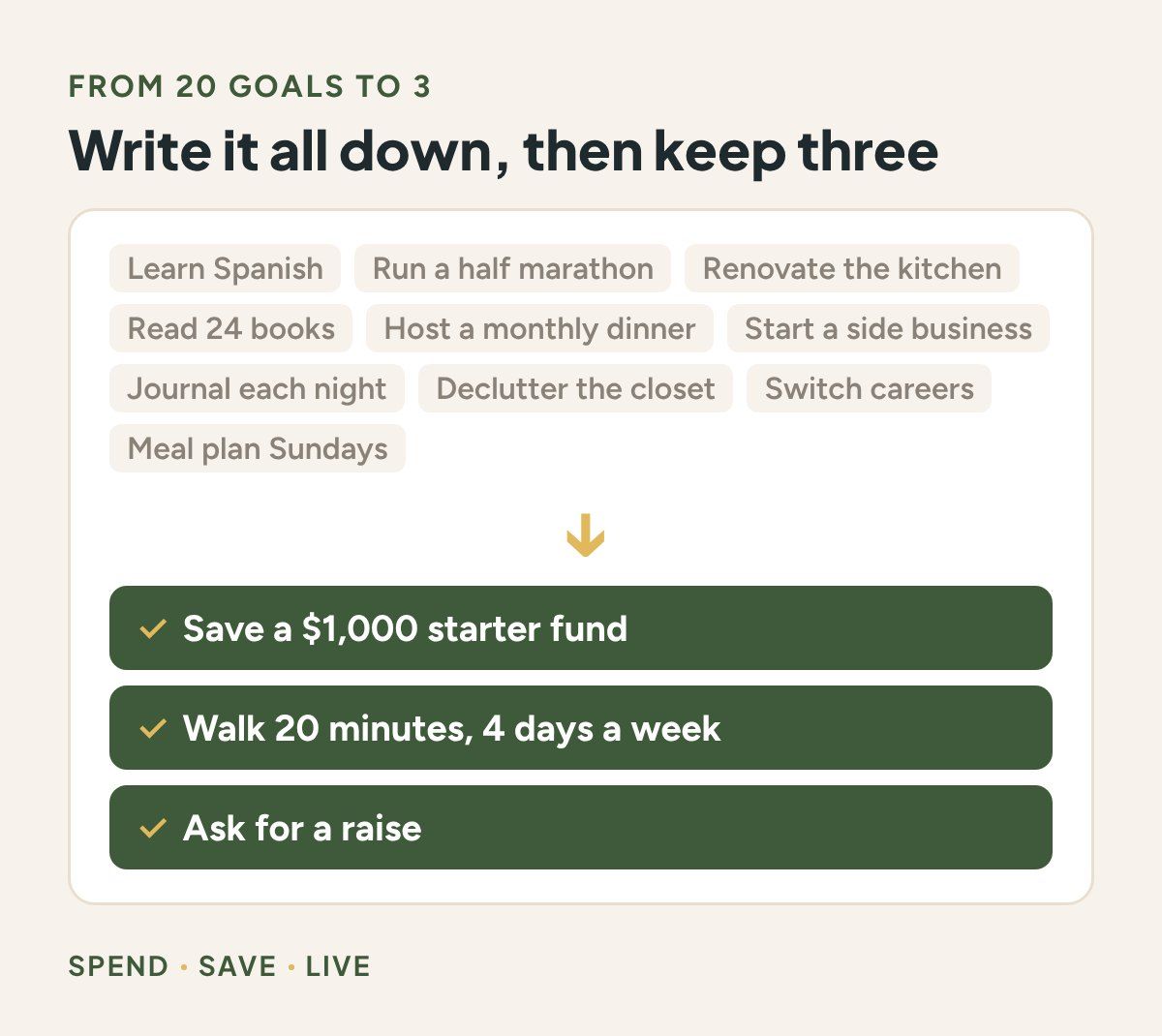
To choose a few life goals from a long list, run each goal through four yes or no filters: is it really yours, does it fit this season’s time and money, is there a 15-minute first step, and does it avoid clashing with another goal. Keep up to three that pass and park the rest with a look-back date.
The usual advice for a life goals list is to make it longer, add another area, another dream, another 50 ideas from someone else’s list, and somewhere around goal number 37 the whole thing stops feeling like a list of possibilities and starts feeling like a pile of homework you assigned yourself (with no teacher, no deadline and somehow still a lot of guilt).
Here we go the other way. You’ll write the long list fast, then cut it down to three with four plain yes or no questions, using a filled-in list of 20 goals where every number adds up, and the goals that don’t make it get a proper home instead of a quiet death. It sits with our other habits and life planning guides, and all you need is a pen and about 30 minutes.
Read this also:
- A New Year Goal Setting Worksheet That Fits Your Real Week
- A Life Audit That Helps You Choose One Change for 2027
- Year-End Reflection Questions That Lead to One Clear Change
- A 90-Day Goal Planner With Weekly Actions You Can Review
I don’t make New Year resolutions, by the way. I have long-term goals, and each year I pick a few that move me closer to them, which is basically this whole post in one sentence, just with more tick boxes.
Why Does a Long Life Goals List Feel Like a Pile of Obligations?
A long life goals list feels heavy because everything on it is asking for the same small pool of money, hours and energy at the same time. Written in one place, a goal stops being a nice someday thought and turns into a little IOU, and twenty IOUs on one page is a lot to look at on a Tuesday.
There’s nothing wrong with the long list itself. Writing down everything you might want is useful, and it’s kind of fun (the part where you write “learn to make pasta from scratch” at 11 pm is the best part). The trouble starts when the long list quietly becomes the plan, because nobody has the time to start twenty things in January, and then the list makes you feel behind before you’ve done anything at all.
So keep the dream list, and add a second, much shorter list for now, plus a clear place for everything else. This post is for you if:
- Your goals list has more than about ten things on it
- Looking at it makes you tired instead of excited
- You keep starting a few goals and dropping all of them by February
How Do You Build a Life Goals List Without Editing Yourself?
Write your life goals list first and judge it later: set a 10-minute timer, write every goal that comes to mind, then sort the list into life areas. Most people end up with somewhere between 20 and 60 goals, and that’s fine, the cutting comes after.
Dump 20 to 60 goals in 10 minutes
Don’t rank, don’t fix the wording, don’t cross anything out yet. Big ones and weird ones both go on the page. If you get stuck, these year-end reflection questions are good prompts, because what bugged you this year usually points at a goal for the next one.
Sort them into life areas
Next, put each goal under an area: money, health, home, people, growth, work, life admin and habits. Rename or merge any that don’t fit your life. Seeing the areas helps later, because a shortlist with three goals in one area tends to wobble, and if you’re not sure which areas matter most right now, a life audit worksheet scores them for you.
Keep this list about your own life planning, though. A bucket list of trips, a wedding mood board or a list of hobbies to try is a different exercise, and it’s a lovely one, just not the one we’re cutting down here.
How Do You Filter a Long Life Goals List Down to a Few?
Ask four yes or no questions about each goal, in this order, and only goals with four yeses can go on the shortlist. A yes or no beats a gut-feel ranking because you can’t fudge it at 10 pm when every goal suddenly seems equally important.

Filter 1: Is it mine?
Would you still want this goal if nobody ever saw it, praised it or asked about it? Psychologists have a whole model for this, the self-concordance model, which looks at the motives behind goals, and it separates goals you chase because they matter to you from goals you chase because you feel pushed or would feel guilty otherwise. A no here goes straight to Let go, no matter how the goal does on the other three filters. If you’re not sure what’s really yours, personal values exercises help you check.
Filter 2: Does it fit this season?
Does the goal fit into the spare money and hours you have right now? Write down what’s left each month after bills and savings, and the free hours you have each week, then set a cap: no single goal gets more than half of either. That cap is our own rule of thumb, not a law of nature, but it stops one big goal from eating everything. Money is the bit people skip, and the CFPB makes the same point, that most goals cost money to reach (CFPB on goals that take money). If money is one of your goals, a financial goals worksheet turns it into an amount per payday.
Filter 3: Is there a 15-minute first step?
Can you name one step that takes 15 minutes or less and that you could do this week? “Look up three pay listings for my role” passes, “Figure out my career” does not. A goal with no small first step can wait until it’s ready, and a personal goal worksheet or these SMART goal examples help you shrink it into one.
Filter 4: Does it clash with another goal?
Does it fight another goal for the same dollars, the same Saturday or the same energy? Researchers who reviewed the studies on this point out that clashing goals can hurt both well-being and performance (a 2017 review of goal conflict research in Frontiers in Psychology). When two goals clash, keep the one that matters more this season and move the other one to Later.
What Does a Filled-In Goal Shortlist Look Like?
Here’s Maya, a fictional reader we made up for this example, whose life goals list of 20 goals ends up as 3 on the shortlist, 7 next in line, 7 for later and 3 let go. Maya is 32, works full time, and after bills and savings she has about $150 a month and 5 free hours a week to spare, so her season cap per goal is $75 a month and 2.5 hours a week.
Maya’s 20 goals and her four filters
| Goal | Filter it missed | Pile |
|---|---|---|
| 1. Save a $1,000 starter emergency fund | None | Shortlist |
| 2. Check the budget weekly | None | Next in line |
| 3. Save $2,400 toward a used car | Season ($200 a month), clash | Later |
| 4. Walk 20 minutes, 4 days a week | None | Shortlist |
| 5. Be in bed by 11 pm | None | Next in line |
| 6. Run a half marathon | Mine (also season, clash) | Let go |
| 7. Ask for a raise | None | Shortlist |
| 8. Get promoted this year | Mine | Let go |
| 9. Finish a certificate course | Season (4 hours), clash | Later |
| 10. Switch careers to UX design | Season (5 hours), first step, clash | Later |

| Goal | Filter it missed | Pile |
|---|---|---|
| 11. Declutter the closet | None | Next in line |
| 12. Renovate the kitchen | Season ($600 a month), first step, clash | Later |
| 13. Call my sister weekly | None | Next in line |
| 14. Host a monthly dinner | Season (3 hours), clash | Later |
| 15. Learn Spanish | Season (3 hours) | Later |
| 16. Read 24 books | Mine | Let go |
| 17. Put key documents in one folder | None | Next in line |
| 18. Meal plan every Sunday | None | Next in line |
| 19. Journal each night | None | Next in line |
| 20. Start a side business | Season (6 hours), first step, clash | Later |
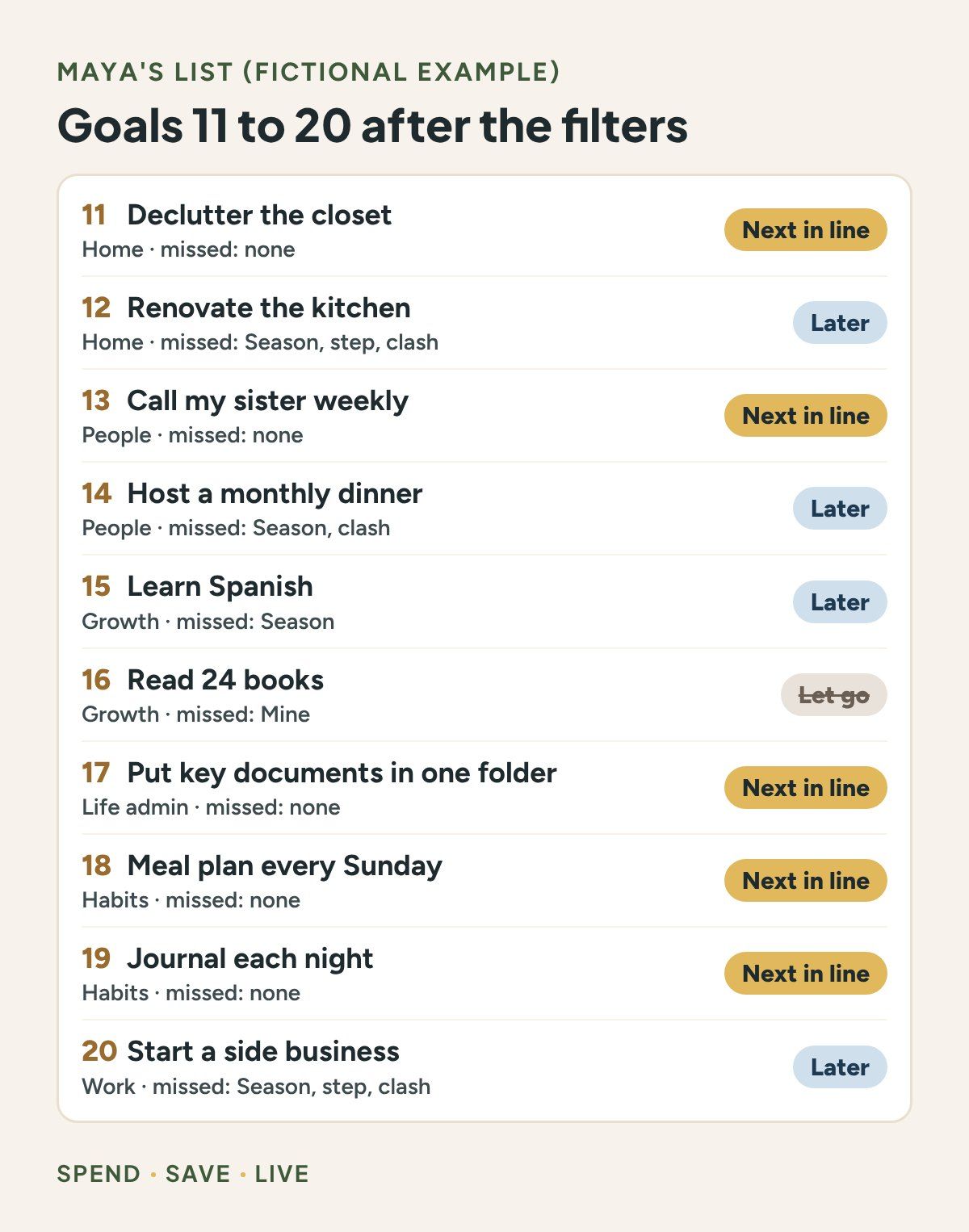
Look at the three Let go goals for a second. The half marathon is a friend’s goal, the 24 books came from a list on the internet, and the promotion is more her boss’s wish than hers. They could be great goals for someone else, and catching that is the whole point of filter 1.
Her three shortlisted goals
Ten goals passed all four filters, which is still way too many to start at once, so Maya keeps at most one goal per area and only three areas. She picks Money, Health and Work, because those were her biggest gaps when she did a life audit:
| Goal | First step (15 min or less) | Cost per week |
|---|---|---|
| Save a $1,000 starter emergency fund | Open a separate savings pot (10 minutes) | $75 a month, 0.5 hours |
| Walk 20 minutes, 4 days a week | Put the walks in Monday’s calendar | $0, about 1.3 hours |
| Ask for a raise | Look up 3 pay listings for her role | $0, 1 hour |
| Total | $75 a month, 2.8 hours |

The math: $75 + $0 + $0 = $75 a month, which leaves $75 of her $150 spare. And 0.5 + 1.3 + 1 = 2.8 hours a week, which leaves 2.2 of her 5 spare hours. That leftover is on purpose, because weeks are never as tidy as the plan, and a shortlist that uses every last hour breaks the first time someone gets sick.
Where Do the Goals That Did Not Make the Shortlist Go?
Every goal on your life goals list that didn’t make the shortlist goes into one of three piles: Next in line, Later with a look-back date, or Let go. “Not now” is a decision you made on purpose, and writing it down is what stops the long list from nagging you all year.

Next in line
These passed all four filters but lost the one-per-area rule, like Maya’s weekly budget check and her bedtime goal. When one shortlist goal turns into a habit or gets done, the next one in line takes its slot. If you’d like to see how a whole year of goals fits around what you already do, here’s how to fit annual goals around your commitments.
Later, with a look-back date
These are goals you still want that need more money, more time or a smaller first step than this season has. Give the whole pile one look-back date, Maya uses Sunday, April 4, 2027, and on that day check whether anything changed. Maybe the car fund fits once the starter fund is full, maybe Spanish fits in summer, maybe not, and that’s fine too.
Let go
Anything that failed “is it mine?” goes here. You can cross these out with a little ceremony if you like, I won’t judge (you’re allowed to feel lighter, that’s the reward). And if one of them sneaks back next year as something you really want, it can go through the filters again like everybody else.
Read more: A New Year Goal Setting Worksheet That Fits Your Real Week
What Is in the Goal Shortlist Selector?
It’s a two-page life goals list printable: page one is for dumping and filtering your list, and page two holds your three shortlisted goals plus the Next in line, Later and Let go piles. We tested it by filling it in with Maya’s 20 goals, so every box has a job.
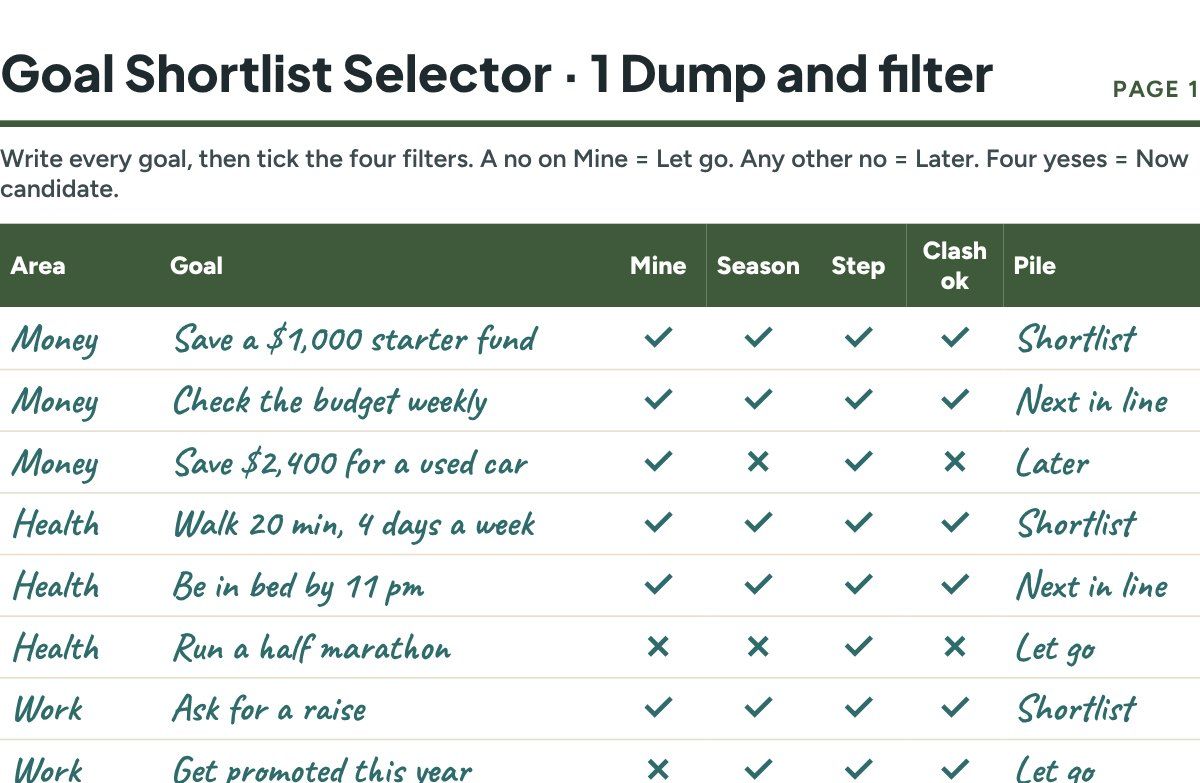

Get the full Goal Shortlist Selector
The full printable PDF is coming soon. It will be free to SPEND • SAVE • LIVE readers.
What Do You Do With Your Shortlist Next?
Give each of your three goals a slot in your real week, a first step with a date and a check-in, because a shortlist that only lives on paper is just a shorter list. The 2027 goal setting worksheet checks your goals against your free minutes, and a 90-day goal planner breaks each one into weekly actions you can review.
Then put them where you’ll see them. A weekly time-blocking template gives each goal an actual spot in the week, and you can put your few goals on a vision board. I made a vision board once and used it as my phone and desktop wallpaper, so I saw it every single day, and three goals fit on a wallpaper a lot better than twenty.
If one of your three is a money goal, a money vision board ties it to what you move on payday. And for the small daily ones, like Maya’s walks, a printable habit tracker keeps count for you. How many life goals should you have at once? Two or three is plenty for most busy people, and you can always pull the next one in line when a slot opens.
Read more: A 90-Day Goal Planner With Weekly Actions You Can Review
What a Shortlist Can’t Do, and Where to Get Real Help
A shortlist can help you choose, but it can’t fix a hard season, money trouble or health worries, and none of that is about willpower.
- If low mood is behind the “I never finish anything” feeling, call or text 988 to reach the 988 Suicide & Crisis Lifeline. It’s free, confidential and open 24/7.
- For local help paying bills, finding food or with housing costs, 211 connects you to services near you.
- For health goals, talk to your doctor first. This post doesn’t give health advice.
- New to SPEND • SAVE • LIVE? Start here for the calm basics.
Key Takeaways
- Write the long list fast, then sort it into life areas before you cut anything.
- Run every goal through four yes or no filters: mine, this season, a 15-minute first step, no clash.
- Keep up to three goals, one per area, and leave some money and hours unused.
- Everything else goes to Next in line, Later with a look-back date, or Let go.
Frequently Asked Questions
How to make a life goals list?
Set a 10-minute timer and write every goal that comes to mind without judging it. Sort the goals into life areas, then run each one through four yes or no filters. You end up with a long list on paper and a short list in your week.
What are 10 life goals?
There’s no official ten. Common ones are building a starter emergency fund, walking most days, asking for a raise, decluttering a room, calling family weekly, learning a language, keeping key documents together, meal planning, checking the budget weekly and journaling. Yours should come from your own list.
What are some examples of life goals?
Life goals sit in areas such as money, health, home, people, growth, work, life admin and habits. Examples are saving $1,000, walking 20 minutes four days a week and putting key documents in one folder. The 20 goals in this post show each area with its filter result.
Why are life goals important?
A written list helps you see what matters to you and decide what doesn’t. Goals you want for your own reasons tend to be easier to stick with, which is why the first filter asks if the goal is really yours. They don’t all need to start now, though.
What life goals should I have?
None are required. From your own list, pick the goals you’d still want if no one saw them, that fit this season’s money and time, and that you can start with a 15-minute step. Two or three at once is plenty.
How many life goals should I have at once?
Two or three is plenty for most people with a full week, ideally one per life area. Keep the rest in a Next in line pile and pull one in when a slot opens.
Three Goals Now, Seventeen Waiting Politely
Twenty goals on one page will always feel like homework if you try to start them all in January, so let the long list stay long, run it through the four filters, give three goals a slot in your week and let the other seventeen wait politely for April. And when you’re ready to put those three to work, start with the New Year goal setting worksheet.
Sources (checked November 2026)
- Smith, Ntoumanis and Duda (2007), Goal striving, goal attainment, and well-being: adapting and testing the self-concordance model in sport (Journal of Sport and Exercise Psychology; describes the self-concordance model of Sheldon and Elliot, 1999)
- Gorges and Grund (2017), Aiming at a Moving Target: Theoretical and Methodological Considerations in the Study of Intraindividual Goal Conflict between Personal Goals, Frontiers in Psychology (review of goal conflict research: possible effects on well-being and performance)
- Consumer Financial Protection Bureau, You’ve got goals for your life, and some of them take money to achieve (Feb 23, 2015)
Educational content, not financial advice.