

Goal setting for couples worksheets work best in a fixed order. Each of you fills in a solo page, then you sort both into shared, personal and parked goals, check the money and hours you really have and agree one next step each, with a date. A smaller yes you can both fund beats a big plan only one of you wanted.
You both want a better year, you both made a list, and the lists don’t match (of course they don’t, you’re two different people who just happen to share a fridge). One of you wants a course, the other wants a trip home, and the shared account has room for maybe one of those. This is where most goal setting for couples worksheets stop being useful, because they hand you a page of pretty boxes and assume you’ll agree on what goes in them.
This post gives you the order that goes before the boxes: a page for you, a page for me, one sorting step and a money and time check, with a fictional couple worked through in real numbers. It works for married, engaged, living-together or dating couples, kids or no kids, and it sits next to our goal list that fits your week in the Goals and New Year guides.
Read this also:
- A New Year Goal Setting Worksheet That Fits Your Real Week
- A Financial Goals Worksheet That Turns a Wish Into a Plan
- Year-End Reflection Questions That Lead to One Clear Change
- A Life Audit That Helps You Choose One Change for 2027
Is this the right page for the two of you? Probably, if any of these sound familiar:
- You want a shared plan for next year, and your two lists look nothing alike
- One person’s goal keeps getting bumped for an “us” goal (or the other way around)
- You’ve talked about goals before, and nothing ever got a date
- Neither of you knows how much money or time you can actually give to goals
One honest exception before we start. If money talks between you turn into fights, or one of you controls all the money, skip down to the help section first, because a worksheet is the wrong tool for that.
What Is a Goal Setting for Couples Worksheet, and Why Not Just Wing the Talk?
A goal setting for couples worksheet puts two separate voices on paper before the conversation starts, which is exactly the part a chat on the sofa skips. When you just talk, the person who speaks first (or loudest, or cries first, no judgment) tends to set the agenda, and the quieter list never makes it out of their head.
Our couples goal setting worksheet runs in four moves, in this order:
- A solo page each, written alone
- One shared sort: shared, personal or parked
- A capacity check on money and hours
- One next step per person, with a date
This is our method, not an official one, but the pieces aren’t new. The Live Well Play Together guide has each partner answer the questions on their own before you review them together, and Motley Fool Money tells couples to each bring their own short, medium and long-term goals and look for a shared vision that still includes individual ones. What most worksheets leave out is the third move, the boring math step, and in my experience that’s the step that decides whether the plan makes it past February.
Which Areas of Life Should You Two Set Goals In?
Pick three areas at most for this one conversation. A long list of goal setting areas of life looks thorough, and then it eats the whole evening and nobody chooses anything.
Seven areas to choose from (our list, so tweak it):
- Money
- Home
- Time and routines
- Health
- Work or learning
- Fun and travel
- The relationship itself
Each of you circles your top three alone, without peeking. Then keep the areas that both of you circled, and add one personal area each, even if the other person didn’t pick it. If you both circled money and home, and one of you also circled learning and the other fun, you talk about four areas, and two of them belong to one person each. That last bit is the whole point, because it puts “me” on the agenda before anyone has a chance to be noble about it.
Not sure which areas need you most right now? A quick life audit to find your weak areas helps, and if your list is huge, this guide to choosing a few life goals from a long list narrows it down.
What Goes on Each Person’s Solo Page?
The solo page is about fifteen minutes alone (our suggestion, not a research number) with three questions per area, written before you see your partner’s answers.
The three questions are:
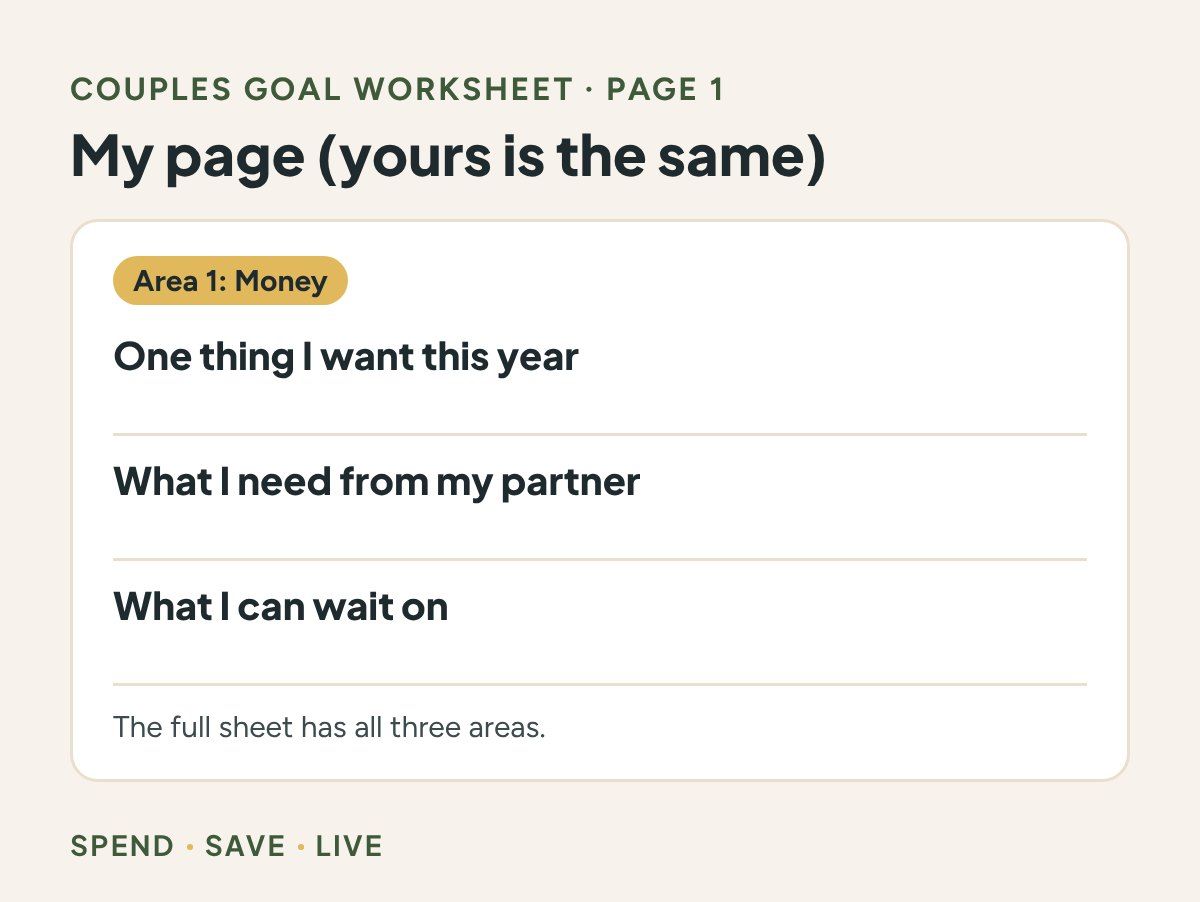
- What is one thing I want this year in this area?
- What would I need from my partner to make it happen?
- What am I willing to wait on?
That third question is my favorite, because writing down what you’d wait on, alone and calm, is a lot easier than giving it up live at the kitchen table while someone watches your face.
Blanking on personal goals? Some examples of personal goal-setting to adapt: finish a course, run a 10K, read twelve books, get back into a hobby, change jobs, or set up a small side income. Write the one you actually want, not the one that sounds good out loud.
No vetoes yet, either. The solo page is a wish list, not a negotiation, so nobody gets to cross anything out at this stage.
I don’t do New Year resolutions, for what it’s worth. I have a few long-term goals, and each year I pick a few goals that move me closer to them, which is basically a solo page with fewer boxes. If you want a longer version just for you, this personal goal worksheet that starts with the next action goes deeper.
How Do Two Solo Pages Turn Into One Conversation?
You read both pages out loud without answering, then sort every item into one of three piles: shared, personal (supported by the other person) or parked. Plan about 45 to 60 minutes for it, which is our guess at a comfortable length, and put it in the calendar like a date, because a goal talk squeezed in after a long workday rarely goes well.
Live Well Play Together suggests making it a date and celebrating last year first, and I’d keep both. The agenda on our worksheet goes like this:
- Start with last year. Name two things that went well, together.
- Partner one reads their page. Partner two only listens (yes, no commentary, no eyebrows).
- Swap.
- Sort every item: shared, personal or parked.
- Stop there. Don’t decide money tonight.

Parked isn’t a polite word for no. A parked goal gets a date to come back to it (Priya and Marcus parked a new car until June), so it stays on the page instead of vanishing. If you want help with the “last year” part, these year-end reflection questions make it quick, and couples who’d rather start with money can use a budget meeting agenda that ends with one decision instead.
Can You Actually Afford Your Combined Wish List?
Add up what your lists cost per month in money and in hours, then hold that next to the room you really have, before anyone says yes to anything. Most couples skip this part, and then wonder in March why the shared plan fizzled.
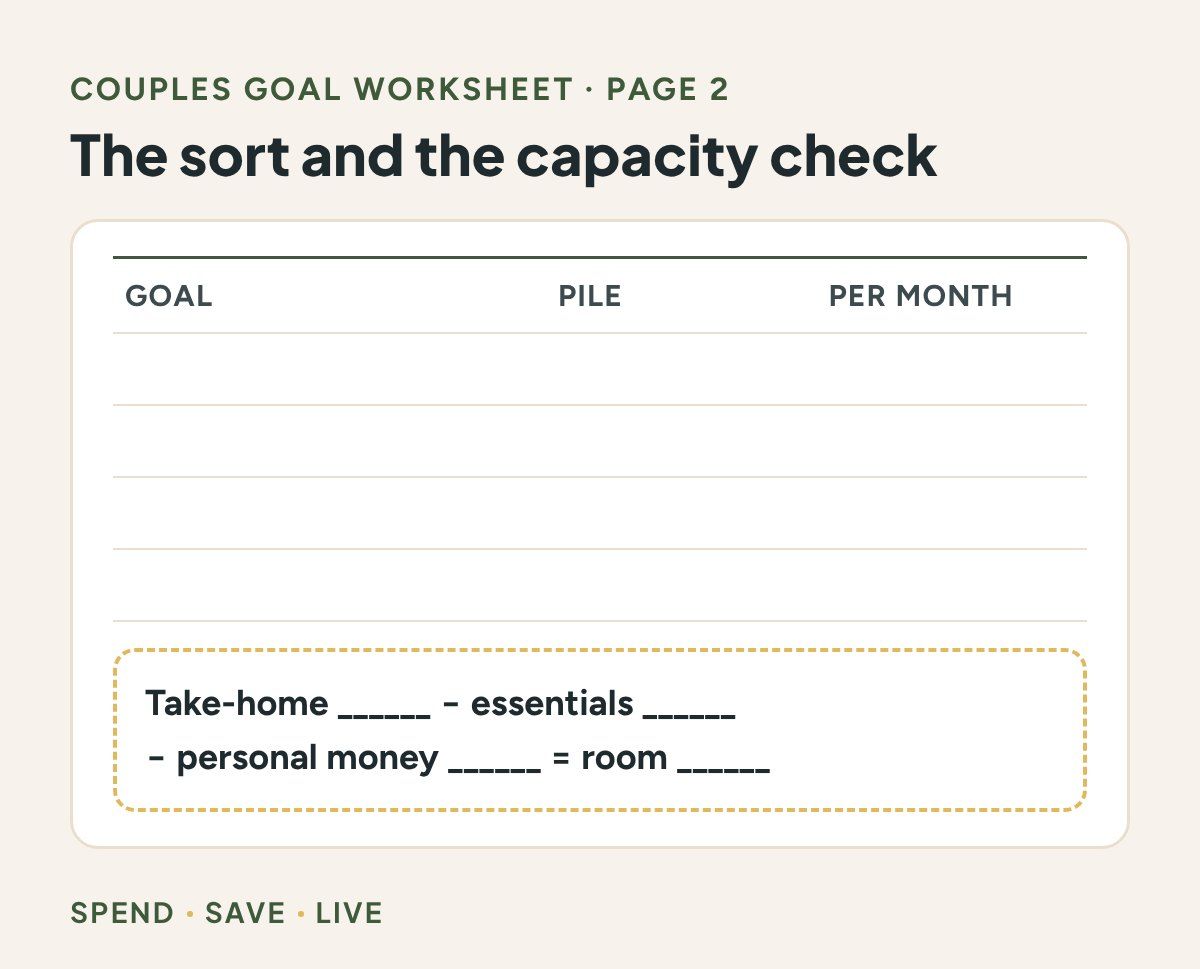
The money side is simple subtraction. Start with both take-home pays, take away the essentials, take away a personal spending amount for each of you, and what’s left is the room for goals. Motley Fool lays out the same order (your income, then the non-negotiable expenses first, then divide what’s left between spending and goals) and warns that a plan with nothing left for enjoying yourself can make you quit the goals altogether. Personal money is how you avoid that.
Meet Priya and Marcus, a fictional couple with made-up numbers. Priya takes home $3,900 a month and Marcus $3,100, so $7,000 together. Their essentials are $5,200 and each keeps $300 of personal spending money, so the room for goals is $7,000 minus $5,200 minus $600, which is $1,200 a month. Their two solo pages asked for this:
| Wish | Per month | Total and timing |
|---|---|---|
| Shared: emergency fund top-up | $250 | Ongoing |
| Shared: trip to see family | $400 | $2,400 in 6 months |
| Priya: certification course | $500 | $3,000 in 6 months |
| Marcus: guitar and lessons | $300 | $1,800 in 6 months |
| Total asked | $1,450 |
That’s $1,450 asked against $1,200 of room, so they’re $250 a month over. Nobody did anything wrong here, by the way, the lists just add up to more than one budget.

Then run the same check on time. Say they each have about 5 free hours a week, so 10 together. Priya’s studying needs 4, Marcus’s practice 2 and their time together 3, which is 9 hours. Time fits and money doesn’t, and knowing which limit is the real one tells you exactly what to shrink.
My husband and I split our shared bills by income and keep a shared account for the bills and the mortgage, so the “what’s left for goals” number is pretty easy for us to see each month. If you haven’t sorted that part yet, here’s how to split bills when your incomes differ. To turn one goal into a monthly amount, the financial goals worksheet does the math, and a time audit worksheet gives you the hours side. If two savings goals are fighting over the same dollars, here’s which savings goal gets the next dollar.
Read more: A Financial Goals Worksheet That Turns a Wish Into a Plan
What If You Disagree About a Goal?
Shrink the shared goal and protect one personal priority each, instead of pushing for a yes. A forced yes looks like agreement on paper, and then one of you stops funding it without saying a word.
These are the four rules on page 3 of the worksheet (ours, not from a textbook):
- Each person keeps one personal goal, funded first, even if it’s a small amount.
- Shared goals shrink before personal goals vanish: a smaller trip, a later date or a trial month.
- Still stuck? Park it for a month, then look again with fresh eyes.
- No trading goals for favors. “I gave up my thing, so you owe me” is how the same fight comes back in April.
Priya and Marcus closed their $250 gap like this. They kept the emergency top-up at $250, trimmed the trip fund from $400 to $350, slowed Priya’s course from $500 to $400 a month and cut Marcus’s guitar plan from $300 to $200:
| Goal | Per month | How long |
|---|---|---|
| Shared: emergency fund top-up | $250 | Ongoing |
| Shared: trip to see family | $350 | 7 months ($2,450) |
| Priya: course | $400 | 7.5 months |
| Marcus: guitar | $200 | 9 months |
| Total | $1,200 | Fits |
Now it adds up to exactly $1,200. The $3,000 course takes 7.5 months at $400, the trip fund reaches $2,450 after 7 months (enough for the $2,400 trip), and the $1,800 guitar plan takes 9 months at $200.
Nobody got everything, which is a completely normal result. Both still have their own thing on the list with money going to it every month, and that beats one person “winning” while the other sulks into their cereal.
And when goal setting doesn’t work, it’s usually one of the same few reasons: too many goals at once, no owner, no capacity check, or a list where only the shared goals got discussed. The rules above are there to block all of those.
How Do You Make the Plan Stick After the Talk?
Write one next action per person, with an owner and a date, before you leave the table. A goal without an owner belongs to nobody, and nobody is famously bad at follow-through.
This is what Priya and Marcus wrote on page 3:
| Action | Owner | Date |
|---|---|---|
| Open the course payment plan page | Priya | Fri, Dec 11 |
| Set the $200 guitar transfer for payday | Marcus | Next payday |
| Price two trip options | Both | Sun, Dec 20 |
Then book a monthly check-in of about 20 minutes (again our number) and ask three things: what moved, what changed and what needs revising. The CFPB’s Your Money, Your Goals toolkit has tools for Setting SMART goals, Putting goals into action and Revising goals, which line up nicely with that check-in, and Motley Fool also recommends accountability check-ins and staying flexible.
For the weeks in between, a 90 day goal planner with weekly actions breaks each goal into small steps. A budget calendar puts the payday transfers where you’ll see them, a printable habit tracker handles the practice-type goals, and if your year is already packed, this guide to annual goal planning around your commitments helps you fit things in.
Read more: A 90 Day Goal Planner With Weekly Actions You Can Review
What Are Some Good Couple Goals to Set?
Good couple goals are specific, fit your money and time, and have an owner, so treat these twelve as starting points to adapt, not a list to copy off Pinterest:
- Money: top up the emergency fund, save for one trip, pay down one balance, hold a monthly money check
- Home: finish one room project, do a yearly declutter
- Time: one shared evening a week, one planning night a month
- Health: a walk together three times a week
- Fun: try one new thing each season
- Relationship: one proper date a month
- Work or learning: one course each
A few of these cost nothing but hours, which is handy when the money check comes back tight. If pictures help you two stay on track, a money vision board gives each goal a number, and here’s how to make a vision board you will use after January. I used mine as my phone and desktop wallpaper so I saw it every day, and a shared one works the same way.
What Is in the Couples Goal Conversation Worksheet?
Three pages walk you through the four moves, and a fourth page shows Priya and Marcus filled in. Page 1 is “My page” and “Your page” with the three areas and three questions each, page 2 is the sort and the capacity check, and page 3 has the four rules, one action per person with an owner and a date, and a line for your monthly check-in.

Get the full Couples Goal Conversation Worksheet
The full printable PDF is coming soon. It will be free to SPEND • SAVE • LIVE readers.
What Can a Worksheet Not Fix, and When Should You Get Help?
A worksheet can’t fix essentials that cost more than you earn together, and it can’t fix a partner who controls the money. Those need a different kind of help, and there’s no shame in going and getting it.
- If your essentials already add up to more than your combined take-home pay, the NFCC is a nonprofit network of certified credit counselors who help with budgets and debt (877-360-6322).
- If one partner controls the money, hides spending, blocks the other from working or you feel unsafe, that isn’t a goal-setting problem. The Hotline explains what financial abuse is and offers support by phone (1-800-799-7233), live chat or text (START to 88788).
- If the same argument keeps coming back no matter what’s on the page, a licensed couples therapist is the right person for that, not a printable.
- New to SPEND • SAVE • LIVE? The Start Here page lists our beginner guides in order.
Key Takeaways
- Write a solo page each before you talk, so both voices are on paper first.
- Sort everything into shared, personal and parked, and stick to three areas at most.
- Check money and hours together before saying yes, because the limit that’s really tight tells you what to shrink.
- When you disagree, shrink the shared goal and keep one personal priority each.
- Leave with one next action per person, with an owner and a date.
Frequently Asked Questions
How do I use a goal setting worksheet for couples?
Each of you fills in your own page first, then you read them out loud, sort every goal into shared, personal or parked, check the money and hours you have and agree one next step each with a date. The order matters more than the layout of the page.
What are the 5 goal setting steps?
There’s no single official list. Ours are reflect alone, share, sort, check your capacity and commit to a dated next step. SMART goals are another common framework, and the CFPB’s Your Money, Your Goals toolkit has a Setting SMART goals tool.
Can you give me some examples of personal goal-setting?
Finishing a course, running a 10K, reading twelve books, getting back into a hobby, changing jobs or starting a small side income. In our example, Priya’s personal goal is a $3,000 certification course at $400 a month.
What are some good couple goals to set?
A trip you save for together, a bigger emergency fund, one room project, a weekly shared evening, a monthly date or a walk three times a week. Pick the ones that fit your money and time and give each one an owner.
Why doesn’t goal setting work?
Usually because there are too many goals at once, nobody owns the next step, nobody checked whether the money and time exist, or the list only covered one person’s wishes. Fewer goals with owners and dates fix most of that.
What if we can’t agree on a shared goal?
Make the shared goal smaller or later, keep one personal priority each, and if you’re still stuck, park it for a month and look again. Don’t trade it for a favor.
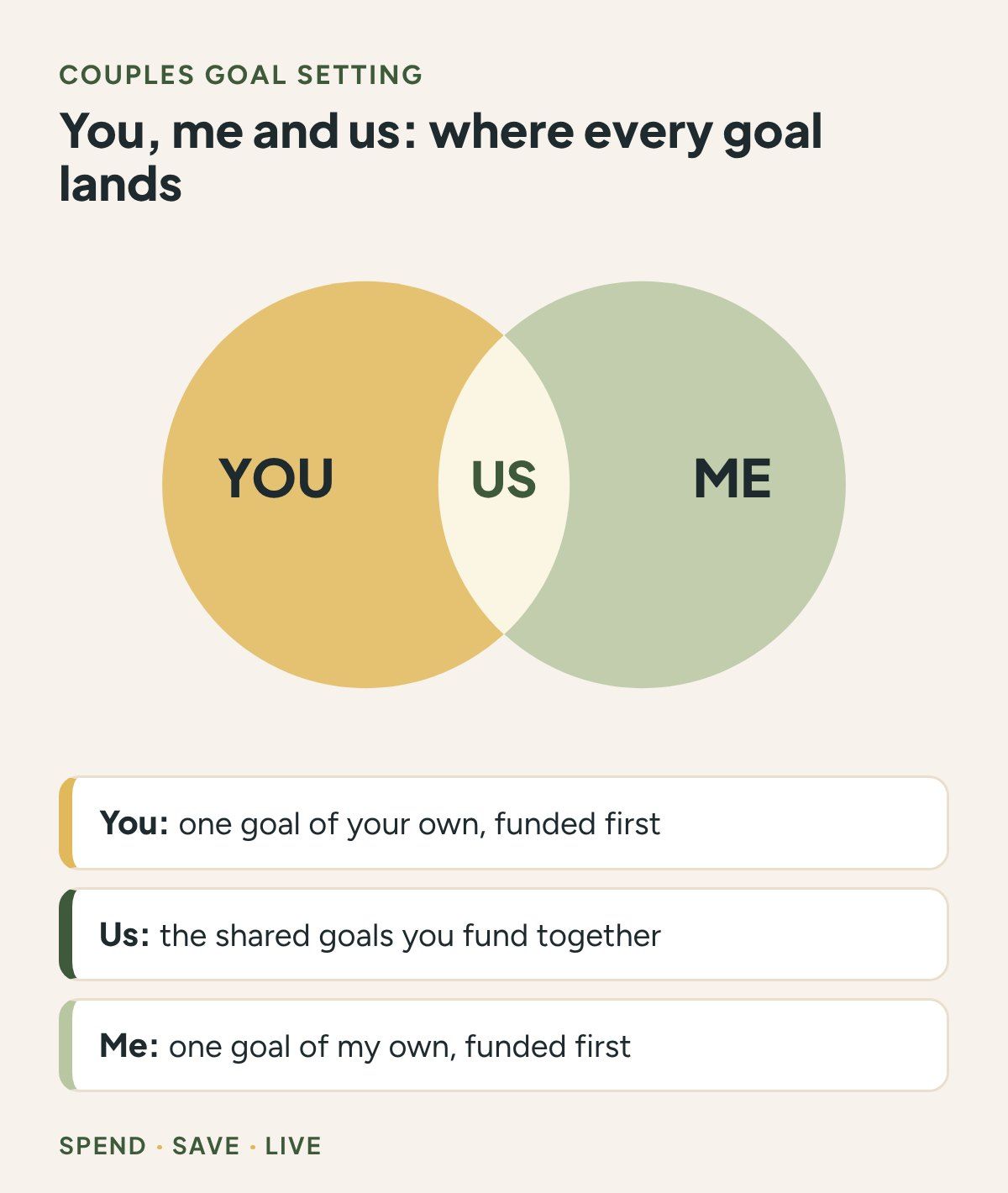
You Get a Circle, I Get a Circle, and We Share the Middle
What you want at the end is a plan where both of you still recognize your own list, with money and a date behind at least one thing each. Do the solo pages this week, book the talk for a calm evening and let the math decide what shrinks. Then put your next steps into a New Year goal setting worksheet that fits your real week so they don’t get lost after the holidays.
Sources (checked November 2026)
- Motley Fool Money, 5 steps to setting financial goals with your spouse (updated July 17, 2021)
- Live Well Play Together, setting goals with your spouse (updated January 9, 2025)
- CFPB, Your Money, Your Goals toolkit (Setting SMART goals, Putting goals into action, Revising goals)
- National Foundation for Credit Counseling
- The Hotline, What is financial abuse?
Educational content, not financial or relationship advice.